The Gap Between Mention and Resolution
In the world of AI-powered assistance, a critical distinction is emerging that impacts everything from healthcare to customer support: the difference between a topic being mentioned and a question being truly answered. Many AI scribes and assistants excel at detecting keywords and confirming that a subject came up in conversation. However, they frequently fail to ascertain whether the user's underlying query was resolved. This oversight creates a dangerous illusion of completeness, leaving users or professionals with unresolved issues that require follow-up, potentially leading to significant inefficiencies and errors.
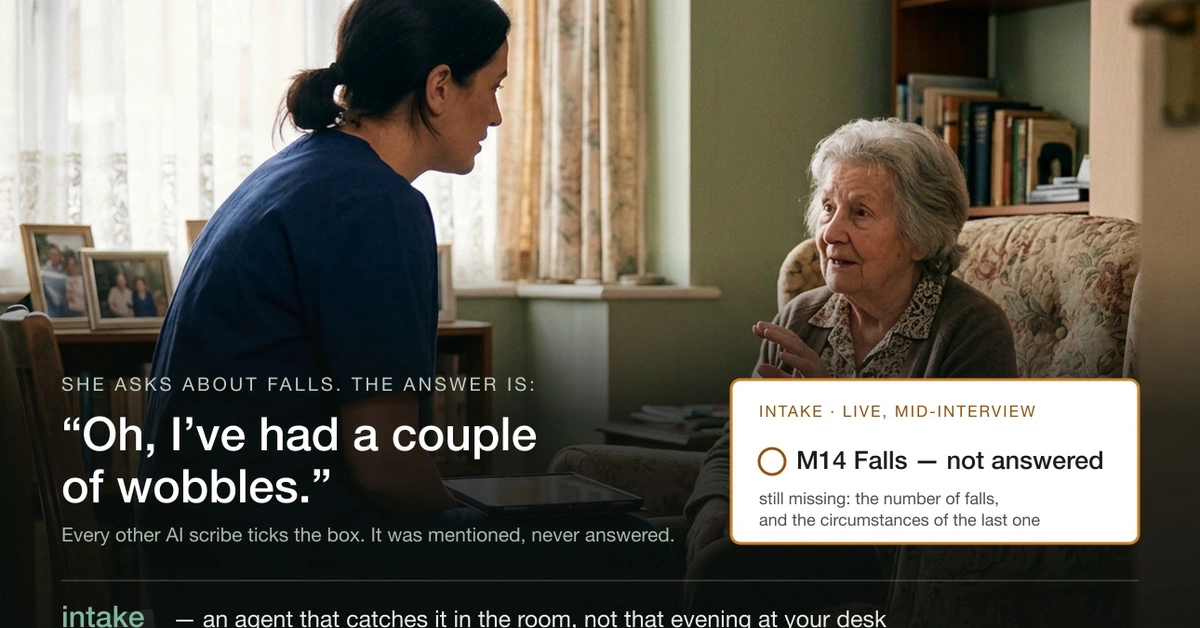
Consider a community nurse on a legally mandated ninety-minute visit. She asks a patient about falls in the past year. The patient responds, "Oh, I've had a couple of wobbles." An AI scribe, designed to track conversation topics, will dutifully tick off "falls" as mentioned. The AI has fulfilled its current programming: it noted the subject was present. But it has not answered the nurse's implicit question: how many falls? Was it two, or was it twenty? Was it a minor stumble or a serious injury requiring medical attention?
The patient's response is vague. It was a mention, not an answer. The nurse, relying on the AI's summary, might leave the visit believing the topic is closed. The real problem emerges later, perhaps that evening at her desk, when she reviews her notes. She discovers the gap: the precise information needed for the legal form is missing. The person who possessed the answer—the patient—was sitting three feet away an hour ago, and the opportunity is lost. This gap, this failure to elicit a definitive answer, is the entire product's failing.

Why Competitors Miss the Mark
A survey of current AI scribe products reveals a common pattern. Tools like Microsoft Teams' Facilitator, for instance, mark a topic as "covered" once it's mentioned. This approach is understandable from a development perspective; detecting the presence of a keyword or phrase is a more straightforward technical challenge than verifying the semantic completeness and accuracy of a response relative to an implicit or explicit user intent. The architecture is built around topic tracking, not necessarily problem-solving or information verification.
This focus on mention detection is pervasive. It's easier to build a system that says, "Yes, the user discussed X," than to build one that can confidently assert, "Yes, the user's specific question about X has been fully and accurately addressed." The latter requires a deeper understanding of context, intent, and the nuances of human communication, including ambiguity, evasion, and underspecification. It necessitates a more sophisticated model that can not only identify topics but also evaluate the quality and completeness of the information provided in relation to those topics.
The current state of AI assistants often mirrors this. Many are trained to provide information or complete tasks based on explicit commands. When a user asks, "What's the weather?" and the AI responds with the current temperature, it has answered the question. But when a user provides a vague statement, the AI lacks the framework to probe further. It's akin to a librarian who, when asked about books on "gardening," hands you a shelf of books on horticulture, rather than asking, "Are you interested in vegetable gardening, flower arranging, or pest control?" The former is a mention; the latter is an attempt to answer.
The Product is the Resolution
The core of the problem lies in defining the product's success. If the product is merely a transcription and topic-tagging service, then current AI scribes are succeeding. However, if the product is meant to genuinely assist professionals by capturing actionable, complete information, then they are failing. The community nurse scenario highlights this vividly. The nurse doesn't just need to know that falls were discussed; she needs to know the number of falls and their severity to complete her report accurately.
To bridge the gap between mention and answer, AI systems need to evolve. This requires developing capabilities for:
- Intent Recognition: Understanding the underlying question or need behind a user's statement.
- Ambiguity Detection: Identifying when a response is vague, incomplete, or potentially evasive.
- Clarification Strategies: Formulating follow-up questions to elicit specific, necessary details.
- Information Verification: Assessing whether the provided information sufficiently addresses the original query.
Building these capabilities is significantly more complex. It moves beyond pattern matching and keyword spotting into the realm of natural language understanding (NLU) and natural language generation (NLG) that can engage in genuine dialogue. It requires models that can maintain a state of understanding, track the progress of a query, and recognize when a resolution has been achieved.
The Implications for AI Development
The distinction between "mentioned" and "answered" has profound implications for the future of AI development, particularly in fields requiring accuracy and completeness. For developers building AI assistants, this means a shift in focus from simply processing input to actively facilitating understanding and resolution. It’s a move from being a passive recorder to an active participant in ensuring information utility.
This challenge is not trivial. It requires advancements in:
- Contextual Awareness: AI needs to understand the broader context of a conversation, the user's role, and the stakes involved.
- Proactive Engagement: Systems should be designed to proactively seek clarification rather than passively accepting vague input.
- Domain-Specific Knowledge: In fields like healthcare or legal services, AI needs access to and understanding of domain-specific terminology and requirements.
The hackathon project mentioned in the source, `jwlai-cloud/intake`, appears to be an attempt to address this very problem. By focusing on the gap between a topic being mentioned and a question being answered, it highlights the critical need for AI tools that provide not just data points, but actionable insights derived from complete information.
Ultimately, the next generation of AI assistants must be judged not by how many topics they can detect, but by how effectively they can ensure that crucial questions are truly answered, closing the gap that current technologies leave open.