FlexAttention and MPS Support on Apple Silicon
Attention mechanisms, the backbone of many large language models, become computationally expensive as input sequences grow. This expense is particularly noticeable with longer contexts. The challenge is to accelerate these computations without sacrificing model performance. PyTorch 2.13 introduces a significant development for Apple Silicon users: the integration of FlexAttention, a prototype feature announced in October 2024 with PyTorch 2.5, now available on Macs with Metal Performance Shaders (MPS) support. This allows developers to express attention rules as concise Python functions, offering a new level of flexibility and potential performance gains.
The core idea behind FlexAttention is to enable developers to define attention patterns programmatically. Instead of relying on fixed, highly optimized kernels for all attention types, FlexAttention permits custom attention logic. This is crucial because standard attention mechanisms are often over-provisioned for tasks that do not require every token to attend to every other token. When attention is restricted to local windows or exhibits sparsity, the full computational cost of standard attention is unnecessary overhead.
For Mac users, the MPS backend is key. MPS provides access to the powerful GPU on Apple Silicon chips like the M1 Max. By enabling FlexAttention to run via MPS, PyTorch unlocks hardware acceleration for these custom attention kernels, bridging the gap between flexible algorithmic definition and high-performance execution on consumer hardware.
Performance Benchmarks: Sparse vs. Causal Attention
To gauge the real-world impact of FlexAttention on Apple Silicon, a series of benchmarks were conducted using an M1 Max chip. The comparison pitted FlexAttention against the standard Scaled Dot-Product Attention (SDPA) within PyTorch 2.13. The test focused on two primary scenarios: long, extremely sparse attention and ordinary causal attention.
In the scenario with 32,768 tokens and a restricted 256-token local window (simulating highly sparse attention), FlexAttention demonstrated a dramatic speedup. It completed the operation in 75.27 milliseconds. In stark contrast, standard SDPA required 589.05 milliseconds for the same task. This translates to an impressive 7.83x speed advantage for FlexAttention under these specific, sparse conditions.
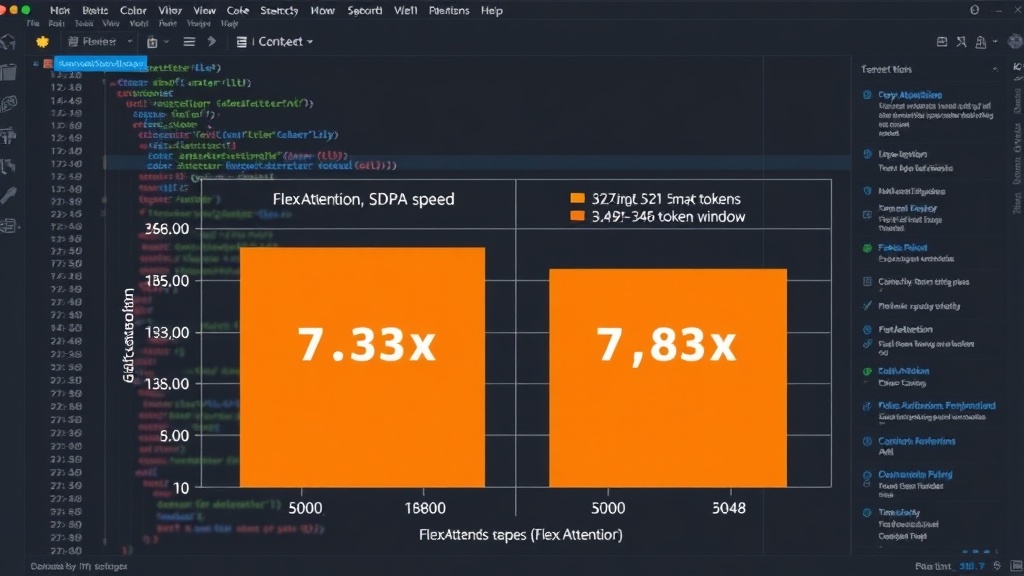
However, the results were not universally favorable for FlexAttention. When tested with ordinary causal attention, a common requirement for autoregressive language generation where each token attends to all preceding tokens, the performance profile reversed significantly. In this configuration, SDPA was approximately 19 times faster than FlexAttention. This counterintuitive finding highlights that FlexAttention’s benefits are highly contingent on the sparsity pattern of the attention mechanism.
Understanding the Nuance: When FlexAttention Excels
The benchmark results underscore a critical point: FlexAttention is not a universal replacement for standard attention mechanisms. Its strength lies in scenarios where the attention pattern is inherently sparse or can be constrained. Such scenarios are becoming increasingly relevant in the development of large language models.
For instance, models employing techniques like sliding window attention, dilated attention, or other forms of local context aggregation can potentially benefit immensely. These methods intentionally limit the scope of attention to reduce computational load, making them ideal candidates for FlexAttention’s specialized acceleration. The ability to define these sparse patterns directly in Python and have them compiled and executed efficiently via MPS on Apple Silicon offers a powerful new tool for researchers and developers working on resource-constrained hardware or seeking to optimize inference for specific long-context tasks.
The surprising detail here is not just the magnitude of the speedup in sparse scenarios, but the substantial slowdown in dense, causal attention. This implies that the overhead associated with FlexAttention's dynamic kernel generation or its specific implementation strategy is significant when applied to tasks that do not leverage its sparse-friendly architecture. For developers, this means careful consideration of the attention patterns employed by their models is paramount before adopting FlexAttention.
Implications for Developers and Future Work
The availability of FlexAttention with MPS support in PyTorch 2.13 opens up new avenues for optimizing AI workloads on Mac hardware. Developers can now experiment with custom attention kernels tailored to their specific model architectures and data characteristics. This is particularly relevant for those developing or fine-tuning models for tasks that involve very long sequences, where the quadratic complexity of standard attention becomes a bottleneck.
If you are developing transformer-based models and find your inference times on Apple Silicon are dominated by the attention layers, especially when dealing with sparse or local attention patterns, it is worth investigating FlexAttention. The potential for significant speedups, as demonstrated in the sparse attention benchmark, could drastically reduce iteration cycles and improve the responsiveness of applications running on Macs. However, if your models rely heavily on dense causal attention, sticking with SDPA may currently yield better performance.
The development of FlexAttention also points towards a future where more specialized AI computations can be efficiently mapped to diverse hardware architectures. The ability to express complex operations as flexible code, which is then optimized for specific hardware backends like MPS, is a powerful paradigm. Future work may involve further optimizations to FlexAttention’s kernels, broader support for different sparsity patterns, and potentially integration into higher-level libraries for easier adoption by the broader AI community.