The Challenge of Embarrassingly Parallel Workloads
Many scientific and engineering simulations fall into the category of "embarrassingly parallel" problems. This means the core computation can be broken down into many independent tasks, each requiring the same program but with different input parameters. Think of scanning a phase diagram where each point is an independent calculation, or running simulations with multiple random seeds to capture statistical variance. The number of independent jobs can quickly balloon into the hundreds or thousands.
While the parallel nature is conceptually simple, managing the surrounding workflow often becomes a significant bottleneck. Developers face a cascade of practical questions:
- How to systematically generate input files for each distinct job?
- How to name and track potentially thousands of individual output files?
- How to efficiently execute the compute-heavy simulation core?
- How to reliably collect and aggregate results from all the disparate output files?
- How to ensure reproducibility by easily rerunning the exact same workflow later?
These workflow complexities can detract from the core scientific or engineering task, consuming valuable development time and increasing the potential for errors. This is where a well-designed pipeline becomes crucial.
Introducing the Python/C++ Simulation Pipeline
A new open-source repository, accessible on GitHub, presents a solution designed to address these workflow challenges head-on. The pipeline leverages a combination of Python and C++ to provide a compact and efficient framework for managing embarrassingly parallel simulations.
The core idea is to abstract away the common, repetitive tasks associated with orchestrating such workloads. Python is used for the high-level workflow management, handling tasks like parameter generation, job submission, and result aggregation. This allows for rapid development and easy modification of the simulation parameters and experimental setup. The compute-intensive simulation itself is implemented in C++, offering performance benefits for the heavy numerical computations. This separation of concerns—Python for orchestration, C++ for execution—allows developers to optimize each part of the pipeline independently.
Pipeline Architecture and Workflow
The pipeline is structured to streamline the entire simulation lifecycle. It begins with defining the simulation parameters, often in a configuration file or a Python script. The Python component then takes these parameters and generates the necessary input files for each individual simulation run. This ensures that each job starts with the correct, distinct set of conditions.
Job submission can be managed through various mechanisms, depending on the available compute infrastructure. The pipeline can be configured to run jobs locally, on a cluster using tools like SLURM, or potentially on cloud computing platforms. The key is that the pipeline handles the creation of job scripts and the execution commands, abstracting this complexity from the user.
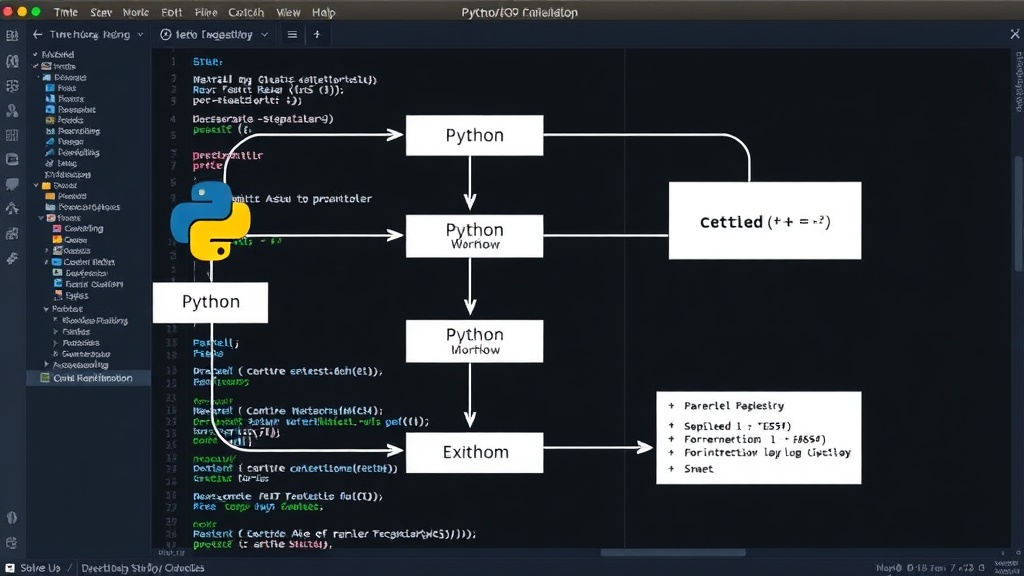
As each independent simulation job completes, it generates output files. The pipeline is designed to collect these outputs systematically. This might involve copying files from remote compute nodes back to a central location, or directly processing them if they are generated locally. The naming convention for these output files is often standardized by the pipeline to ensure easy identification and prevent conflicts.
Finally, once all individual jobs have finished and their outputs have been collected, the Python component can be used to aggregate and process the results. This could involve combining data from multiple output files into a single dataset, performing statistical analysis, or generating plots. The pipeline also emphasizes reproducibility; by storing the exact parameters used for a given run, it becomes straightforward to re-execute the entire simulation suite later, whether for verification, further analysis, or to incorporate updates to the simulation code.
Benefits and Use Cases
The primary benefit of this pipeline is its ability to significantly reduce the overhead associated with running large numbers of independent simulations. By automating input generation, job management, and output collection, it frees up researchers and engineers to focus on the scientific problems they are trying to solve.
The combination of Python and C++ offers a compelling balance of development speed and execution performance. Python's ease of use and extensive libraries are ideal for workflow management, while C++ provides the raw computational power required for demanding simulations. This hybrid approach is particularly valuable in fields such as computational physics, materials science, fluid dynamics, and computational chemistry, where complex simulations are commonplace.
For developers working on such problems, this pipeline offers a tangible starting point. It provides a tested framework that can be adapted to specific needs, saving the effort of building such a system from scratch. The open-source nature of the repository means it can be inspected, modified, and improved by the community.
Future Directions and Considerations
While this pipeline addresses the core challenges of embarrassingly parallel simulations, there are always avenues for further development. Enhancements could include more sophisticated job scheduling capabilities, integration with distributed computing frameworks like Dask or Ray for even greater scalability, or improved visualization tools for analyzing the aggregated results.
One important consideration for users will be the initial setup and configuration. While the pipeline aims for compactness, understanding the interplay between the Python orchestration layer and the C++ execution core will be key to effective utilization. Adapting the C++ simulation code to fit the pipeline's expected interface might require some effort, depending on the existing codebase.
The question remains, however, about how widely such specialized pipelines will be adopted versus leveraging general-purpose workflow management tools like Snakemake or Nextflow. The strength of this particular solution lies in its tight integration of Python for workflow and C++ for computation, offering a potentially more streamlined experience for those whose primary simulation code is already in C++ and who prefer Python for scripting.