Python's Ecosystem Advantage in AI
Python's position at the forefront of AI development in 2026 is not a matter of chance; it's the result of a deliberate and organic growth of its ecosystem. It serves as the central hub, seamlessly connecting research, orchestration, and production environments. This universality is its strongest asset.
The ecosystem is mature and battle-tested, providing developers with the tools they need to move rapidly from concept to deployment. Frameworks like PyTorch have become the de facto standard for transitioning research breakthroughs into production-ready machine learning models. Simultaneously, Scikit-learn continues to be the benchmark for practical, everyday machine learning tasks. This duality means engineers can prototype and iterate quickly without being hindered by the language itself. The availability of extensive libraries, pre-trained models, and community support lowers the barrier to entry and accelerates project timelines. This robust foundation allows developers to focus on the core AI problem rather than wrestling with language-specific complexities.
LLMs Amplify Python's Dominance
The advent and rapid evolution of Large Language Models (LLMs) have further cemented Python's reign. LLMs are trained on vast datasets of text and code. Python's inherent readability and its pervasive presence in this training data mean that LLMs excel at generating high-quality, idiomatic Python code. This creates a powerful, self-reinforcing feedback loop. As LLMs become more adept at producing Python, AI engineers can leverage them to write code faster and more efficiently. This accelerated development cycle allows for more experimentation, quicker iteration on models, and faster deployment of AI applications. The synergy between LLMs and Python means that developers can offload repetitive coding tasks, focus on higher-level architectural decisions, and explore more complex AI concepts. This relationship is not just about convenience; it's about fundamentally changing the pace of AI innovation.
What remains to be seen is how this LLM-driven code generation will impact the skill requirements for entry-level AI engineers. Will the emphasis shift from pure coding proficiency to prompt engineering and model integration?
Python as the Nervous System for AI Agents
The most significant shift in the AI landscape in 2026 is the rise of agentic workflows. These are sophisticated systems designed to plan, utilize tools, and interact with external APIs autonomously. In this paradigm, if an AI model represents the 'brain,' then Python serves as the 'nervous system' – the critical connective tissue that enables communication, execution, and adaptation.
AI agents are more than just conversational interfaces. They are programs capable of perceiving their environment, making decisions, and taking actions to achieve specific goals. Unlike a simple chatbot that merely responds to prompts, an agent can dynamically employ tools, follow multi-step processes, and adjust its behavior based on real-time context. This capability is crucial for automating complex tasks, from managing cloud infrastructure to performing intricate data analysis and even controlling robotic systems.
Building these agents requires a language that can easily integrate with various APIs, manage asynchronous operations, and handle complex decision-making logic. Python excels here due to its extensive libraries for networking, task management, and data manipulation. Frameworks and libraries designed for agent development, such as LangChain and LlamaIndex, are predominantly Python-based, further reinforcing Python's role. These tools abstract away much of the complexity involved in building agent loops – the core cycle of receiving input, deciding on actions, using tools, and generating responses.
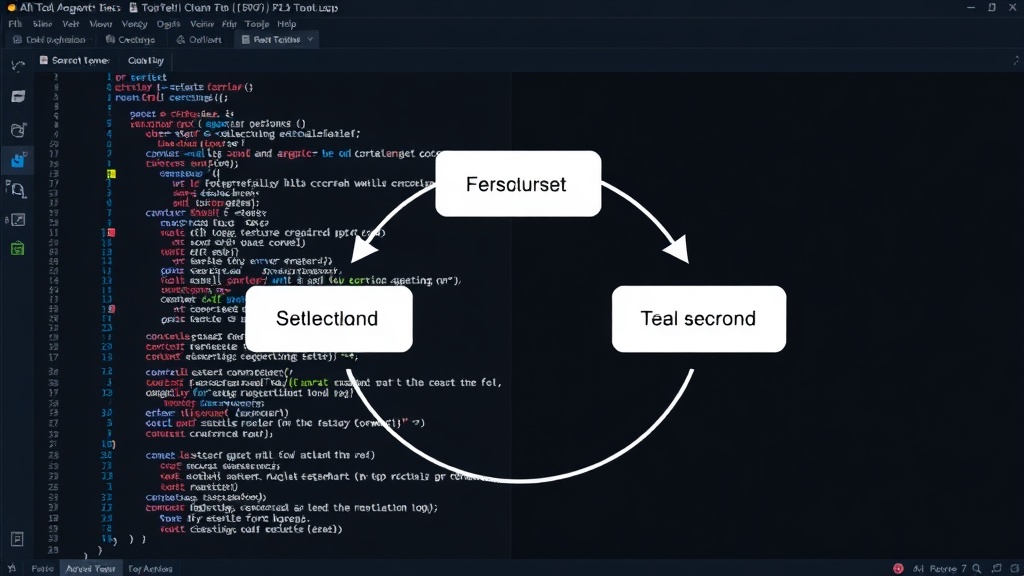
For instance, a weather assistant agent built in Python can query a weather API based on a user's request. The agent's Python code receives the user's query, determines that a weather API call is necessary, executes the API call with the appropriate parameters, processes the returned weather data, and then formulates a natural language response for the user. This entire process, from perception to action, is orchestrated by Python.
The prerequisites for developing such agents are becoming standard for many AI practitioners: a solid grasp of basic Python, a recent Python version (3.10+), and API keys for services like OpenAI and specific data providers (e.g., OpenWeatherMap). The ability to install necessary libraries via pip and understand the fundamental agent loop are key to getting started. As AI systems become more autonomous and integrated into everyday workflows, Python's role as the orchestrator of these intelligent agents will only expand, solidifying its undisputed leadership in AI development for the foreseeable future.