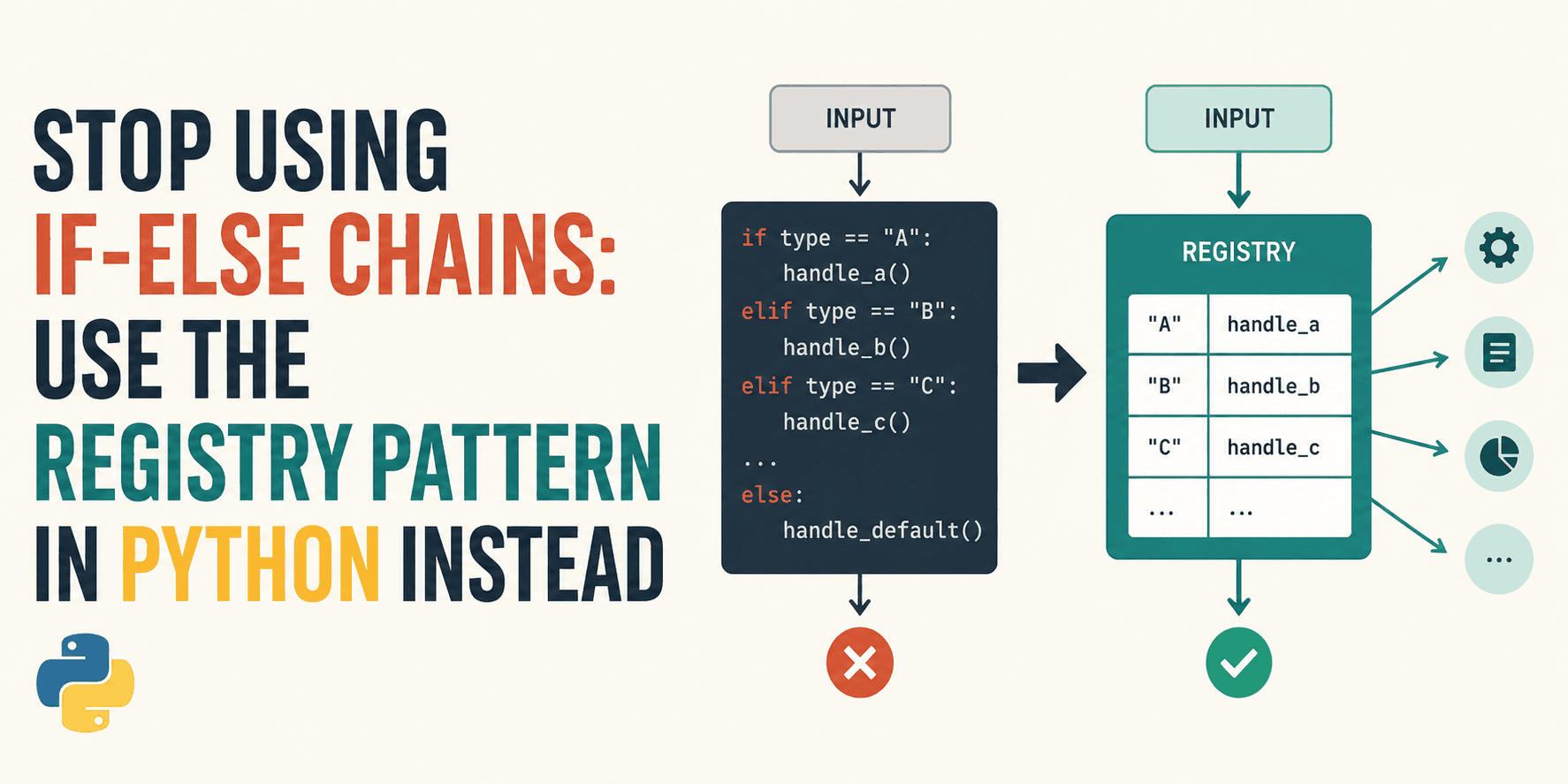
The Problem with Deeply Nested If-Else Statements
As Python projects grow, so does the complexity of managing conditional logic. Developers often resort to deeply nested if-elif-else chains to handle different cases or dispatch actions based on specific criteria. While seemingly straightforward for small tasks, this approach quickly becomes unwieldy. Imagine a function that needs to process various file types, user roles, or command-line arguments. Each new condition requires adding another branch to the existing chain. This leads to code that is:
- Difficult to read: Indentation levels increase, making it hard to follow the logic flow.
- Hard to maintain: Modifying or debugging a specific branch can have unintended consequences on others. Adding a new case means carefully weaving it into the existing structure without breaking anything.
- Not easily extensible: Introducing new behaviors often means touching and potentially altering core conditional logic, increasing the risk of introducing bugs.
This pattern is akin to a single, overloaded switchboard operator trying to connect every incoming call manually. As call volume increases, the operator becomes a bottleneck, prone to errors and unable to scale efficiently. The logic becomes tightly coupled, making it brittle.
Introducing the Registry Pattern
The Registry Pattern offers a more elegant and Pythonic solution. Instead of hardcoding conditional logic, we centralize the mapping of identifiers to specific functions or classes in a registry. This registry acts as a lookup table, allowing us to dynamically select and execute the appropriate code based on an input key.
At its core, a registry is a dictionary-like structure where keys represent the identifiers (e.g., a command name, a file extension, a user type) and values are the functions or classes responsible for handling those identifiers.
Consider the file processing example. Instead of an if-elif-else chain, we can create a registry:
# registry.py

PROCESSORS = {}

def register_processor(file_type):
    def decorator(func):
        PROCESSORS[file_type] = func
        return func
    return decorator

def process_file(file_path, file_type):
    processor = PROCESSORS.get(file_type)
    if processor:
        return processor(file_path)
    else:
        return f"No processor found for file type: {file_type}"
Now, individual processor functions can register themselves:
# processors.py

from registry import register_processor

@register_processor('csv')
def process_csv(file_path):
    return f"Processing CSV file: {file_path}"

@register_processor('json')
def process_json(file_path):
    return f"Processing JSON file: {file_path}"

@register_processor('xml')
def process_xml(file_path):
    return f"Processing XML file: {file_path}"
And the main application logic becomes incredibly simple:
# main.py

from registry import process_file

print(process_file('data.csv', 'csv'))
print(process_file('config.json', 'json'))
print(process_file('report.xml', 'xml'))
print(process_file('image.png', 'png'))
This structure decouples the dispatch mechanism from the specific implementations. The process_file function doesn't need to know about process_csv or process_json directly; it only knows how to look them up in the PROCESSORS registry.
Benefits of the Registry Pattern
Adopting the registry pattern yields significant advantages for Python development:
- Improved Readability: The core dispatch logic is clean and concise. The responsibility for handling specific cases is isolated within their respective functions.
- Enhanced Maintainability: Changes or bug fixes are confined to the specific registered function. Adding new functionality means simply defining a new function and registering it, without altering existing code.
- Increased Extensibility: New processors can be added dynamically without modifying the central dispatch mechanism. This is particularly useful in plugin architectures or when dealing with evolving requirements.
- Testability: Individual registered functions can be tested in isolation, making unit testing more straightforward. The registry itself can also be tested to ensure correct registration and lookup.
- Reduced Coupling: The dispatch logic and the handler functions are loosely coupled. The main application only depends on the registry interface, not on a multitude of specific handler implementations.
Think of the registry pattern less like a tangled web of phone cords and more like a modern automated call routing system. You dial a number (the key), and the system instantly directs you to the correct department (the function) without a human operator needing to manually connect each call. As new departments (features) are added, the system is updated to include them in the routing, but the core routing mechanism remains unchanged.
Implementing a More Sophisticated Registry
For more complex scenarios, the registry can be enhanced:
- Class-based Registries: Instead of registering functions, you can register classes. This is useful when each handler requires its own state or configuration. The registry would then instantiate the class upon lookup.
- Arguments and Return Values: The registry can be designed to pass specific arguments to the registered functions or classes and to handle their return values in a standardized way.
- Error Handling: Implement robust error handling for cases where a key is not found in the registry or when a registered function raises an exception.
- Configuration-driven Registration: Load registrations from external configuration files (e.g., JSON, YAML) to make the system even more dynamic and configurable at runtime.
A common pattern for class-based registries involves a base class and a registry manager:
# class_registry.py

class BaseHandler:
    def handle(self, data):
        raise NotImplementedError

class RegistryManager:
    def __init__(self):
        self._registry = {}

    def register(self, name, handler_cls):
        if not issubclass(handler_cls, BaseHandler):
            raise TypeError(f"{handler_cls.__name__} must be a subclass of BaseHandler")
        self._registry[name] = handler_cls

    def get_handler(self, name, *args, **kwargs):
        handler_cls = self._registry.get(name)
        if not handler_cls:
            raise ValueError(f"Handler '{name}' not found.")
        return handler_cls(*args, **kwargs)


# handlers.py

from class_registry import BaseHandler, RegistryManager

registry = RegistryManager()

class CsvHandler(BaseHandler):
    def handle(self, data):
        return f"Handling CSV data: {data}"
registry.register('csv', CsvHandler)

class JsonHandler(BaseHandler):
    def handle(self, data):
        return f"Handling JSON data: {data}"
registry.register('json', JsonHandler)


# main_class.py

from handlers import registry

csv_handler = registry.get_handler('csv')
print(csv_handler.handle("some csv data"))

json_handler = registry.get_handler('json')
print(json_handler.handle("some json data"))

try:
    xml_handler = registry.get_handler('xml')
except ValueError as e:
    print(e)
When to Use the Registry Pattern
The registry pattern is particularly beneficial in scenarios such as:
- Command Dispatch: Mapping command-line arguments or user inputs to specific functions.
- Event Handling: Registering callbacks for specific events.
- Plugin Systems: Allowing external modules to register their functionality.
- Configuration-based Logic: Selecting behavior based on configuration settings.
- API Gateways: Routing requests to different backend services based on the request path or method.
If your Python code is starting to resemble a plate of spaghetti with too many if-elif-else statements, it's time to consider the registry pattern. It transforms tangled conditional logic into a clean, maintainable, and extensible system.