Leveraging Python Data Classes: More Than Just Shorter Code
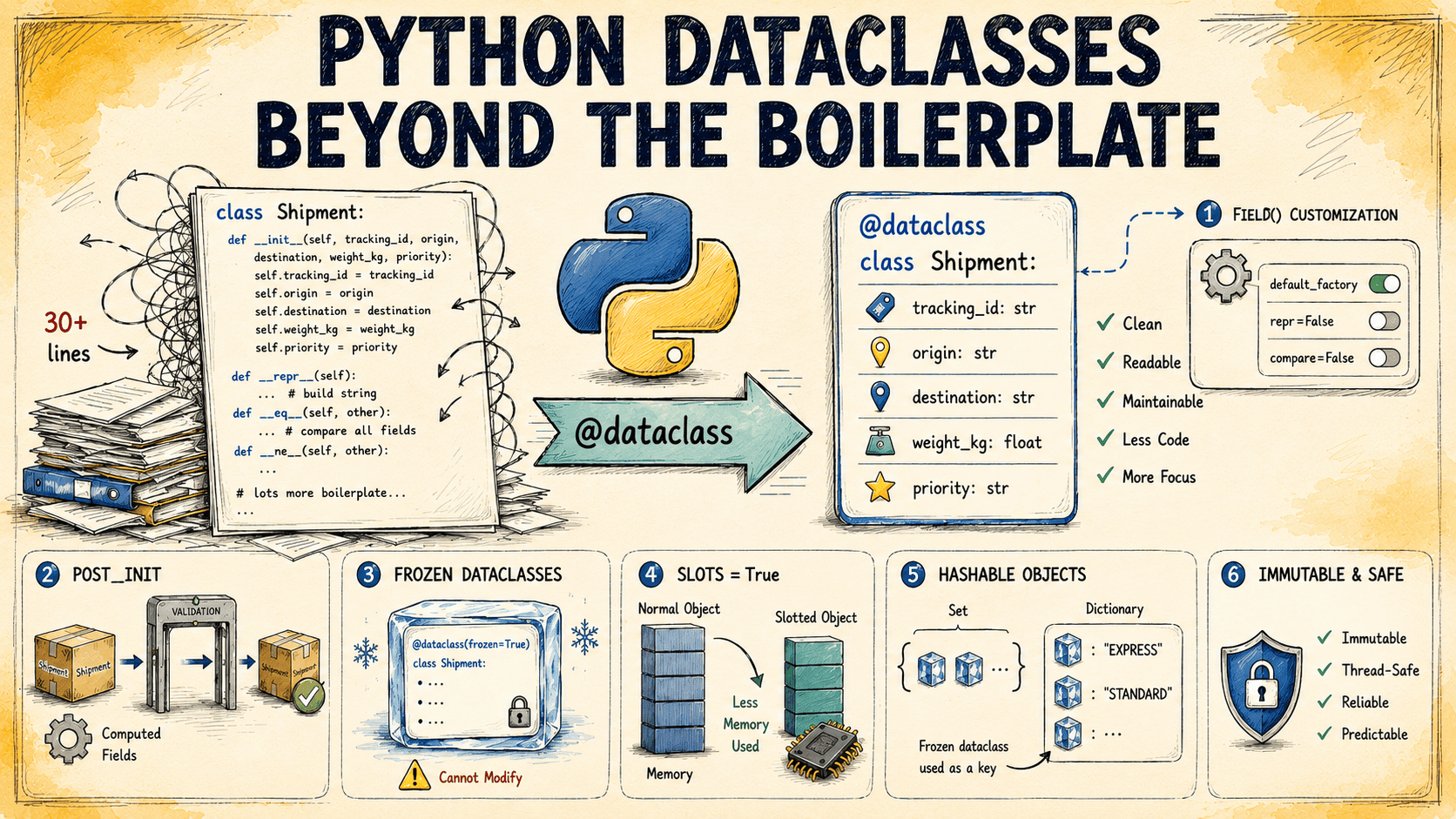
Python's `dataclasses` module, introduced in Python 3.7, offers a powerful way to reduce boilerplate code associated with creating classes that primarily store data. While the initial appeal lies in automatically generating methods like `__init__`, `__repr__`, and `__eq__`, the true strength of dataclasses emerges when you move beyond these basic conveniences and explore their more advanced capabilities. These include custom field types, data validation, computed attributes, ensuring immutability, and optimizing memory usage. Mastering these techniques transforms simple data containers into robust, efficient, and maintainable components of your Python applications.
Customizing Fields and Types
Dataclasses allow for fine-grained control over field definitions. Beyond standard type hints, you can leverage the `typing` module for more complex types and use `field()` to specify additional metadata or configurations for individual fields. This is crucial when a field might not fit a simple primitive type or when you need to associate extra information with a field, such as default factory functions or whether it should be included in generated methods.
Consider a scenario where you have a `User` dataclass. You might want a `permissions` field that is always a set, even if not explicitly provided. The `default_factory` argument of `field()` is perfect for this:
from dataclasses import dataclass, field
from typing import Set

@dataclass
class User:
    username: str
    email: str
    permissions: Set[str] = field(default_factory=set)
This ensures that every `User` instance will have an empty set for permissions if none is supplied, preventing potential `AttributeError` exceptions when you later try to add permissions. This pattern is invaluable for fields that represent collections or require a specific initial state.
Implementing Data Validation
While dataclasses don't have a built-in validation mechanism, integrating validation logic is straightforward and essential for data integrity. The most common approach is to perform validation within the `__post_init__` method. This special method is called after the default `__init__` generated by the dataclass decorator has run, allowing you to inspect and validate the initialized attributes.
For example, validating an email address or ensuring a numerical value is within a specific range can be handled here. You can raise `ValueError` or `TypeError` for invalid data, making your dataclasses more resilient to bad input.
from dataclasses import dataclass, field
import re

@dataclass
class Product:
    name: str
    price: float
    sku: str

    def __post_init__(self):
        if not re.match(r'^[A-Z0-9-]+$', self.sku):
            raise ValueError(f"Invalid SKU format: {self.sku}")
        if self.price < 0:
            raise ValueError(f"Price cannot be negative: {self.price}")
This `__post_init__` pattern is a cornerstone of building robust data models. It keeps validation logic close to the data it pertains to, enhancing code readability and maintainability. For more complex validation scenarios, consider using external libraries or creating helper methods that `__post_init__` can call.
Computed Attributes and Properties
Dataclasses can also manage computed attributes—values that are derived from other fields but don't need to be stored directly. While you could implement this using `property` decorators, dataclasses offer a slightly different, often cleaner, approach for simple computed values using `__post_init__` or by defining methods that act as computed properties.
For fields that should not be part of the stored state but are calculable on the fly, you can use `field(init=False)`. This means the field won't be an argument to the generated `__init__` method. You can then assign a value to it within `__post_init__` or through a separate method.
from dataclasses import dataclass, field

@dataclass
class OrderItem:
    product_name: str
    quantity: int
    unit_price: float
    total_price: float = field(init=False)

    def __post_init__(self):
        self.total_price = self.quantity * self.unit_price
This effectively creates a computed attribute `total_price` that is calculated once during initialization. If the `total_price` needed to be dynamic and recomputed upon access, a `property` decorator would be more appropriate. However, for values that are fixed after initialization based on other fields, this dataclass approach is clean and explicit.
Ensuring Immutability
By default, dataclasses are mutable. You can change the values of their fields after an object has been created. However, for certain data structures, especially those used in contexts like caching, state management, or as dictionary keys, immutability is a critical requirement. Dataclasses provide a direct way to achieve this using the `frozen=True` parameter.
When `frozen=True` is set on the `@dataclass` decorator, any attempt to modify a field after instantiation will raise a `FrozenInstanceError`. This makes your data objects behave like tuples or namedtuples in terms of mutability, significantly increasing data integrity and predictability.
from dataclasses import dataclass, FrozenInstanceError

@dataclass(frozen=True)
class ImmutableConfig:
    api_key: str
    timeout: int = 30

config = ImmutableConfig(api_key='mysecretkey')
try:
    config.timeout = 60
except FrozenInstanceError as e:
    print(f"Caught expected error: {e}")
Using `frozen=True` is a powerful tool for safeguarding data. It's akin to making a snapshot of your data that cannot be altered. This is particularly useful when passing data between threads or ensuring that a configuration object remains constant throughout an application's lifecycle.
Memory Optimization Techniques
For applications dealing with a large number of objects, memory efficiency can become a significant concern. Dataclasses offer several avenues for optimization. One key aspect is the `slots=True` parameter.
When `slots=True` is used, the dataclass generates `__slots__` for the instance attributes. This means that instead of each instance having a `__dict__` to store its attributes, the attributes are stored directly in the object's structure. This can lead to substantial memory savings, especially when creating millions of small objects, and can also offer a slight performance improvement for attribute access.
from dataclasses import dataclass, field

@dataclass(slots=True)
class DataPoint:
    timestamp: int
    value: float
    sensor_id: str = field(repr=False) # Example of suppressing repr
However, using `slots=True` comes with a trade-off: instances of a slotted class cannot have new attributes added to them after creation. This is a direct consequence of not having a `__dict__`. This limitation aligns well with the concept of immutable or fixed-structure data objects and can be a good fit for performance-critical applications where object structure is well-defined.
Another consideration for memory is the use of appropriate types. For instance, using `bool` where `int` might be overkill, or leveraging specialized integer types if known ranges are small, can contribute to overall memory efficiency, though this is more a general Python practice than a dataclass-specific feature.
Conclusion: Elevating Data Handling in Python
Python's dataclasses are far more than just a syntactic sugar for reducing `__init__` and `__repr__` boilerplate. By understanding and applying custom field configurations, validation in `__post_init__`, computed attributes, the `frozen=True` option for immutability, and `slots=True` for memory optimization, developers can build more robust, efficient, and maintainable data-centric applications. These advanced techniques transform simple data holders into sophisticated components capable of enforcing integrity, managing complex states, and operating with high performance. Embracing these features allows Python developers to write cleaner, more reliable code for data handling tasks.