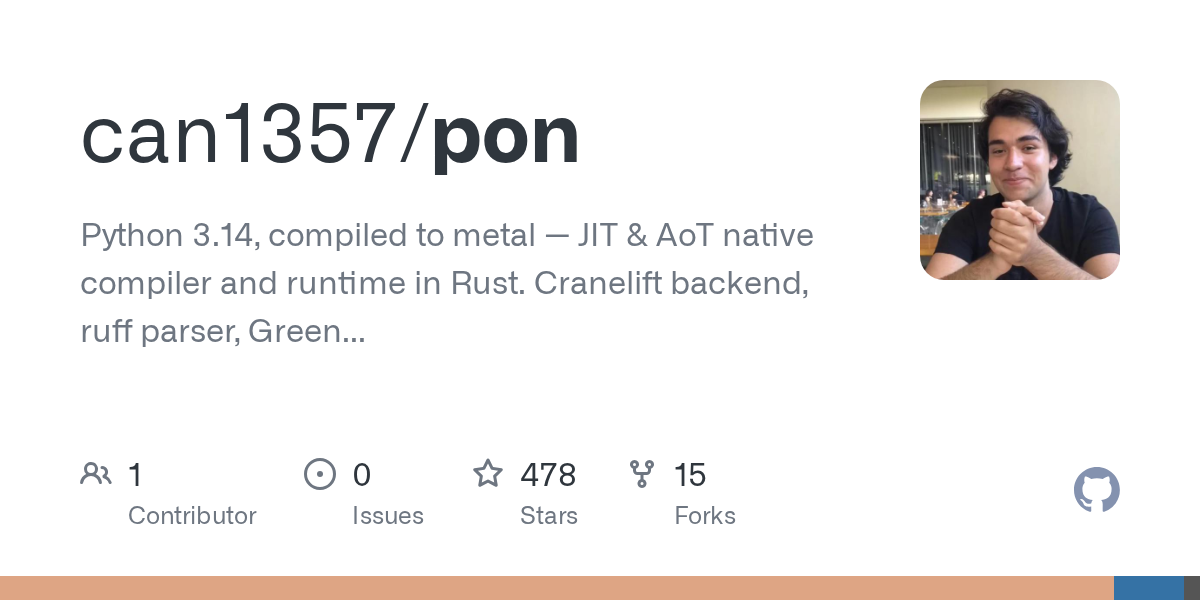
Native Python: The Pon Project
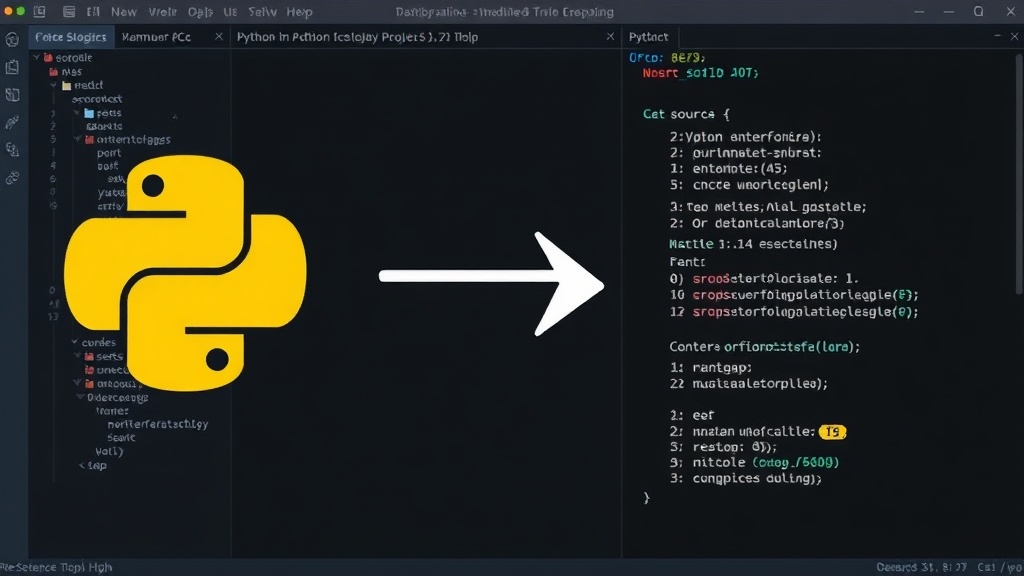
A nascent project, dubbed 'Pon', is exploring a radical departure from Python's traditional execution model. Instead of relying on the standard CPython interpreter, Pon aims to compile Python 3.14 source code directly into native machine code. This approach, if successful and scalable, could unlock significant performance improvements for Python applications by removing the overhead associated with interpretation.
The core idea is to treat Python not as a scripting language that needs an interpreter to translate it at runtime, but as a high-level language whose source code can be transformed into low-level machine instructions that a CPU can execute directly. This is similar to how languages like C, C++, Rust, or Go are compiled. The benefits are potentially substantial: faster execution speeds, reduced memory footprint, and the ability to leverage hardware-specific optimizations more effectively.
Currently, Python's performance is often a bottleneck for computationally intensive tasks. While solutions like Just-In-Time (JIT) compilers (e.g., PyPy) and optimized libraries written in C or Fortran (like NumPy) mitigate this, they don't fundamentally change the interpreter-based nature of standard Python. Pon's ambition is to offer a path to native performance without requiring developers to switch languages entirely or to rewrite critical sections in C/C++.
How Pon Works (Conceptually)
The project, found on GitHub under the handle 'can1357', is in its very early stages. The foundational concept involves taking Python 3.14 source files and feeding them into a compiler that understands Python's syntax and semantics. This compiler would then generate assembly code or directly produce an executable binary for a specific target architecture. The process would likely involve several stages: parsing the Python code into an Abstract Syntax Tree (AST), performing static analysis and type inference (if possible and beneficial), optimizing the intermediate representation, and finally generating machine code.
The challenges are immense. Python's dynamic typing, its extensive standard library, and its reliance on the Global Interpreter Lock (GIL) for concurrency present significant hurdles for ahead-of-time (AOT) compilation. A traditional AOT compiler needs to know types and memory layouts at compile time, whereas Python often determines these at runtime. Furthermore, generating efficient machine code that correctly handles Python's object model, garbage collection, and exception handling is a complex undertaking.
The project's current status suggests it is more of a proof-of-concept than a production-ready tool. Building a robust compiler for a language as flexible and feature-rich as Python requires tackling intricate details of the language's implementation. This includes managing Python objects, method dispatch, and the intricacies of the CPython API if any compatibility is to be maintained.
Implications and Future Prospects
If Pon or a similar initiative matures, the implications for the Python ecosystem could be profound. Developers could see a significant boost in application speed for CPU-bound tasks, potentially making Python a more viable choice for areas where performance is paramount, such as game development, high-frequency trading, or complex scientific simulations, without sacrificing the language's renowned readability and developer productivity.
However, the path from a GitHub repository with a README to a widely adopted tool is long and arduous. Key questions remain about its compatibility with existing Python libraries, especially those with C extensions. How would NumPy, Pandas, or TensorFlow integrate with a compiled Python binary? Would these libraries also need to be compiled to native code, or would Pon provide mechanisms for interoperability with their C/C++ implementations?
Another significant consideration is the Python ecosystem's reliance on dynamic features. Features like `exec()`, `eval()`, dynamic imports, and monkey patching are powerful but notoriously difficult to compile ahead of time. A successful Pon would need to either disallow or find sophisticated ways to handle these dynamic aspects, potentially with performance trade-offs or by limiting the scope of what can be compiled.
The project also raises questions about the future of Python's interpreter. For decades, CPython has been the de facto standard. While other implementations exist (Jython, IronPython, PyPy), a successful native compiler could offer a compelling alternative, especially for performance-critical applications. It's unlikely to replace CPython entirely, given Python's ubiquity in scripting, web development, and data science where raw speed is not always the primary concern. Nevertheless, it represents an exciting exploration into pushing the boundaries of Python's performance envelope.
The current focus on Python 3.14 is likely a pragmatic choice, targeting a recent, stable version of the language. As the project evolves, its ability to support newer Python versions and its compatibility with the vast Python package ecosystem will be critical for its adoption. For now, Pon stands as an intriguing experiment, demonstrating the ongoing effort to make Python faster and more versatile.