
Why Data Engineering Needs Testing
Data engineering code is software. Software without tests is a liability. Imagine a production pipeline silently producing incorrect numbers because a downstream transformation assumed a column's data type remained constant, only for an upstream change to alter it. This is the pain testing prevents. Testing isn't merely about confirming a pipeline runs; it's about verifying that every transformation, every logical branch, and every edge case behaves precisely as intended.
This article introduces the fundamentals of testing data pipelines using pytest. We will cover the core principles of why testing is crucial, the universal structure of any test, how to write your initial tests and assertions, methods for confirming your code raises expected exceptions, and techniques for mocking external dependencies to ensure tests are both fast and deterministic. By the end, you will possess a robust understanding for writing unit tests that identify regressions before they impact production systems.
The Anatomy of a Test
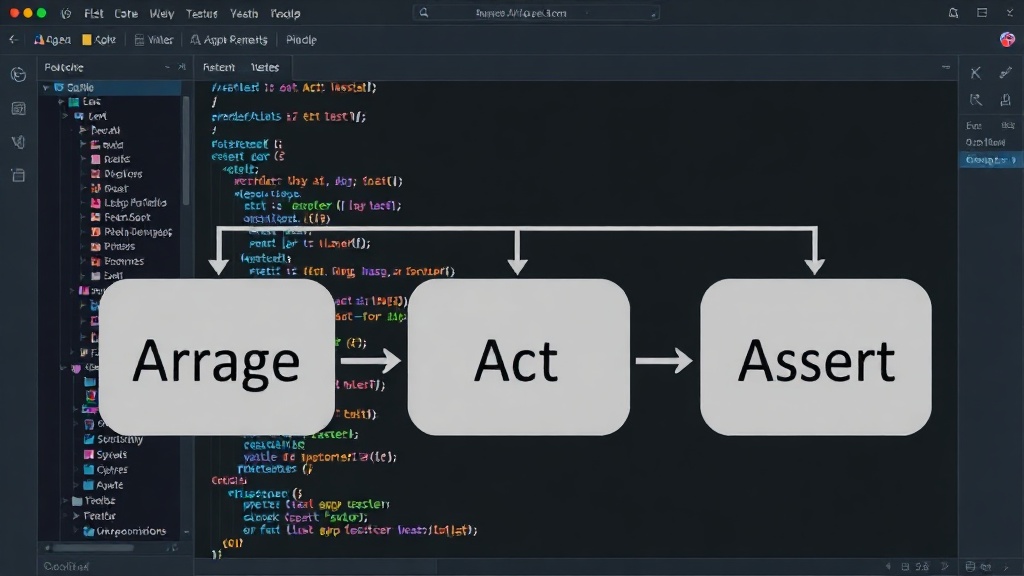
Every well-written test follows a consistent pattern, often referred to as Arrange-Act-Assert (AAA). This structure provides clarity and makes tests easier to read and maintain.
Arrange
This phase involves setting up the necessary preconditions and inputs for your test. For data engineering, this might mean creating dummy data files, initializing a mock database connection, or defining specific input parameters for a function. The goal is to isolate the component under test and ensure it starts from a known state.
Act
Here, you execute the code you want to test. This could be calling a function, running a transformation script, or invoking a method on an object. The action should be a single, focused operation that you want to verify.
Assert
This is where you check if the outcome of the action meets your expectations. Assertions are statements that evaluate a condition and raise an error if the condition is false. Pytest provides a rich set of assertion capabilities, but you can also use Python's built-in `assert` statement. For example, you might assert that a function returns a specific value, that a DataFrame has a certain number of rows, or that a particular exception was raised.
Writing Your First Pytest Tests
Pytest is a powerful and flexible testing framework for Python. Its simple syntax and extensive plugin ecosystem make it ideal for data engineering tasks.
Basic Assertions
The simplest form of a test involves using Python's `assert` statement. Pytest enhances these assertions by providing detailed introspection when a test fails.
Consider a simple Python function that adds two numbers:
def add(a, b):
    return a + b
A basic pytest test for this function would look like:
# test_math.py

from my_module import add

def test_add_positive_numbers():
    assert add(2, 3) == 5

def test_add_negative_numbers():
    assert add(-1, -1) == -2

def test_add_zero():
    assert add(5, 0) == 5
When you run pytest from your terminal in the directory containing these files, it will discover and execute `test_add_positive_numbers`, `test_add_negative_numbers`, and `test_add_zero`. If any assertion fails, pytest will report it clearly, often showing the values involved in the comparison. This is a significant advantage over standard Python `unittest` assertions.
Testing DataFrames
Data engineers frequently work with libraries like Pandas. Testing DataFrame transformations requires asserting specific properties of the DataFrame, such as its contents, shape, or data types. While direct DataFrame comparison can be brittle, you can assert key characteristics.
Suppose you have a function that cleans a DataFrame:
import pandas as pd

def clean_data(df):
    df['column_a'] = df['column_a'].str.strip()
    df = df.dropna(subset=['column_b'])
    return df
A test for this function could verify the stripping of whitespace and the removal of rows with nulls in `column_b`:
# test_data_processing.py

import pandas as pd
from my_module import clean_data

def test_clean_data_strips_whitespace_and_drops_na():
    # Arrange
    input_data = {
        'column_a': ['  value1  ', 'value2', '  value3'],
        'column_b': [1, None, 3]
    }
    input_df = pd.DataFrame(input_data)

    expected_data = {
        'column_a': ['value1', 'value2', 'value3'],
        'column_b': [1, 3]
    }
    expected_df = pd.DataFrame(expected_data)

    # Act
    actual_df = clean_data(input_df.copy()) # Use .copy() to avoid modifying original df

    # Assert
    pd.testing.assert_frame_equal(actual_df, expected_df)
Here, we use `pandas.testing.assert_frame_equal` which is specifically designed for comparing DataFrames, handling nuances like index alignment and data types. This is far more robust than simple equality checks.
Testing for Exceptions
Robust data pipelines must handle errors gracefully. Pytest makes it straightforward to assert that your code raises specific exceptions under certain conditions. This is critical for validating error handling logic.
Imagine a function that parses a configuration file, and it should raise a `ValueError` if the file is malformed:
# my_module.py

def parse_config(file_path):
    with open(file_path, 'r') as f:
        content = f.read()
    if 'invalid_key' in content:
        raise ValueError('Configuration file is malformed')
    return content.split('=')[1] # Simplified parsing
To test that `ValueError` is raised:
# test_config.py

import pytest
from my_module import parse_config

def test_parse_config_raises_value_error_on_malformed_file():
    # Arrange: Create a dummy malformed file
    with open('malformed.conf', 'w') as f:
        f.write('key=invalid_key\nvalue')

    # Act & Assert
    with pytest.raises(ValueError, match='Configuration file is malformed'):
        parse_config('malformed.conf')

    # Clean up dummy file
    import os
    os.remove('malformed.conf')
The `pytest.raises` context manager is a powerful tool. It asserts that a specific exception (in this case, `ValueError`) is raised within the `with` block. The optional `match` argument checks that the exception message contains a specific substring, adding another layer of verification. If the exception is not raised, or if it's a different type of exception, the test will fail.
Mocking External Dependencies
Data engineering often involves interacting with external systems: databases, cloud storage, APIs, or message queues. Testing code that relies on these dependencies can be slow, unreliable, and expensive. Mocking allows you to replace these external dependencies with controlled substitutes during tests.
Pytest integrates seamlessly with Python's `unittest.mock` library. The `@patch` decorator or the `mocker` fixture can be used to replace objects or functions with mock objects.
Consider a function that reads data from a specific S3 bucket:
# data_reader.py

import boto3

def read_from_s3(bucket_name, file_key):
    s3 = boto3.client('s3')
    response = s3.get_object(Bucket=bucket_name, Key=file_key)
    return response['Body'].read().decode('utf-8')
To test `read_from_s3` without actually hitting AWS:
# test_data_reader.py

from unittest.mock import MagicMock
import pytest
from data_reader import read_from_s3

@pytest.fixture
def mock_s3_client(mocker):
    mock_client = MagicMock()
    mocker.patch('boto3.client', return_value=mock_client)
    return mock_client

def test_read_from_s3_calls_correct_s3_method(mock_s3_client):
    # Arrange
    bucket = 'my-test-bucket'
    key = 'test_file.csv'
    mock_s3_response = {'Body': MagicMock()}
    mock_s3_response['Body'].read.return_value = b'col1,col2\n1,2'
    mock_s3_client.get_object.return_value = mock_s3_response

    # Act
    result = read_from_s3(bucket, key)

    # Assert
    mock_s3_client.get_object.assert_called_once_with(Bucket=bucket, Key=key)
    assert result == 'col1,col2\n1,2'
In this test: 1. We use a pytest fixture (`mock_s3_client`) to patch `boto3.client` globally for this test. 2. We configure the mock client's `get_object` method to return a specific, controlled response. 3. We call the `read_from_s3` function. 4. We assert that `get_object` was called with the expected arguments. This verifies the interaction logic without making a network call. This pattern is essential for keeping tests fast and reliable.
Conclusion: Building a Testing Culture
Mastering these pytest fundamentals—the AAA pattern, basic assertions, DataFrame testing, exception handling, and mocking—provides a solid foundation for data engineers. Implementing these practices consistently transforms code from a potential liability into a reliable asset. The next step is to integrate these tests into your development workflow, ensuring that code quality and correctness are maintained as pipelines evolve.