
The Challenge of Temporal Reasoning in LLMs
Large Language Models (LLMs) excel at processing and generating human-like text, but their ability to reason about temporal relationships – how events unfold over time – remains a significant challenge. Traditional retrieval-augmented generation (RAG) systems, which fetch relevant information to ground LLM responses, often struggle with time-sensitive data. This is because standard RAG typically relies on semantic similarity, meaning it retrieves documents based on keyword matching or conceptual overlap, not necessarily their chronological order or causal links. For LLMs to effectively answer questions about historical events, sequences, or time-dependent processes, they need a mechanism that explicitly understands temporal context.
Consider a query like, "What were the key technological advancements that led to the widespread adoption of smartphones?" A standard RAG system might pull articles about smartphones, mobile technology, and perhaps even specific companies. However, it might struggle to order these advancements chronologically or to distinguish between precursor technologies and the final breakthroughs. This is where semantic precompilation – essentially, manually curating and structuring knowledge about time – becomes necessary for many existing systems. This process is labor-intensive, brittle, and scales poorly. The need for a method that imbues LLMs with temporal reasoning capabilities without such extensive upfront engineering is paramount for applications ranging from historical analysis and scientific research to financial forecasting and event sequencing.
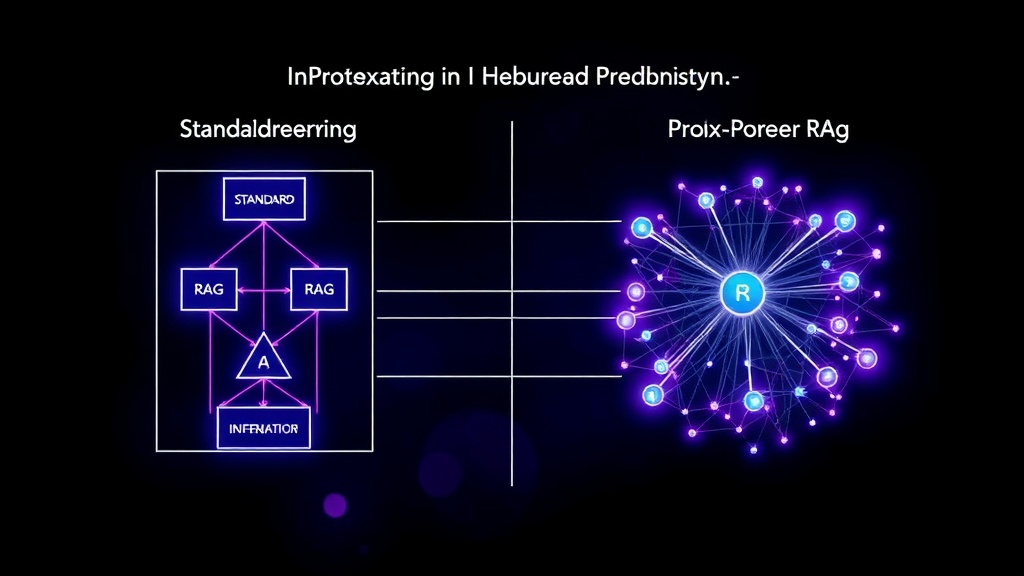
Introducing Proxy-Pointer RAG
Proxy-Pointer RAG emerges as a novel approach to tackle this limitation. The core innovation lies in its ability to perform temporal reasoning without requiring semantic precompilation of the knowledge base. Instead of relying solely on semantic similarity, Proxy-Pointer RAG introduces a system that can dynamically track and reason about temporal relationships within retrieved documents. This is achieved through a sophisticated mechanism that uses "proxy pointers" to navigate and connect information based on its temporal context.
At its heart, the system augments the retrieval process. When a query is posed, Proxy-Pointer RAG doesn't just fetch documents that are semantically related. It also considers the temporal metadata associated with the information. The "proxy pointers" act as navigational aids, allowing the LLM to traverse a sequence of information, much like following a chain of breadcrumbs. These pointers can link related events, identify causal chains, or simply establish a chronological order. This is analogous to how a historian might use timelines and cross-references to build a narrative, but it's performed programmatically and integrated directly into the RAG pipeline.
This approach bypasses the need to pre-process and tag every piece of information with explicit temporal labels or to build complex knowledge graphs beforehand. The system learns to infer temporal relationships from the structure and content of the documents it accesses, making it more adaptable and efficient for dynamic knowledge bases. The comparison to LLM-Wiki, another RAG variant, highlights this difference. While LLM-Wiki might leverage structured internal wikis, Proxy-Pointer RAG aims for a more fluid, inferential understanding of temporal dynamics directly from raw or less structured text.
How Proxy-Pointer RAG Works
The technical underpinnings of Proxy-Pointer RAG involve a multi-stage process. First, when a query is received, the system retrieves a set of potentially relevant documents. Unlike standard RAG, the retrieval might be biased not just by semantic relevance but also by temporal signals, if available, or by the potential to form sequential links. Once a candidate set of documents is identified, the proxy-pointer mechanism comes into play. This mechanism can be thought of as an internal navigation system within the LLM's context window.
When the LLM processes a retrieved document, it can activate proxy pointers. These pointers can mark specific entities, events, or time points. Crucially, these pointers can then be used to link to other relevant pieces of information within the same document or across different retrieved documents. For example, if the LLM identifies an event in Document A and then finds a subsequent event in Document B that is chronologically plausible and semantically linked, a proxy pointer can establish that connection. This creates a dynamic, query-dependent temporal graph that the LLM can then reason over.
This contrasts sharply with systems that require a pre-built knowledge graph or extensive metadata. Proxy-Pointer RAG aims to infer these relationships on the fly. The LLM, guided by these proxy pointers, can then construct a coherent narrative or answer that respects the temporal order of events. This is particularly powerful for complex queries that involve understanding cause and effect, identifying temporal overlaps, or tracing the evolution of a phenomenon over extended periods. The system essentially builds a temporary, context-specific temporal reasoning framework for each query.
Implications and Future Directions
The development of Proxy-Pointer RAG signifies a crucial step forward in making LLMs more adept at handling time-sensitive information. For developers, this means the potential to build more sophisticated applications that can analyze historical data, predict future trends based on past patterns, or even simulate complex temporal processes. Imagine an LLM that can accurately summarize the progression of a scientific field, not just list its discoveries, or one that can trace the causal chain of events leading to a geopolitical incident.
The absence of semantic precompilation is a significant advantage. It lowers the barrier to entry for creating temporal reasoning systems, as it reduces the need for laborious data curation and structuring. This makes the technology more accessible and scalable. Furthermore, it allows LLMs to work with more dynamic and evolving datasets, where precompilation would quickly become outdated. The ability to infer temporal relationships dynamically means the system can adapt to new information and changing contexts more effectively.
However, questions remain about the robustness and scalability of these inferred temporal relationships, especially in highly complex or ambiguous historical accounts. The surprising detail here is not the theoretical novelty but the practical implication: LLMs might soon be able to perform sophisticated historical or scientific timeline analysis with significantly less human effort in data preparation. This opens up new avenues for research in areas like automated historical research, long-term scientific trend analysis, and even dynamic operational planning based on evolving real-world conditions. The next steps will likely involve benchmarking Proxy-Pointer RAG against existing temporal reasoning methods and exploring its application in diverse domains.