The Bottleneck in Hardware Prototyping
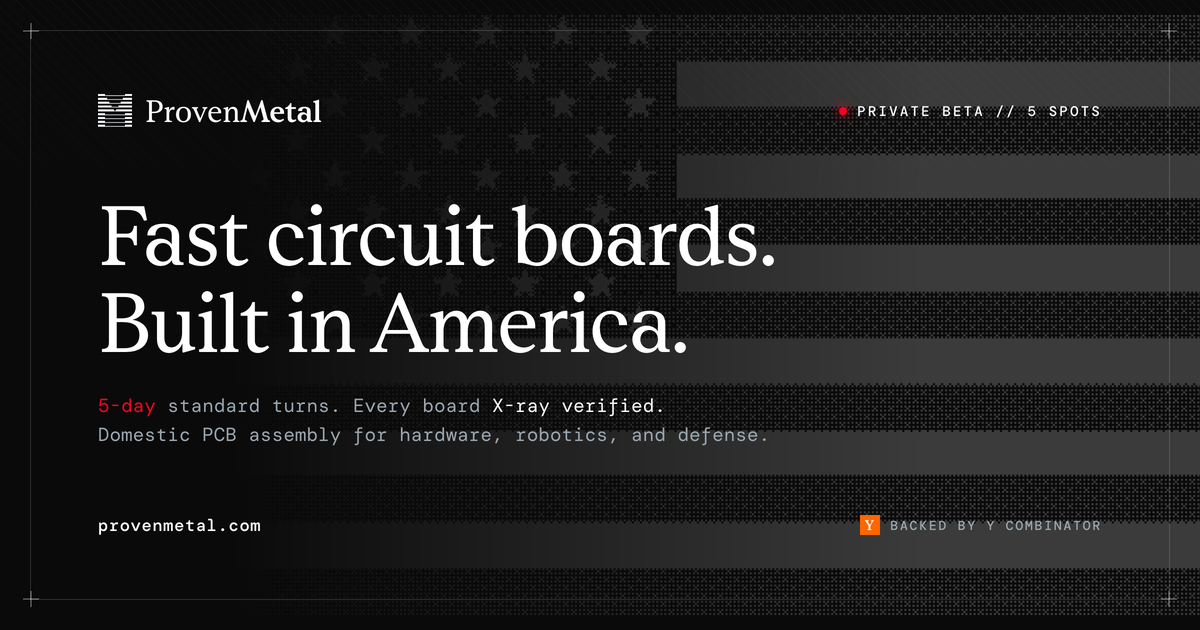
For engineers and product developers, the lead time for custom circuit boards has long been a frustrating bottleneck. Traditional manufacturers often quote weeks, sometimes months, for even simple prototypes. This delay directly impacts iteration speed, pushing back product launch timelines and increasing development costs. ProvenMetal, a new startup backed by Y Combinator's S26 batch, claims to have solved this problem by delivering functional circuit boards in a matter of days.
The company's core innovation lies in its proprietary automation and advanced manufacturing processes. Unlike conventional PCB fabrication, which involves manual steps and sequential operations that are difficult to parallelize, ProvenMetal has engineered a system that significantly reduces the touch time required for each board. This isn't just about faster machines; it's a fundamental re-architecting of the entire production workflow, from order placement to final inspection.

Automated Fabrication: The Key to Speed
At the heart of ProvenMetal's offering is its highly automated manufacturing floor. The company has invested heavily in custom-built machinery and software that orchestrates the entire fabrication process with minimal human intervention. This includes automated stencil printing, pick-and-place operations for surface-mount components, advanced reflow soldering, and automated optical inspection (AOI). The integration of these systems allows for a continuous, high-throughput production line that can handle a variety of board designs and component complexities.
A critical aspect of their approach is the ability to rapidly switch between different designs. Traditional lines are often set up for large runs, and retooling for small, custom batches can be time-consuming. ProvenMetal's automation is designed for flexibility, enabling them to efficiently produce one-off prototypes or small runs of boards without significant downtime. This is achieved through intelligent software that dynamically configures machinery based on the incoming design files, effectively eliminating the manual setup delays that plague conventional services.
The company emphasizes that this speed does not come at the expense of quality. They employ rigorous quality control measures at multiple stages of the production process, including advanced AOI and in-circuit testing (ICT) for functional verification. For customers, this means receiving boards that are not only fast but also reliable and ready for integration into their projects.
What This Means for Hardware Development
The implications of ProvenMetal's service are significant for the hardware development ecosystem. For startups and R&D teams, the ability to get functional prototypes in hand within a week dramatically accelerates the design-test-iterate cycle. This can mean the difference between a product hitting the market before competitors or missing a crucial window of opportunity. Imagine a scenario where a critical bug is found in a prototype on a Tuesday; with ProvenMetal, a corrected board could be back in the lab by Friday, allowing development to continue with minimal interruption.
This speed also has a direct impact on cost. While the per-board cost for rapid prototyping services can sometimes be higher than for bulk orders, the reduction in overall project timelines and the avoidance of costly delays often result in a lower total cost of ownership for a project. Furthermore, the ability to test more design iterations in a shorter period can lead to more robust and optimized final products.
The traditional model of PCB manufacturing, which has remained largely unchanged for decades, is characterized by long lead times and a focus on mass production. ProvenMetal is directly challenging this status quo by demonstrating that rapid, high-quality custom PCB fabrication is achievable. Their model is particularly attractive to companies operating in fast-paced sectors like consumer electronics, IoT, and aerospace, where innovation cycles are shortening and time-to-market is a critical competitive advantage.
The Future of On-Demand Hardware
ProvenMetal's launch signifies a broader trend towards on-demand manufacturing and hyper-automation in the hardware space. As AI and advanced robotics continue to mature, we can expect more companies to leverage these technologies to reduce lead times and increase customization options across various hardware components. The question for the industry is not if this shift will happen, but how quickly other manufacturers will adapt or if new players will emerge to further disrupt the market.
For developers who have grown accustomed to waiting weeks for their circuit board designs to materialize, ProvenMetal offers a glimpse into a future where hardware prototyping moves at the speed of software development. This acceleration could unlock new levels of innovation and enable a new generation of hardware products to come to market faster than ever before.