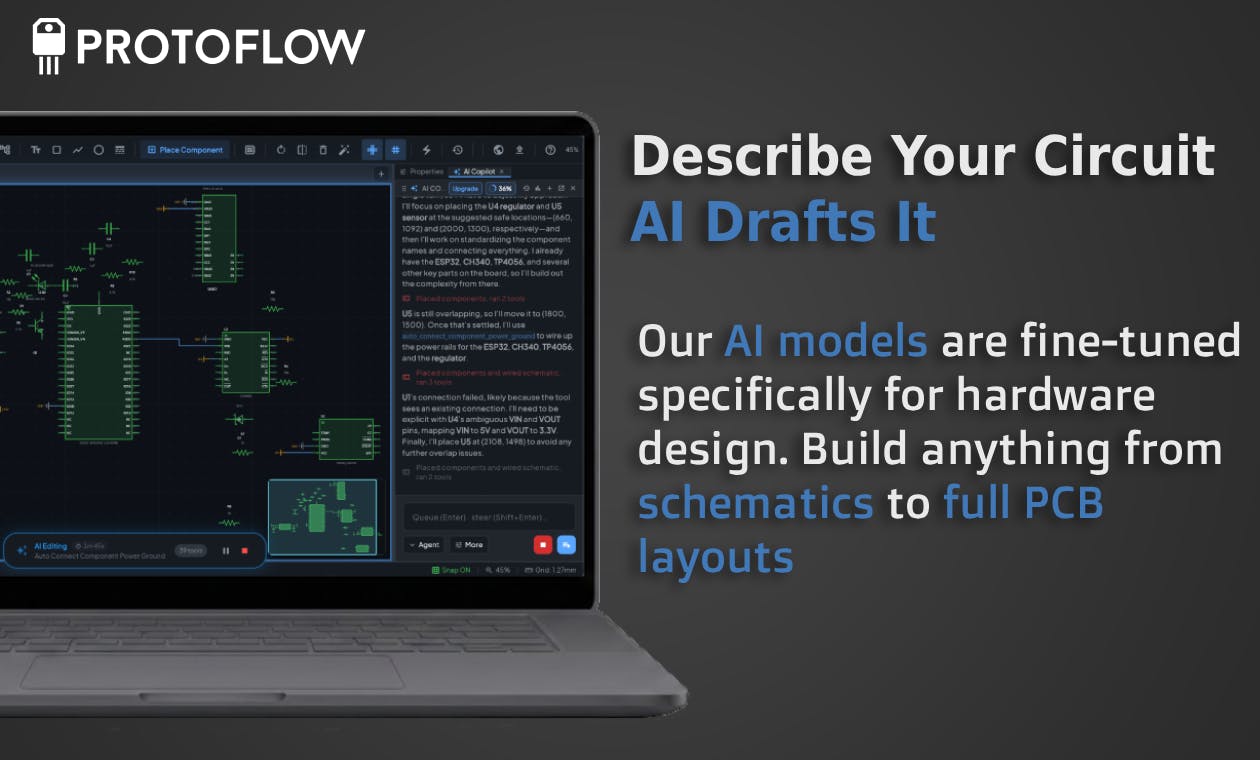
ProtoFlow: AI Streamlines PCB Design for Hardware Teams
ProtoFlow has launched an AI-powered platform designed to accelerate and simplify the complex process of printed circuit board (PCB) design. The tool targets professional engineers and hardware development teams, aiming to reduce the time and cognitive load associated with creating functional and efficient circuit boards.
Traditional PCB design involves numerous intricate steps, from schematic capture and component selection to layout, routing, and verification. Each stage requires deep technical expertise and can be a bottleneck in the product development lifecycle. ProtoFlow positions itself as a solution to these challenges by integrating artificial intelligence to automate and optimize key design tasks.
Key Features and Functionality
At its core, ProtoFlow leverages AI to assist engineers throughout the PCB design workflow. While specific algorithms and architectures are not detailed, the platform's promise lies in its ability to learn from vast datasets of existing designs and best practices. This allows it to suggest optimal component placements, generate efficient routing paths, and even identify potential design flaws or manufacturability issues early in the process.
One of the primary benefits highlighted is the acceleration of the design cycle. By automating repetitive tasks and providing intelligent recommendations, ProtoFlow aims to shave significant time off the design process. This is particularly valuable in fast-paced hardware development environments where time-to-market is a critical competitive factor. Engineers can spend less time on tedious manual operations and more time on innovation and complex problem-solving.
The platform also focuses on improving design quality. AI can analyze a multitude of design parameters simultaneously, something that is challenging for human designers to do consistently. This includes optimizing for signal integrity, power delivery, thermal management, and electromagnetic interference (EMI). By considering these factors holistically, ProtoFlow can help produce more robust and reliable PCBs.
Target Audience and Market Impact
ProtoFlow is clearly aimed at professional engineers and established hardware development teams within companies. The emphasis on efficiency, optimization, and reducing design errors suggests a focus on professional-grade applications where precision and reliability are paramount. Startups and individual makers might also find value, particularly those with limited experience in advanced PCB layout techniques.
The introduction of AI into PCB design is not entirely new, but ProtoFlow's approach appears to be more integrated and user-friendly than some previous attempts. The market for electronic design automation (EDA) tools is mature and dominated by large players. ProtoFlow's success will likely depend on its ability to offer a compelling value proposition that either significantly outperforms existing tools in specific areas or democratizes advanced design capabilities at a more accessible price point.
The broader implication for the hardware industry is a potential shift in how PCBs are designed. As AI tools become more sophisticated, they could lower the barrier to entry for complex hardware development, enabling smaller teams or even individuals to design more sophisticated electronic products. This could foster greater innovation and competition in the hardware space.
The Unanswered Question of Integration
What remains to be seen is how seamlessly ProtoFlow integrates with existing EDA ecosystems. Many engineering teams have established workflows and rely on specific software suites for different stages of development. For ProtoFlow to gain widespread adoption, it must either serve as a standalone, comprehensive solution or provide robust import/export capabilities and APIs that allow it to coexist and collaborate with popular tools like Altium Designer, Eagle, or KiCad. Without smooth integration, even the most advanced AI features may struggle to find a foothold in established professional environments.
Future Outlook
ProtoFlow's entry into the market signifies a growing trend of AI adoption across specialized engineering disciplines. As AI models become more capable of understanding complex physical and electrical constraints, we can expect to see more tools emerge that automate and optimize design processes in fields like mechanical engineering, materials science, and even chip design. ProtoFlow is an early indicator of this broader shift, aiming to bring the power of AI to the tangible world of hardware.