Introducing Prop For That: Bridging the Gap Between Browser State and CSS
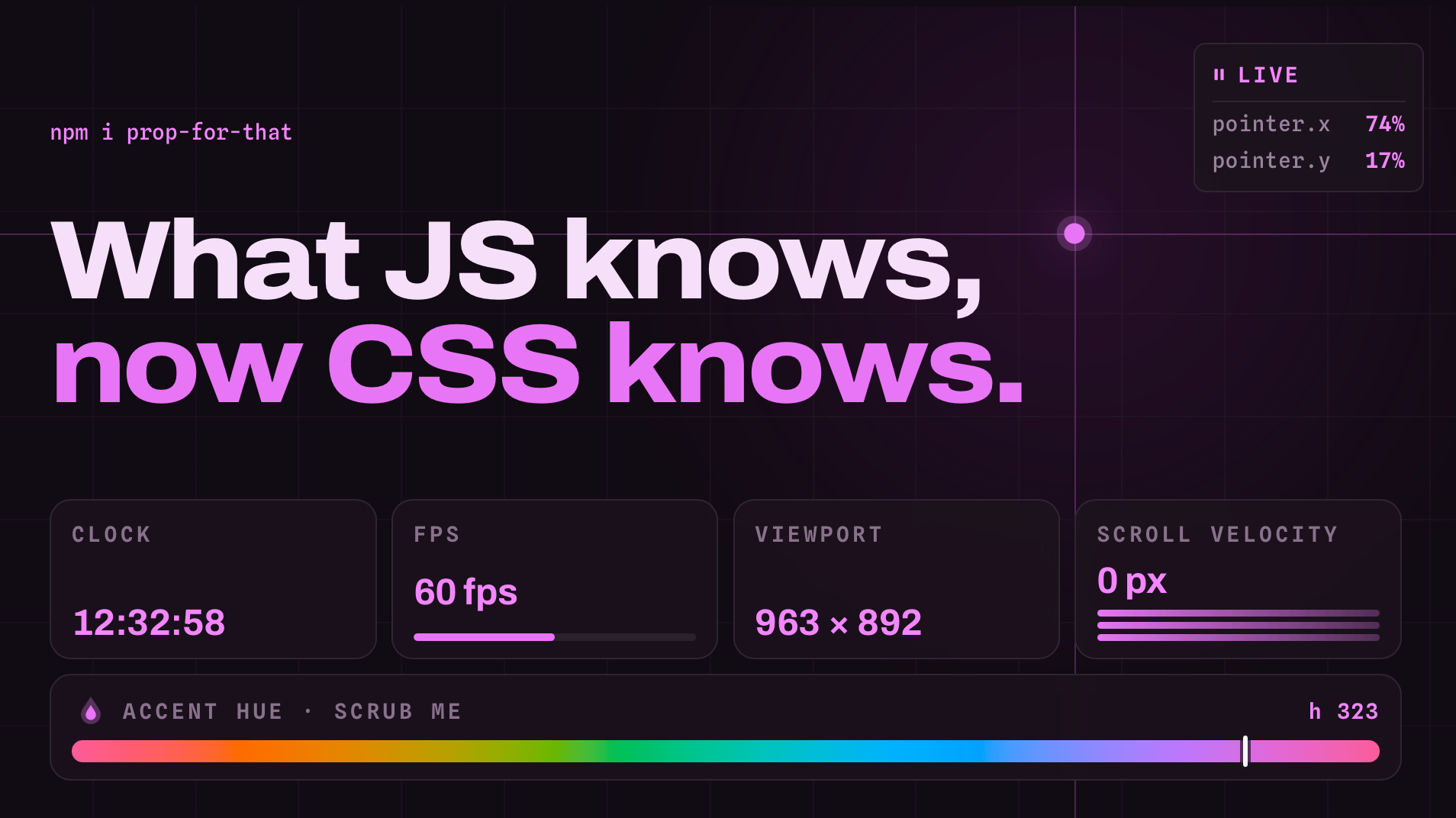
For years, frontend developers have relied on JavaScript to bridge the gap between dynamic browser states and CSS styling. Information like cursor position, scroll velocity, form input states, or even the current time was typically captured by JavaScript, processed, and then injected into the DOM or directly into CSS variables. Geoff Graham's new project, Prop For That, aims to fundamentally change this workflow by enabling CSS to directly access and react to these live browser states without explicit JavaScript manipulation in the styling layer. This framework, inspired by the success of Open Props, offers a novel approach to dynamic styling, making previously inaccessible browser data available directly within CSS custom properties.
The core innovation of Prop For That lies in its ability to register and expose browser-specific data points as CSS variables. Instead of writing custom JavaScript to track mouse coordinates and update a --cursor-x variable, developers can now leverage Prop For That. The library handles the background scripting required to sniff these states. The developer's role then shifts to importing the library, declaring the desired prop in their HTML via data attributes, and finally, styling their elements using these new CSS variables. This abstraction significantly simplifies the process of creating highly interactive and responsive user interfaces.

How Prop For That Works: Data Attributes and CSS Variables
The mechanism behind Prop For That is elegantly simple. Developers mark up their HTML elements with specific data attributes that signal which browser states they want to track. For instance, an element might be tagged with data-props-for="pointer". Once this attribute is present, Prop For That's background scripts begin monitoring the associated browser state—in this case, the cursor's X and Y coordinates. These live values are then automatically registered as CSS custom properties, typically prefixed with --live- (e.g., --live-pointer-x, --live-pointer-y).
With these live CSS variables available, styling becomes a matter of standard CSS syntax. A developer can then use these variables in `calc()` functions or directly as values, as demonstrated in the example: left: calc(var(--live-pointer-x, 0) * 1px);. The fallback value `0` ensures that if the variable isn't immediately available, the element defaults to a safe position. This approach eliminates the need for developers to write boilerplate JavaScript for state tracking, allowing them to focus on the visual presentation and user experience.
The potential applications are vast. Imagine styling elements based on scroll speed to create parallax effects without complex scroll event listeners. Consider form inputs that change their appearance based on validation states (e.g., :valid, :invalid) or even based on user interaction intensity. The framework also supports tracking progress values, which could be useful for dynamic loading indicators or interactive tutorials. The underlying script handles the heavy lifting, making these dynamic states accessible to CSS in a declarative manner.
Beyond Cursor Position: A Glimpse at Other Capabilities
While cursor tracking is a compelling initial use case, Prop For That's capabilities extend much further. The framework is designed to expose a range of browser-native states that are typically difficult or verbose to access via CSS alone. This includes, but is not limited to:
- Scroll Velocity: Style elements based on how quickly the user is scrolling, enabling advanced scroll-driven animations.
- Form States: React to native form validation states (like
:validand:invalid) and potentially other interactive states not directly exposed by CSS pseudo-classes. - Current Time: Dynamically update styles based on the current hour, minute, or second, opening doors for time-sensitive UI elements or ambient displays.
- Progress Values: Track the progress of tasks or user interactions, useful for progress bars, step indicators, or completion animations.
The demos provided by Graham showcase the framework's potential. One notable example involves an element that follows the cursor, changing its background color and position in real-time. Another demonstrates a dynamic background blend mode that shifts based on the pointer's location. These examples are not just proofs of concept; they are polished demonstrations of how Prop For That can elevate the interactivity and visual polish of web interfaces. The ease with which these effects are implemented suggests a significant reduction in development time and complexity for tasks that previously required extensive JavaScript.

Implications for Developers and Designers
Prop For That represents a significant shift in how frontend developers approach dynamic styling. By abstracting away the JavaScript needed to capture browser states, it empowers CSS to become a more powerful reactive language. Developers can write cleaner, more declarative CSS, reducing the amount of imperative JavaScript code they need to maintain. This not only streamlines development but also potentially improves performance, as the framework's background scripts are likely optimized for efficiency.
For designers, this opens up new avenues for creating sophisticated and fluid user experiences. The ability to directly tie visual elements to real-time browser interactions without complex JS workarounds means more intricate animations, more responsive layouts, and more engaging interfaces can be realized with greater ease. It lowers the barrier to entry for implementing advanced interactive design patterns.
The framework's reliance on data attributes makes it highly compatible with existing HTML structures and CSS methodologies. It integrates smoothly into current workflows, requiring minimal disruption. The inspiration from Open Props also suggests a commitment to a robust and developer-friendly ecosystem. While specific performance benchmarks are yet to be widely published, the underlying principle of offloading state tracking to a dedicated, optimized library is a sound one.
The Future of Reactive CSS
Prop For That is more than just a utility library; it's a statement about the evolving capabilities of CSS. As browsers become more powerful and standards evolve, we are seeing CSS take on responsibilities that were once exclusively the domain of JavaScript. This project is a prime example of that trend, pushing the boundaries of what can be achieved with declarative styling. What remains to be seen is how widely this pattern will be adopted and whether other frameworks or even browser vendors will embrace similar approaches to expose more dynamic browser states directly to CSS.
The project's success hinges on its ability to provide a stable, performant, and comprehensive set of tracked states. If it can deliver on this promise, Prop For That could become an indispensable tool for frontend developers looking to create highly interactive and visually rich web experiences with unprecedented ease. It offers a glimpse into a future where CSS plays an even more central role in defining the dynamic behavior of web applications.