The Slippery Slope of AI-Assisted Development
When companies first integrate AI into their workflows, the goal is often straightforward: automate repetitive tasks and boost efficiency. For a team of analysts tasked with collecting requirements, preparing tasks, describing changes, and aligning implementation, introducing an AI tool to generate first drafts seemed like a logical step. This approach promises to free up valuable human hours for more complex problem-solving.
However, the reality of software development is that a single change rarely exists in isolation. A modification to a system is typically reflected across multiple artifacts: Jira tickets, Confluence pages, design mockups, test scenarios, technical notes, and even direct codebase instructions. Each of these documents serves a specific purpose, yet all describe the same intended system behavior. When the wording in these disparate sources drifts apart, it can lead to confusion and errors, with different team members unknowingly working from conflicting versions of the truth. This is where AI, particularly in its prompt-based interactions, begins to complicate matters.

Consider a scenario where an analyst needs to implement a new feature. They might craft a detailed prompt for an AI model, specifying not just the desired outcome but also the precise parameters, constraints, and even stylistic nuances. This prompt might be fed into a large language model (LLM) to generate a user story, a set of test cases, or even code snippets. If this prompt is sophisticated enough, it contains implicit logic that dictates the generated output with a high degree of specificity. The prompt effectively becomes a set of instructions that, when executed by the AI, produce a predictable, albeit complex, result.
Prompts as Implicit Code
The core issue arises when these detailed prompts are not formally version-controlled, documented, or treated with the same rigor as traditional code. A prompt that specifies conditional logic, iterative processes, or intricate data transformations starts to resemble a program. For instance, a prompt like: "Generate a Python function that takes a list of user IDs, filters out those older than 30, and for the remaining users, calculates the average purchase value from a provided transaction log, returning the result as a JSON object. Ensure error handling for empty lists and invalid transaction data." This prompt contains multiple elements that mirror programming constructs: input parameters, filtering logic, aggregation (calculation), specific output format, and error handling. It’s not just a request; it’s a specification for a computational process.
When such a prompt is used repeatedly to generate consistent outputs – be it documentation, test data, or code – it functions as an undocumented program. The output is reproducible, but the instructions to achieve it are embedded within a natural language query that is not subject to typical software engineering practices. This creates a significant maintenance and understanding challenge. If the AI model evolves, or if the prompt needs to be adapted, the original intent and the precise execution path can be lost, especially if the prompt was complex and developed organically over several iterations.
The Hidden Maintenance Burden
The danger of prompts becoming undocumented programs lies in their lack of transparency and formal management. Traditional software development relies on version control systems like Git, rigorous code reviews, and comprehensive testing to ensure reliability and maintainability. Prompts, however, often live in chat interfaces, text files, or simple documents, without formal tracking. This makes it difficult to:
- Track Changes: When and why was a prompt modified? What was the impact of that change?
- Reproduce Results: If a critical output generated by a prompt is needed again, can it be reliably recreated, especially if the AI model or the prompt itself has changed?
- Onboard New Team Members: How does a new analyst understand the complex AI-driven processes that generate essential project artifacts?
- Debug Issues: If an AI-generated output is incorrect, tracing the root cause back to a specific, complex prompt and its subtle interactions with the AI model can be a Herculean task.
This situation is akin to having a critical piece of infrastructure built with invisible bricks. The structure stands, but understanding its internal workings and how to repair or modify it becomes a significant hurdle. The reliance on an AI’s interpretation of a prompt, without a clear, versioned record of the prompt’s exact logic, introduces a brittle dependency.
Mitigation Strategies: Treating Prompts Like Code
To address this growing problem, organizations must start treating sophisticated prompts with the same seriousness as code. This involves several key practices:
- Prompt Version Control: Implement systems to version control prompts, just as code is managed. This could involve dedicated prompt management tools or structured repositories for prompt templates.
- Prompt Documentation: Each complex prompt should be accompanied by documentation explaining its purpose, intended inputs and outputs, assumptions, and any specific logic it encodes.
- Testing Prompts: Develop strategies to test prompts. This might involve creating standardized input datasets and expected outputs to ensure prompt consistency and accuracy over time and across different model versions.
- Prompt Libraries: Curate libraries of well-tested, documented, and versioned prompts for common tasks. This promotes reuse and reduces the creation of ad-hoc, undocumented instructions.
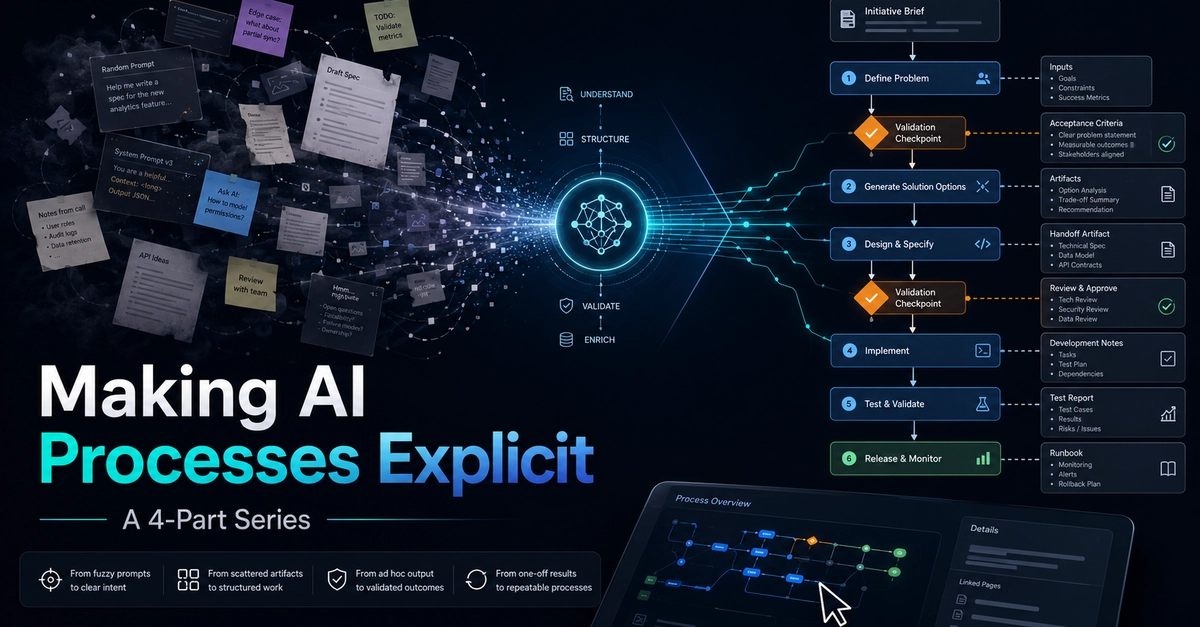
- Formalizing AI Workflows: Integrate AI tools into existing development lifecycles. Instead of ad-hoc prompt engineering, establish formal processes for prompt design, review, and deployment, especially for critical tasks.
As AI becomes more deeply embedded in development and analytical workflows, the distinction between a simple request and a complex, executable instruction blurs. Failing to recognize when a prompt has effectively become an undocumented program risks introducing subtle but significant technical debt and operational fragility into software development processes.