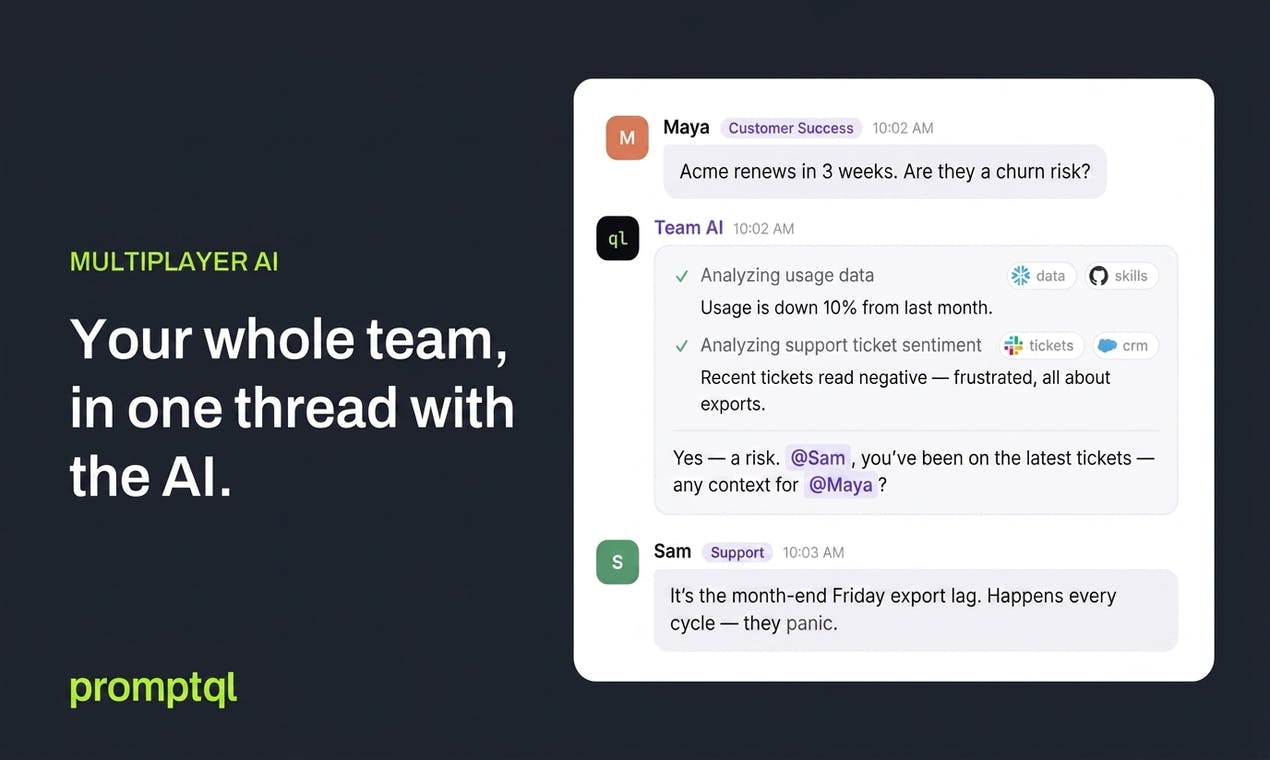
The Multiplayer AI Alternative to Slack
PromptQL is emerging as a new contender in the team communication space, positioning itself as a direct alternative to Slack by integrating artificial intelligence at its core. The platform aims to move beyond simple chat by enabling what it calls "multiplayer AI," where AI agents can actively participate in and contribute to team workflows directly within the communication interface. This approach seeks to streamline tasks, automate responses, and enhance collaboration by making AI a first-class citizen in daily team interactions, rather than an external tool.
The core proposition of PromptQL is to replace the context-switching and manual delegation often associated with using separate AI tools alongside traditional chat platforms. Instead of copying and pasting prompts into ChatGPT, then bringing the results back to a Slack channel, PromptQL intends for AI to operate within the chat itself. This means AI agents can be assigned tasks, respond to queries, summarize discussions, and even generate content collaboratively with human team members, all within a unified environment. The vision is to create a more fluid and integrated experience where AI augments human capabilities seamlessly.
This ambitious goal suggests a fundamental rethinking of how teams interact with AI and with each other. Traditional chat applications are designed for human-to-human communication. PromptQL, by contrast, is built from the ground up with AI agents as integral participants. This requires a sophisticated architecture that can manage AI interactions, maintain conversation context across both human and AI participants, and ensure that AI contributions are relevant and actionable. The platform is betting that this integrated approach will unlock new levels of productivity and efficiency that are not possible with current tool stacks.
Streamlining Workflows with Integrated AI
PromptQL's approach to team communication centers on the idea of AI agents as active collaborators. This isn't just about having a chatbot that answers FAQs. It's about AI agents that can understand project contexts, perform specific tasks, and interact with the team in a dynamic, multiplayer fashion. For instance, an AI agent could be tasked with monitoring a specific project, summarizing daily progress from various team members' inputs, and flagging potential roadblocks. Another agent might be responsible for drafting meeting minutes based on the live conversation, or generating marketing copy based on product specifications discussed in a channel.
The platform's design prioritizes ease of use for both human users and AI agents. The concept of "prompting" remains central, but PromptQL aims to make these prompts more powerful and context-aware. Users can direct AI agents, assign them roles, and set parameters for their actions, much like assigning a task to a human colleague. The "multiplayer" aspect comes into play as multiple AI agents, alongside human team members, can engage in a conversation or collaborate on a task simultaneously. This could manifest as an AI research agent gathering information, an AI writing agent drafting content based on that information, and a human project manager overseeing and guiding the process – all within the same interface.
This integration is designed to significantly reduce the overhead associated with managing AI tools. Developers and product teams often spend considerable time copying data between different applications, managing API keys, and stitching together workflows. PromptQL seeks to eliminate this friction by providing a native environment for AI-powered collaboration. The success of this model hinges on the platform's ability to accurately interpret user intent, manage AI agent behavior effectively, and provide clear, actionable outputs that genuinely enhance team productivity rather than adding complexity.
The Challenge of AI Integration in Communication
The ambition to replace a tool as entrenched as Slack is considerable. Slack has evolved into a de facto standard for team communication in many organizations, supporting a vast ecosystem of integrations and established user habits. PromptQL faces the challenge of not only offering superior functionality but also convincing teams to migrate and adopt a fundamentally new way of working.
One of the key technical hurdles is managing the complexity of AI interactions within a real-time communication environment. Ensuring that AI agents provide relevant, accurate, and timely responses requires sophisticated natural language understanding and processing capabilities. Furthermore, maintaining a coherent conversation flow when multiple AI agents and human participants are involved is a significant engineering feat. The platform must be able to handle concurrent interactions, manage state effectively, and prevent AI-generated noise from overwhelming human communication.
The concept of "multiplayer AI" also raises questions about control, security, and the potential for AI to misinterpret instructions or generate unintended consequences. While PromptQL aims to make AI a collaborator, the ultimate responsibility for outcomes still rests with human teams. The platform needs robust mechanisms for oversight, auditing, and error correction. For instance, how does a team roll back an AI-generated action that went awry? What are the guardrails in place to prevent AI agents from inadvertently sharing sensitive information or making costly errors?
What's Next for PromptQL?
PromptQL's launch on Product Hunt signals its intent to disrupt the team communication market. The immediate focus will likely be on refining its core "multiplayer AI" functionality and demonstrating tangible productivity gains for early adopters. The platform's success will depend on its ability to deliver on the promise of seamless AI integration, proving that it can indeed offer a more efficient and collaborative alternative to existing solutions.
The broader implications for the future of work are significant. If platforms like PromptQL gain traction, they could usher in an era where AI is not just a tool but an active, integrated member of the digital workforce. This shift could redefine team structures, project management methodologies, and the very nature of collaboration. As PromptQL develops, the industry will be watching closely to see if it can overcome the technical and adoption challenges to make its vision of multiplayer AI a reality.