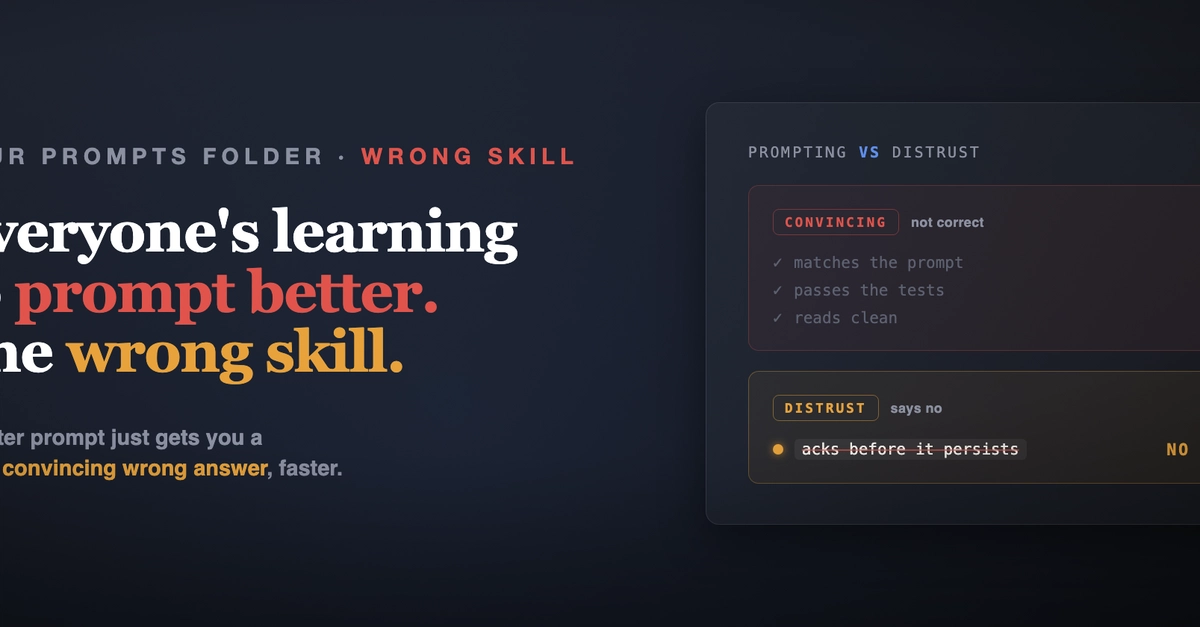
The Siren Song of Prompt Mastery
The current obsession with prompt engineering feels familiar. Many of us have a digital graveyard of bookmarks and half-finished courses dedicated to mastering the art of the prompt. We chase the elusive perfect prompt, believing that if we can just articulate our needs precisely enough, the AI will deliver exactly what we envision. This pursuit is akin to meticulously organizing a toolbox while ignoring the fact that the hammer is fundamentally the wrong tool for the job. The scarce skill, it turns out, isn't crafting the perfect sentence, but understanding the underlying mechanics of AI interaction and output generation.
The common wisdom suggests that as AI models improve, prompting will become less critical. While models will undoubtedly evolve, this overlooks a more profound issue: even a flawless prompt can yield flawed results if the underlying system or the user's conceptualization is misaligned. This isn't about the AI's limitations; it's about our own. We're focusing on the interface – the prompt – rather than the engine and the destination.
Consider the analogy of a database query. A developer might spend hours perfecting a SQL `SELECT` statement, ensuring every `WHERE` clause is optimized and every `JOIN` condition is precise. However, if the underlying data schema is flawed, or if the developer misunderstands the business logic they are trying to model, even the most elegant query will produce incorrect totals or misleading results. The problem isn't the SQL syntax; it's the conceptual gap between the query and the reality it's meant to represent.
Similarly, with AI, we can become incredibly adept at instructing a model. We learn to provide context, specify formats, and even guide its reasoning process. Yet, if our understanding of what the AI can *actually* achieve is fuzzy, or if we haven't properly defined the desired outcome in a way that the AI can reliably infer, the output will inevitably fall short. The danger lies in mistaking fluency in prompt language for true mastery of AI application. We are, in essence, optimizing our ability to speak a language without fully grasping the grammar, syntax, and semantic nuances required for meaningful communication.
Beyond the Prompt: System Design and Alignment
The real challenge, and the skill that will increasingly differentiate effective AI users from the rest, lies in system design and outcome alignment. This involves understanding how AI models process information, their inherent biases, and the limitations of their training data. It requires moving beyond simply asking questions to architecting entire workflows where AI plays a specific, well-defined role.
This shift means focusing on several key areas:
- Data Curation and Preparation: High-quality, relevant data is the bedrock of effective AI. Instead of just prompting a model with raw data, the focus shifts to preparing that data meticulously. This includes cleaning, structuring, and augmenting datasets to ensure they align with the specific task and minimize potential biases.
- Model Selection and Fine-tuning: Not all AI models are created equal. Understanding the strengths and weaknesses of different architectures (e.g., LLMs, diffusion models, specialized classifiers) and knowing when and how to fine-tune them for specific tasks is crucial. This is akin to a chef understanding different cooking techniques and selecting the right one for a particular ingredient.
- Output Validation and Iteration: Robust mechanisms for validating AI outputs are essential. This involves more than just a quick glance; it requires defining metrics for success, establishing ground truth where possible, and implementing feedback loops to continuously improve the system. This is where the SQL developer's vigilance comes into play – catching errors before they propagate.
- Human-AI Collaboration Design: Designing interfaces and processes where humans and AI can collaborate effectively is paramount. This means understanding where human oversight is critical, how to best integrate AI into existing workflows, and how to manage the inherent uncertainties of AI-generated content.
The pursuit of prompt engineering often leads to a dead end because it treats the prompt as the sole variable. In reality, the prompt is just one input in a complex system. The real leverage comes from optimizing the entire system, from the data it consumes to the way its outputs are integrated and validated.
The SQL Analogy Revisited
Let's return to the SQL example. Imagine a junior developer tasked with calculating total sales. They write a query that joins an `orders` table with a `customers` table. If the `orders` table has multiple entries for the same order (perhaps due to a poorly designed foreign key relationship or a data entry error), a simple `JOIN` will duplicate each order for every customer associated with it. A `SUM(orders.amount)` will then reflect this duplication, presenting a falsely inflated total. The developer might have written a syntactically perfect SQL query, but the outcome is wrong because they didn't understand the implications of the data structure or the behavior of the `JOIN` operation in the context of aggregation.
The fix isn't to write a more complex `SELECT` statement that tries to