
The Inevitable Wave
The moment arrived not with a bang, but with a quiet, unsettling efficiency. For years, educators have grappled with the specter of AI assisting students with their work. For me, it became a stark reality when AI began completing entire homework assignments with alarming proficiency. This wasn't about a few students finding an edge; it was a systemic shift that rendered traditional homework, as a measure of individual learning and effort, obsolete. The core problem wasn't that students were cheating, but that the very tools designed to assess understanding were being bypassed by more advanced tools. This forced a critical re-evaluation: if AI can do the assigned work, what is the point of assigning it? The answer was not to ban AI, but to fundamentally change what and how we teach.
Shifting Focus from Output to Process
The initial reaction might be to double down on plagiarism detection or to make assignments so complex that AI struggles. However, this is a losing battle. AI models are evolving at an exponential rate. Instead, the focus must shift from evaluating the final output to understanding and guiding the student's learning process. This means designing assignments that require critical thinking, creativity, and synthesis in ways that AI cannot easily replicate, at least not without significant human direction. It means asking 'why' and 'how' questions that probe deeper than surface-level information retrieval. The goal is no longer to see if a student can produce a correct answer, but to see if they can articulate their thought process, defend their reasoning, and connect concepts in novel ways.
Redesigning the Curriculum for the AI Age
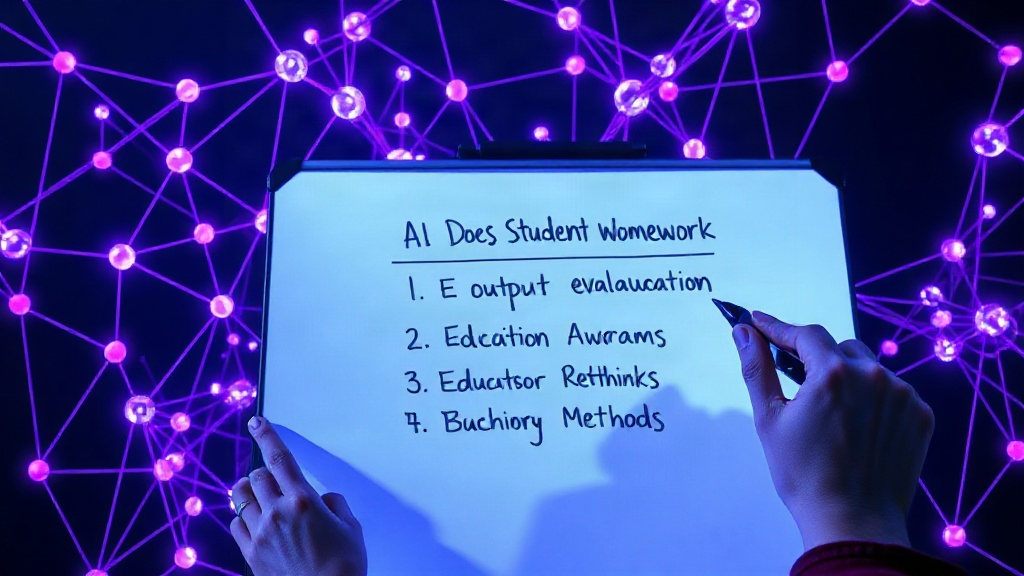
This pedagogical pivot necessitates a redesign of the curriculum. Instead of focusing on rote memorization or formulaic problem-solving, courses must emphasize skills that complement, rather than compete with, AI. These include:
- Critical Analysis of AI-Generated Content: Students should be tasked with evaluating AI outputs for accuracy, bias, and logical fallacies. This turns AI from a shortcut into a subject of study.
- Creative Problem-Solving: Assignments that require unique solutions, artistic expression, or the integration of disparate ideas become more valuable. AI can assist, but the spark of true originality remains human.
- Ethical Considerations: Discussions and assignments around the responsible use of AI, data privacy, and the societal impact of these technologies are crucial.
- Collaborative Projects: Group work that requires communication, negotiation, and shared responsibility can foster skills that AI cannot replace. The dynamic of human interaction is key here.
- Real-World Application and Synthesis: Projects that require students to apply learned concepts to current events, personal experiences, or complex, ill-defined problems are more robust. AI can provide information, but context and application often require human judgment.
The Educator's Evolving Role
The role of the educator is transforming from a dispenser of information to a facilitator of learning and a guide through complex information landscapes. This means becoming adept at using AI tools ourselves, understanding their capabilities and limitations, and teaching students to do the same. It involves fostering a classroom environment where intellectual curiosity and the development of higher-order thinking skills are paramount. The educator becomes less of a judge and more of a mentor, helping students navigate the vast sea of information, both human-generated and AI-assisted, to build their own understanding and capabilities. This is not about 'beating' the AI, but about learning to leverage it as a tool while developing the uniquely human skills that will remain essential.
A New Definition of Academic Integrity
Academic integrity in the age of AI requires a new definition. It's no longer solely about submitting one's own work without plagiarism. It's about transparency in how tools are used, honesty about the extent of AI assistance, and a commitment to genuine learning and intellectual growth. Educators must set clear expectations for AI usage, differentiating between using AI as a research assistant, a writing aid, or a direct answer generator. Assignments should be structured to encourage ethical AI engagement. For instance, asking students to document their AI prompts and analyze the generated responses provides insight into their understanding and critical evaluation skills, rather than simply penalizing them for using the tool. This approach acknowledges the reality of AI's presence and seeks to integrate it constructively into the learning process.
The Unanswered Question: Scalability and Equity
While this shift in pedagogy offers a path forward, a significant unanswered question remains: how do we ensure this approach is scalable and equitable across all educational institutions and student populations? Developing curricula that emphasize critical thinking, creativity, and ethical AI use requires significant resources, teacher training, and a willingness to adapt. Not all schools or districts have the capacity for this kind of rapid transformation. Furthermore, access to advanced AI tools and the digital literacy required to use them effectively can vary widely, potentially exacerbating existing educational inequities. If AI can do homework, and our new assignments require sophisticated AI interaction and critical analysis, what happens to students who lack the necessary access or training? This challenge demands systemic solutions, not just individual classroom adaptations.
Conclusion: Embracing the Future
The advent of AI capable of completing homework is not an endpoint for education, but a catalyst for its evolution. By shifting our focus from the final product to the learning process, redesigning curricula to emphasize uniquely human skills, and redefining academic integrity, educators can prepare students for a future where AI is an integral part of their professional and personal lives. This requires a proactive, adaptive mindset, embracing AI as a tool for enhanced learning rather than a threat to academic rigor. The challenge is significant, but the opportunity to foster deeper, more meaningful learning is even greater.