The Shifting Sands of AI Interaction
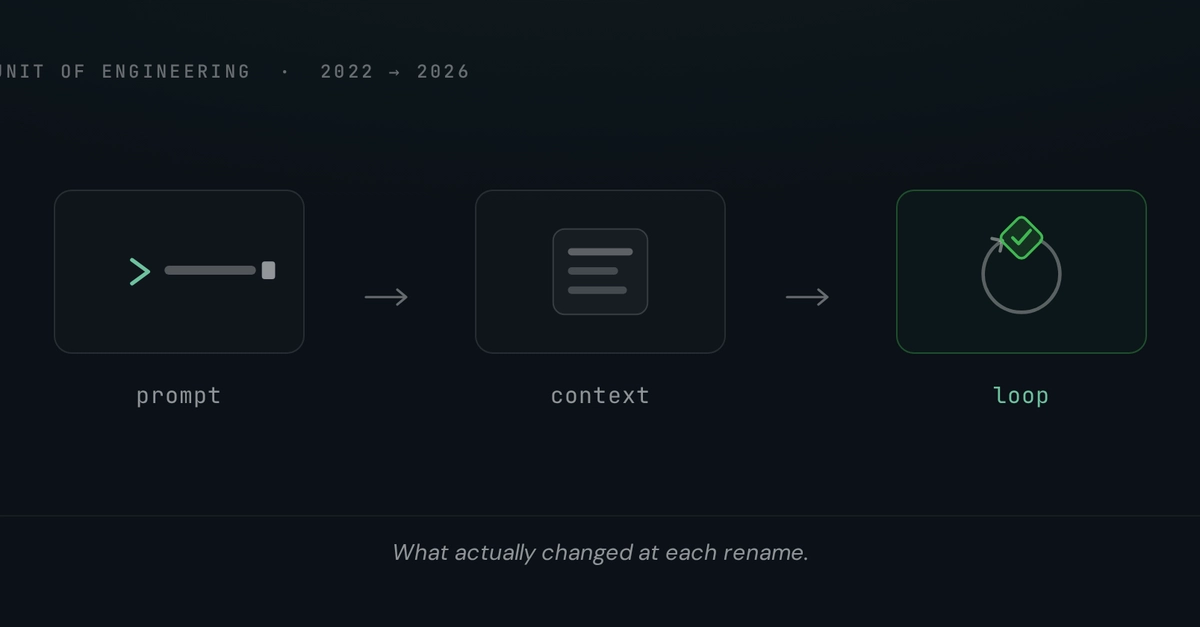
A few years ago, the primary skill in interacting with large language models (LLMs) was known as prompt engineering. The task involved meticulously crafting and rewriting sentences until the AI model produced the desired output. Last year, this same niche area of work adopted a new moniker: context engineering. This year, the discourse is centered around loop engineering, with a recurring refrain: the verifier is the bottleneck, not the model anymore.
Each renaming cycle inevitably sparks a familiar reaction among developers: is this a genuine paradigm shift, or simply a rebranding exercise to facilitate course sales? This skepticism is often warranted. The vocabulary surrounding AI tooling tends to evolve more rapidly than the underlying problems it attempts to describe. However, examining these shifts chronologically reveals that the fundamental nature of the work has indeed changed, focusing on the unit of work rather than just marketing terminology.
The problems that the newest terminology addresses have a traceable, dated public record. By analyzing the evolution of these terms, we can discern the actual changes in how we interact with and control AI systems.
From Prompt to Context: Expanding the Input
Prompt engineering, in its nascent form, was about finding the right words. It was a direct, often iterative, conversation with the LLM. Developers would experiment with different phrasings, keywords, and sentence structures to elicit specific responses. The core challenge was understanding how the model interpreted natural language and subtly guiding it towards a desired outcome. This phase was characterized by a focus on the immediate input – the prompt itself.
The limitations of pure prompt engineering became apparent as AI models grew more sophisticated and applications demanded more complex behaviors. Simply tweaking the prompt wasn't always sufficient. Developers realized that providing the model with more relevant background information, historical data, or specific constraints – essentially, its context – was crucial for improving performance and reliability. This led to the rise of context engineering.
Context engineering broadened the scope. Instead of just focusing on the single instruction, it involved constructing rich, detailed informational environments for the AI. This could include providing relevant documents, previous conversation turns, user profiles, or domain-specific knowledge bases. The goal was to imbue the model with a deeper understanding of the task at hand, enabling it to generate more accurate, relevant, and nuanced outputs. Think of it less like giving a single command to a clerk, and more like providing that clerk with a detailed briefing folder before they start a complex task.
The Emergence of Loop Engineering: Verifying and Iterating
The latest evolution, loop engineering, signifies a critical pivot. The core insight is that with increasingly capable models and sophisticated context management, the bottleneck has shifted from generating the AI's response to verifying its accuracy and usefulness. This is particularly true in applications requiring high degrees of precision, safety, or adherence to complex rules, such as autonomous systems, complex code generation, or critical decision support.
Loop engineering involves designing systems where the AI's output is not treated as final but is instead fed back into a process for evaluation, refinement, and re-submission. This creates a continuous cycle of interaction: the AI generates a response, a verifier (which could be another AI model, a human, or a set of programmatic rules) assesses it, and if necessary, the feedback is used to generate a new, improved prompt or context for the AI. This iterative process aims to achieve a target state through repeated cycles of generation and validation.
The 'verifier' in this context can take many forms. It might be a specialized AI model trained to detect factual inaccuracies, logical fallacies, or non-compliance with specific guidelines. It could be a human-in-the-loop system where a user provides explicit feedback or makes critical decisions. Alternatively, it might be a set of automated tests or validation scripts that check the AI's output against predefined criteria. The key is that the output is not taken at face value; it's subjected to a structured evaluation process.
What This Means for AI Development
This progression from prompt to context to loop engineering reflects a maturing understanding of how to effectively leverage AI. It moves beyond treating LLMs as black boxes that simply respond to queries, towards building robust systems that integrate AI capabilities within larger, controlled workflows.
For developers, this means a shift in focus. While prompt crafting remains important, the emphasis is increasingly on designing the entire interaction loop. This involves understanding how to structure data for context, how to design effective verification mechanisms, and how to manage the flow of information and feedback within these loops. It requires a more systems-level thinking approach.
The implications extend to the types of problems we can tackle with AI. By effectively managing the verification bottleneck, loop engineering opens doors to applications that require a higher degree of reliability and precision than was previously feasible. It allows for the development of AI agents that can perform complex, multi-step tasks autonomously, with built-in mechanisms for self-correction and quality assurance.
Ultimately, each rename marks a step towards more sophisticated and reliable AI integration. Prompt engineering was the first step, context engineering provided the necessary depth, and loop engineering is now establishing the control and validation mechanisms needed for more critical applications. The core challenge remains understanding and guiding AI, but the tools and methodologies for doing so are continuously advancing.