The Pitch: A Single Script Tag
Bradley Matera's ProjectHub, dubbed Scout, presents a deceptively simple facade: a single script tag dropped onto a portfolio page. This embeddable AI assistant allows recruiters to ask natural language questions about Matera's projects, skills, and career aspirations. The external pitch is clear: recruiters can interact with a candidate's digital presence as if they were having a conversation, bypassing lengthy resumes and static project descriptions. It’s designed to answer questions like “What AWS services did you use in your internship?” or “What kind of roles are you looking for?”
Under the Hood: A Symphony of Free Tiers
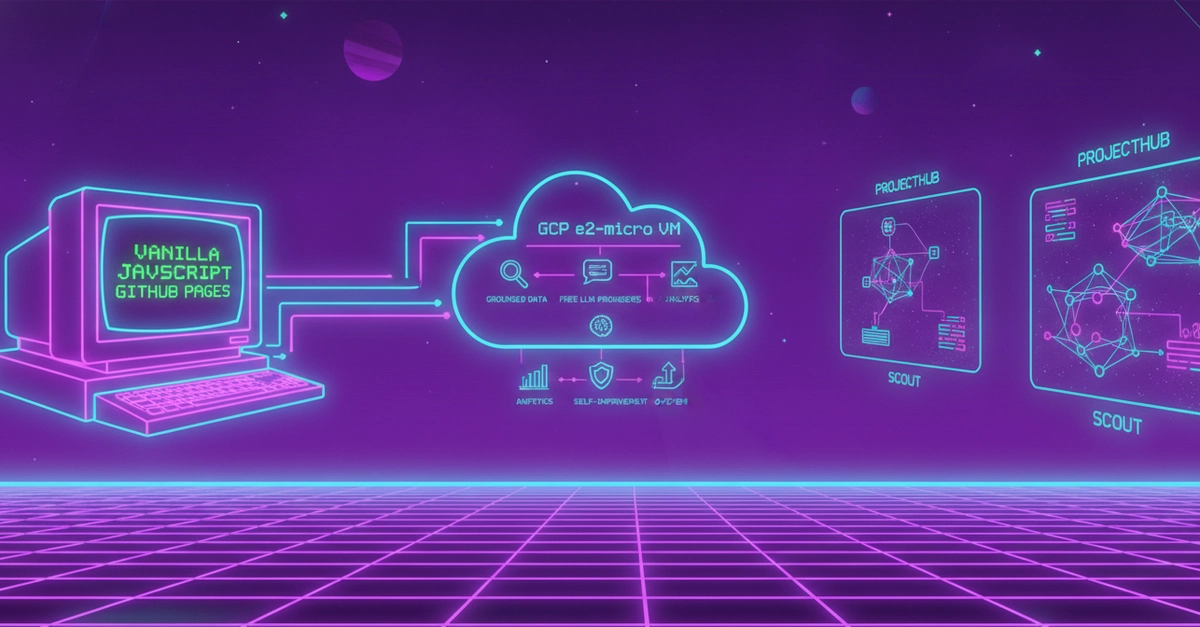
The reality behind Scout's elegant interface is a complex orchestration of various technologies, all meticulously selected to operate within the constraints of free service tiers. Matera built a vanilla JavaScript frontend, ensuring broad compatibility and minimal overhead. The backend is powered by Node.js, hosted on a Google Cloud e2-micro VM, which offers a generous free tier suitable for low-traffic applications. This VM serves as the central hub for processing requests and managing the AI's logic.
The core of Scout's intelligence lies in its knowledge base. Matera pulled this data directly from his GitHub repositories, effectively turning his public code and project documentation into a structured source of truth for the AI. This approach leverages existing content and avoids the need for manual data entry or expensive data scraping services.
To power the AI's conversational abilities, ProjectHub relies on a network of free Large Language Model (LLM) providers. This is perhaps the most critical architectural decision for a project aiming to stay on free tiers. Instead of subscribing to a single, potentially costly API like OpenAI's GPT-4, Matera opted for a strategy that aggregates requests across multiple free or low-cost LLM endpoints. This requires intelligent routing and fallback mechanisms to ensure consistent availability and performance, even if individual providers experience downtime or rate limits.
A crucial component for efficiency and cost-effectiveness is the response cache. By storing frequently asked questions and their corresponding answers, Scout can serve many queries instantly without needing to invoke an LLM, further reducing computational load and response times. This is akin to a chef pre-prepping common ingredients to speed up meal service.
Advanced Features for a Lean System
Beyond basic Q&A, ProjectHub incorporates several sophisticated features that enhance its utility and user experience, all while adhering to free tier limitations:
- Per-Tab Memory: Scout maintains conversational context within each browser tab. This means if a recruiter asks a follow-up question in the same tab, the AI remembers the previous turns of the conversation, enabling more natural and in-depth interactions. This is achieved through client-side storage mechanisms.
- Safety Checks: To prevent misuse or the generation of inappropriate content, Matera implemented safety checks. These filters likely operate on both the input from the recruiter and the output from the LLM, ensuring that interactions remain professional and relevant to the candidate's profile.
- Self-Improvement Loop: A more advanced feature is the self-improvement loop. While the specifics aren't detailed, this suggests that Scout can learn from interactions, perhaps by flagging ambiguous answers or identifying new types of questions. This feedback loop, if implemented carefully, could allow the AI to refine its knowledge base or response strategies over time without constant manual intervention.
Development Rigor: Tests, Docs, and Iteration
Despite the focus on free tiers and minimal infrastructure, Matera emphasized the development process itself. The project includes six test suites, covering various aspects from frontend interactions to backend logic and AI response accuracy. This commitment to testing is essential for maintaining stability in a complex system built from disparate free services.
Furthermore, the project generated more documentation than initially anticipated. This underscores the complexity of integrating multiple services, managing LLM providers, and implementing features like per-tab memory and safety checks. Comprehensive documentation is vital for future maintenance and potential expansion.
What's surprising is not the ambition of the project, but the sheer breadth of functionality packed into a system designed to run on virtually no budget. Building a robust, interactive AI assistant typically involves significant cloud costs and specialized tooling. Matera's success here lies in his deep understanding of free tier offerings and his ability to architect a system that optimizes resource utilization at every level.
The Unanswered Question: Scalability and Vendor Lock-in
While ProjectHub demonstrates an impressive feat of engineering on a shoestring budget, it raises an important question for developers considering similar architectures: what happens when usage scales beyond free tier limits? The current reliance on a network of free LLM providers, for instance, introduces a degree of fragility. If one provider changes its terms, imposes stricter limits, or shuts down, the system's performance could degrade significantly. Matera has architected a resilient system within its current constraints, but the path to scaling beyond those constraints without incurring substantial costs remains an open challenge.
This approach is akin to building a house with only salvaged materials. It's incredibly resourceful and cost-effective for a small dwelling, but scaling it into a mansion would require a fundamental shift in material sourcing and construction methods. For ProjectHub, this means that while it's an excellent tool for individual portfolios or low-traffic applications, widespread adoption by larger organizations would necessitate a move to paid services.