The Evolution of Accessibility in Programming
The narrative of programming history often starts with complex, high-level languages like FORTRAN and COBOL. However, the true story of accessible programming begins much earlier, with the raw, physical interaction of the Altair 8800. Back then, programming was not a task for the masses; it was an arcane ritual. Developers directly manipulated binary code using physical switches, a process requiring deep technical knowledge and painstaking manual consultation. This era confined coding to a select few, a priesthood of technologists.
The landscape dramatically shifted with the advent of BASIC. Spearheaded by initiatives at Dartmouth and propelled by figures like Bill Gates, BASIC democratized programming. It transformed computing from a specialized tool into a household curiosity. Suddenly, individuals could type simple commands like PRINT "HELLO" on their home computers and witness immediate, tangible results. This accessibility fueled an explosive growth in the number of programmers, fundamentally altering the relationship between people and machines.
What textbooks often omit is the foundational role BASIC played even for the pioneers of other languages. Veterans of FORTRAN, COBOL, and ALGOL in the 70s invariably learned BASIC. Its intuitive structure and immediate feedback loop made it the universal starting point, a common language that bridged the gap between complex computational theory and practical application for a burgeoning population of hobbyists and enthusiasts.
The Modern Digital Landscape: A Parallel to BASIC's Dawn
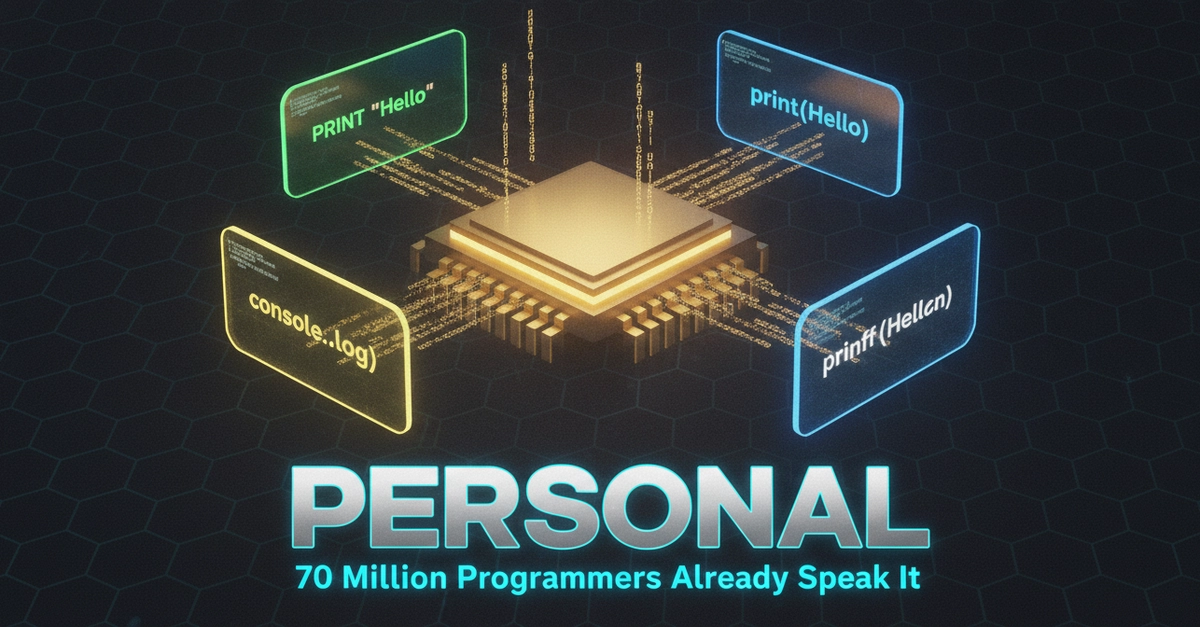
Fast forward to today, and we see a striking parallel emerging. The concept of a "personal" programming language—one that feels intuitive, familiar, and deeply integrated into our daily digital lives—is poised to redefine the programming landscape by 2026. This isn't about learning a new syntax for a niche task; it's about leveraging the tools and interfaces that 70 million developers already implicitly understand and use every day.
Consider the way modern developers interact with their tools. The command line, while powerful, is still a barrier for many. Integrated Development Environments (IDEs) offer more visual and guided experiences, but they often abstract away fundamental concepts. The true innovation for the next era of programming lies not in creating entirely new paradigms, but in refining and extending the *personal* interfaces and workflows that have become second nature.
This is where the idea of a "PERSONAL" language—not a specific product, but a conceptual shift—gains traction. It embodies the principles that made BASIC so successful: immediate feedback, low barrier to entry, and a direct mapping of intent to action. By 2026, we can expect to see a significant push towards programming environments that feel less like alien systems and more like extensions of our own thought processes.
What Does "Programming in 2026" Really Mean?
The notion of "programming in 2026" is not about a single, revolutionary language that will supplant all others. Instead, it signifies a profound shift in how we conceive of and interact with code. The tools and environments of 2026 will likely be characterized by:
- Ubiquitous Personalization: Development environments that adapt to individual user preferences, skill levels, and project contexts. Think of an IDE that suggests code snippets not just based on syntax, but on your past coding patterns and the project's overall architecture.
- Intent-Based Interfaces: Moving beyond explicit commands to more natural language or visual programming metaphors that capture the developer's intent more directly. This could involve describing a desired function and having the system generate or suggest the code.
- Contextual Awareness: Programming tools that understand the broader ecosystem of a project, including dependencies, deployment targets, and collaboration workflows, offering proactive assistance and error prevention.
- Seamless Integration: The lines between application usage and development will blur. Users might discover capabilities within an application that allow them to customize or extend its functionality through intuitive, code-like interactions.
The surprising detail here is not the prediction of a new language, but the assertion that the most impactful advancements will stem from making existing paradigms feel deeply personal and familiar. It’s akin to how the early personal computers didn’t invent new ways to interact with information, but refined existing ones to be accessible to everyone.
The Path Forward: Embracing the Personal
For developers, this means embracing tools that prioritize intuitive interaction and context. It suggests a future where the most powerful programming languages are those that require the least amount of translation from human thought to machine execution. The 70 million developers already fluent in the "language" of their daily digital interactions are best positioned to lead this transition.
By 2026, programming will likely feel less like learning a foreign language and more like an extension of natural human communication, powered by sophisticated, personalized tools. The journey from Altair 8800's physical switches to the seamless, intent-driven interfaces of the near future is a testament to the enduring human desire for accessible creation.