Executive Summary
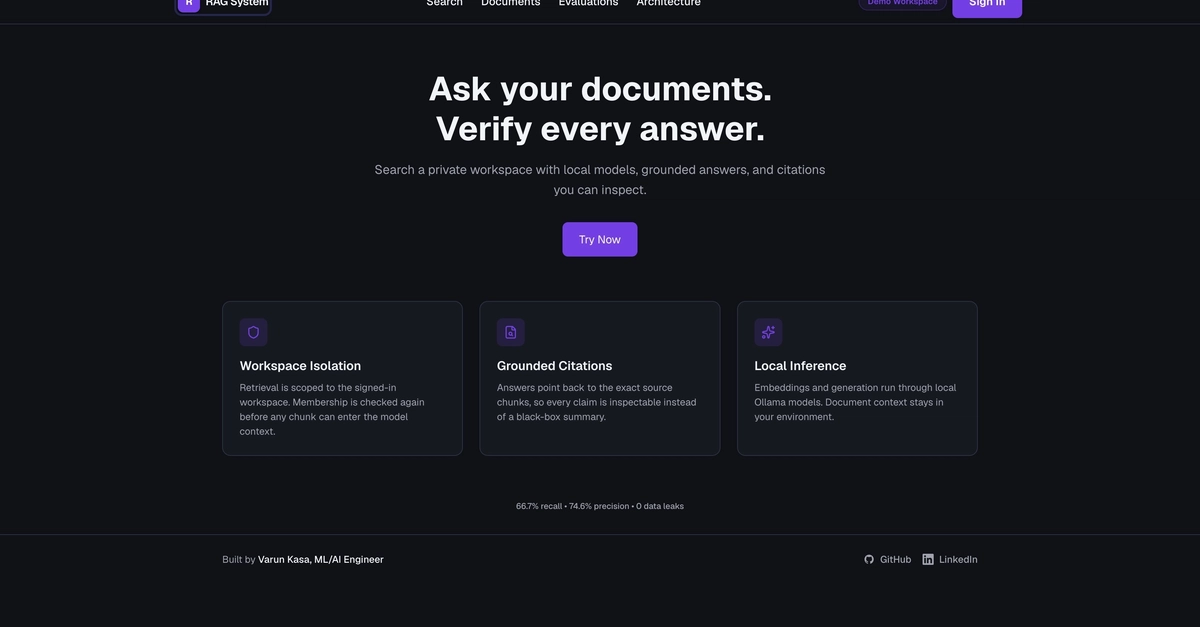
Building Retrieval-Augmented Generation (RAG) systems for production presents significant challenges beyond core model performance. A recently detailed system addresses four critical areas: zero-friction user onboarding, robust enterprise multi-tenancy, scalable hybrid search, and reliable citation validation. This approach moves RAG from experimental to production-ready by solving often-overlooked infrastructure and usability problems.
Zero-Friction Onboarding with Stateless HMAC Cookies
Traditional RAG systems often require users to log in or manage persistent sessions, creating friction. This new system employs stateless HMAC-signed guest cookies for onboarding. These cookies are signed using a secret key, allowing the server to verify their authenticity without needing to store session data. A short Time-To-Live (TTL) of one hour enhances security by limiting the window of opportunity for misuse. The use of timing-safe validation ensures that even if an attacker tries to probe the validation logic, they cannot gain information about the secret key. This method eliminates database overhead for session management, making onboarding seamless for new users.
Enterprise Multi-Tenancy and Workspace Isolation
For enterprise applications, isolating user data and access is paramount. This RAG system implements a layered permission model to achieve robust multi-tenancy. This isolation is enforced at multiple levels:
- Retrieval Layer: Permissions are checked before any data is retrieved. This ensures that only authorized data sources are queried based on the user's context.
- Session Layer: User sessions are isolated, preventing cross-contamination of user states or data.
- Mutation Layer: If the RAG system supports write operations or modifications, these are also subject to strict permission checks, ensuring data integrity.
This comprehensive approach guarantees that each workspace or tenant operates within its defined boundaries, a crucial requirement for enterprise adoption.
Hybrid Search for Scalable Retrieval
Effectively retrieving relevant information at scale often requires more than just vector similarity search. This system implements a hybrid search strategy combining keyword-based search with vector search. Keyword search is powered by PostgreSQL's tsvector functionality, offering efficient full-text search capabilities. Vector search is handled by the pgvector extension, which supports similarity search on embeddings. The results from both keyword and vector searches are then merged using Reciprocal Rank Fusion (RRF). RRF is an algorithm that combines ranked lists from multiple search sources, assigning a higher rank to documents that appear high in multiple lists. This hybrid approach leverages the strengths of both methods, improving retrieval recall and relevance, especially for queries that benefit from exact keyword matches alongside semantic understanding.
Grounded Citations and Validation Pipeline
A key challenge for RAG systems is ensuring that the generated answers are not only relevant but also grounded in the retrieved sources and that these sources are properly cited. This system incorporates a citation validation pipeline designed to address this. The pipeline involves several steps:
- Extraction: Identifying and extracting potential citations from the generated answers.
- Verification: Checking if the cited source actually supports the claim made in the answer. This often involves re-querying the retrieval system or performing targeted checks against the source documents.
- Deduplication: Ensuring that citations are not redundant and that each distinct piece of information is attributed to a single, authoritative source.
In a 15-case evaluation, this pipeline achieved a citation precision of 74.6%, indicating a significant improvement in the trustworthiness of the system's outputs. This focus on citation accuracy is vital for applications where factual correctness and auditability are critical.
Performance Metrics and Future Implications
The system’s performance was evaluated on a 15-case dataset, yielding promising results:
- Retrieval recall: 66.7%
- Citation precision: 74.6%
- Answer correctness: 80%
While retrieval recall could be further improved, the high citation precision and answer correctness demonstrate the system's viability for production deployment. The success of this multifaceted approach highlights the importance of considering the entire RAG pipeline—from user interaction and data isolation to retrieval and output validation—rather than focusing solely on the underlying language model. This holistic engineering effort is what truly enables RAG to operate effectively and reliably at scale in real-world applications.