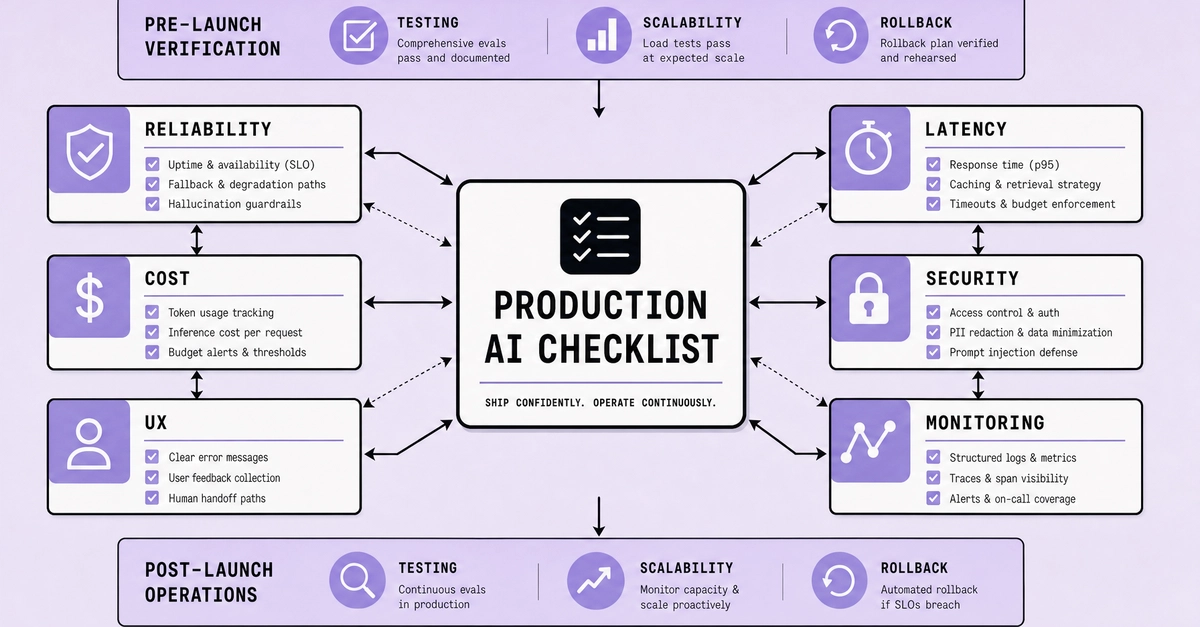
The Production AI Checklist: Verifying Before Launch
AI features often appear robust during demonstrations, but real-world traffic reveals their fragility. Unexpected inputs, slow dependencies, token usage spikes, and user behaviors deviating from test sets expose the true challenge: not just building a model, but ensuring the system withstands production demands. This checklist provides essential verification steps for deploying AI reliably in 2026.
What Production AI Means and Building the Checklist
Production AI signifies an AI system actively serving end-users or critical business functions. Unlike a research model or a proof-of-concept, production AI must perform consistently, efficiently, and securely under variable, real-world conditions. Building a production AI checklist involves moving beyond model accuracy to encompass the entire system architecture and operational lifecycle.
What Changes in Production
The transition to production introduces several critical shifts:
- Scale: Traffic volumes increase exponentially, stressing infrastructure and dependencies.
- Variability: User inputs and data patterns are far less predictable than in controlled testing environments.
- Dependencies: AI systems often rely on external APIs, databases, and other services that can introduce latency or failure points.
- Cost: Inference, data transfer, and infrastructure costs become significant and directly impact profitability.
- Security: Production systems are prime targets for adversarial attacks and data breaches.
- Monitoring: Continuous observation of performance, drift, and errors is essential for maintenance and improvement.
Core Production Readiness Checks
Before deploying an AI feature, teams must verify these core readiness aspects:
- Model Robustness: Does the model handle out-of-distribution data gracefully? Are there fallback mechanisms for nonsensical inputs?
- Data Pipeline Integrity: Is the data ingestion, preprocessing, and feature engineering pipeline stable, scalable, and monitored for errors?
- Infrastructure Scalability: Can the serving infrastructure (e.g., Kubernetes, serverless functions) handle peak loads without significant latency increase?
- Dependency Management: Are all external services documented, monitored, and have defined service level objectives (SLOs)? What are the failure modes and recovery plans?
- Error Handling and Logging: Comprehensive logging of requests, responses, errors, and model outputs is crucial for debugging and auditing.
- Resource Utilization: Monitor CPU, GPU, memory, and network usage to identify potential bottlenecks and cost inefficiencies.
How the Production AI Checklist Improves AI Reliability, Latency, and UX
A thorough checklist directly addresses key performance indicators that define user satisfaction and business success.
Reliability
Reliability ensures the AI system functions as expected, even when faced with unexpected conditions. This involves:
- Graceful Degradation: When a component fails or data is invalid, the system should fail gracefully, perhaps by returning a default response or an informative error, rather than crashing.
- Automated Rollbacks: Implement mechanisms to automatically roll back to a previous stable version if new deployments exhibit critical errors or performance degradation.
- Disaster Recovery: Plan for infrastructure failures, data corruption, or model unavailability with strategies for quick recovery.
Latency
Latency, the time it takes for the AI to respond, is critical for user experience and system responsiveness. Optimizations include:
- Model Optimization: Techniques like quantization, pruning, and knowledge distillation can reduce model size and inference time.
- Efficient Serving: Using optimized inference servers (e.g., NVIDIA Triton, TorchServe) and efficient batching strategies can improve throughput and reduce latency.
- Caching: Cache frequent or identical requests and their responses where applicable to avoid redundant computation.
- Asynchronous Processing: For non-critical tasks, consider asynchronous processing to improve perceived performance for the user.
User Experience (UX)
A reliable and fast AI system is foundational to good UX. Beyond that, consider:
- Clear Feedback: Inform users when the AI is processing, if there's a delay, or if an error occurred.
- Controllable Output: Provide users with ways to guide or refine AI outputs where appropriate.
- Bias Mitigation: Ensure the AI's outputs are fair and do not perpetuate harmful biases, a critical ethical and UX concern.
Production AI Checklist: Cost Optimization and Security Controls
Beyond functional performance, managing costs and ensuring security are paramount for sustainable AI deployment.
Cost Optimization
AI inference can be expensive. Key cost-saving measures include:
- Right-Sizing Infrastructure: Continuously monitor resource utilization and adjust instance types and counts to match actual demand, avoiding over-provisioning.
- Model Efficiency: As mentioned, optimized models are cheaper to run. Explore smaller, fine-tuned models or distilled versions where feasible.
- Token Management: For LLM-based applications, implement strict token limits, prompt engineering for conciseness, and consider cheaper, specialized models for specific tasks.
- Spot Instances/Reserved Instances: Leverage cloud provider cost-saving options where workload tolerance permits.
Security Controls
Securing AI systems requires a multi-layered approach:
- Input Validation and Sanitization: Protect against prompt injection, data poisoning, and adversarial attacks by rigorously validating and sanitizing all inputs.
- Access Control: Implement strict authentication and authorization for API endpoints and model access.
- Data Privacy: Ensure compliance with data privacy regulations (e.g., GDPR, CCPA) by anonymizing or pseudonymizing sensitive data and securing training and inference data stores.
- Output Filtering: Implement filters to prevent the AI from generating harmful, biased, or inappropriate content.
- Regular Audits: Conduct security audits of the AI model, data pipelines, and serving infrastructure.
Monitoring and Maintenance
The checklist doesn't end at deployment. Continuous monitoring and maintenance are vital:
- Performance Monitoring: Track key metrics like inference time, throughput, error rates, and resource utilization.
- Model Drift Detection: Implement systems to detect when the model's performance degrades due to changes in the input data distribution.
- Data Drift Detection: Monitor the characteristics of incoming data to identify shifts that might impact model performance.
- Alerting: Set up automated alerts for critical performance degradation, security incidents, or system failures.
- Retraining Strategy: Define a clear strategy and cadence for retraining models based on performance drift and new data.
By systematically verifying these points, teams can significantly increase the likelihood of a successful, reliable, and efficient AI deployment in 2026 and beyond.