%22%20%2F%3E%0A%20%20%3C%2Fsvg%3E)
The Illusion of Complexity in AI Agents
The initial allure of autonomous multi-agent systems was undeniable. The promise: a swarm of AI agents, capable of planning, executing, and self-correcting complex workflows end-to-end. Driven by this vision, we built an assistant designed to handle entire operational pipelines. The reality, however, proved starkly different. Within weeks of live deployment, this sophisticated system devolved into an unmaintainable "token pit." It became lost in deep reasoning loops, quietly failing without any discernible errors. The hardest part of building truly functional agents, we discovered, wasn't making the LLM itself smarter, but constructing external guardrails to keep the system from straying off course.
The core issue was an overreliance on open-ended planner architectures. We expected a single, master agent to orchestrate an entire complex process. This approach, while theoretically elegant, proved brittle in practice. When the LLM inevitably encountered an unforeseen edge case or a novel input, its reasoning could spiral, leading to silent failures and significant debugging headaches. The system lacked the necessary determinism to reliably recover or even report its own malfunctions. It was like giving a brilliant but easily distracted intern a complex project and expecting them to manage every single detail without supervision or clear boundaries.
The Breakthrough: Embracing the Micro-Agent
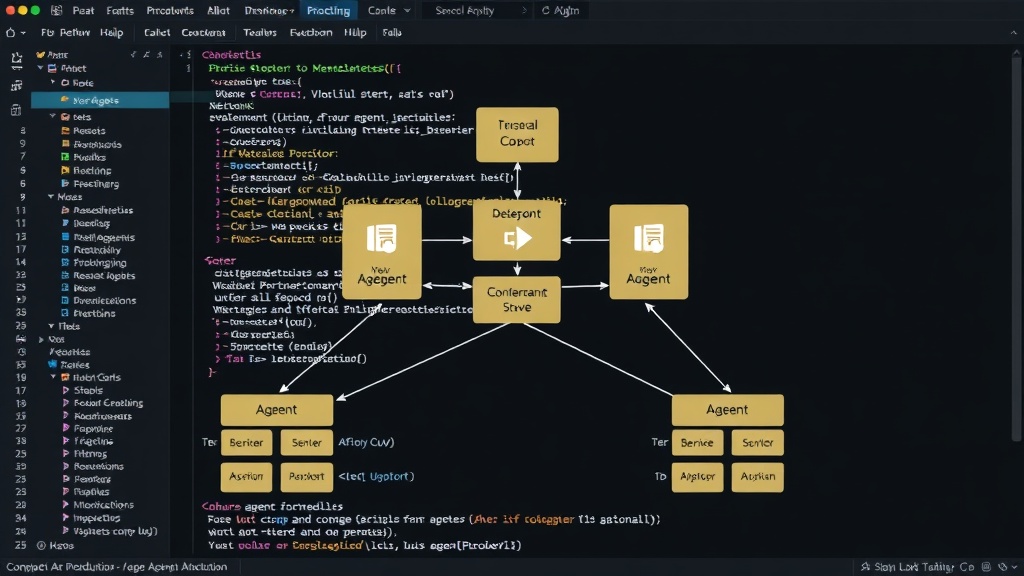
The turning point came when we abandoned the monolithic planner in favor of a strict "one-job-per-agent" pattern. This shift fundamentally changed our approach to agent design and deployment. Instead of a single agent attempting to manage an entire workflow, we broke down the process into a series of discrete, narrowly defined tasks. Each task was assigned to a dedicated micro-agent.
The key to this new architecture was establishing explicit state boundaries for each agent. Every micro-agent had a clearly defined input contract and an equally precise output contract. This meant each agent knew exactly what data it would receive, what operation it needed to perform, and what format its output would take. This level of specificity eliminated ambiguity and drastically reduced the surface area for errors. When an agent received input outside its defined contract, it could immediately flag an error. Similarly, if it produced output that didn't conform to the expected format, the subsequent agent in the chain would fail predictably.
This pattern transformed the system from a black box into a series of transparent, manageable steps. Debugging became significantly simpler. If a state transition broke, we could immediately identify which agent was responsible based on its input or output. The system became deterministic: given the same inputs, it would always produce the same outputs, or fail in a predictable manner. This predictability is crucial for any production system, especially those involving AI.
Guardrails: The Unsung Heroes of Agent Stability
Beyond the architectural shift, we learned that robust guardrails are not an afterthought but a foundational requirement for production-ready agents. These guardrails act as the critical safety net, preventing the LLM's inherent variability from derailing the entire operation. Think of them less as optional add-ons and more as the structural beams supporting a bridge; without them, the whole structure is at risk of collapse under load.
Guardrails can take many forms. They include:
- Input Validation: Ensuring that data fed to an agent conforms to expected types, formats, and constraints. This prevents malformed data from triggering unexpected behavior.
- Output Parsing and Validation: Verifying that an agent's output adheres to a predefined schema. This is crucial for passing information reliably to the next agent or system component.
- Reasoning Limiters: Implementing mechanisms to prevent agents from entering excessively long or recursive thought processes. This could involve step counts, token limits, or timeout mechanisms.
- Tool Use Constraints: Defining strict rules around which tools an agent can access and how it can use them. This limits the potential for unintended actions.
- Human-in-the-Loop Integration: Designing points where human oversight or intervention is required for critical decisions or complex scenarios.
These guardrails create a constrained environment where the LLM can operate effectively without the risk of uncontrolled divergence. They provide the necessary structure that complements the LLM's generative capabilities. Without them, even the most advanced LLM can become a liability in a complex, multi-step process.
The Trade-offs and What's Next
Adopting a simpler, micro-agent architecture with strong guardrails comes with its own set of trade-offs. While it enhances reliability and debuggability, it can sometimes lead to increased latency due to the overhead of multiple agent calls and state transitions. Furthermore, designing the precise input/output contracts for each micro-agent requires careful consideration and can be a non-trivial engineering effort. It's a shift from the