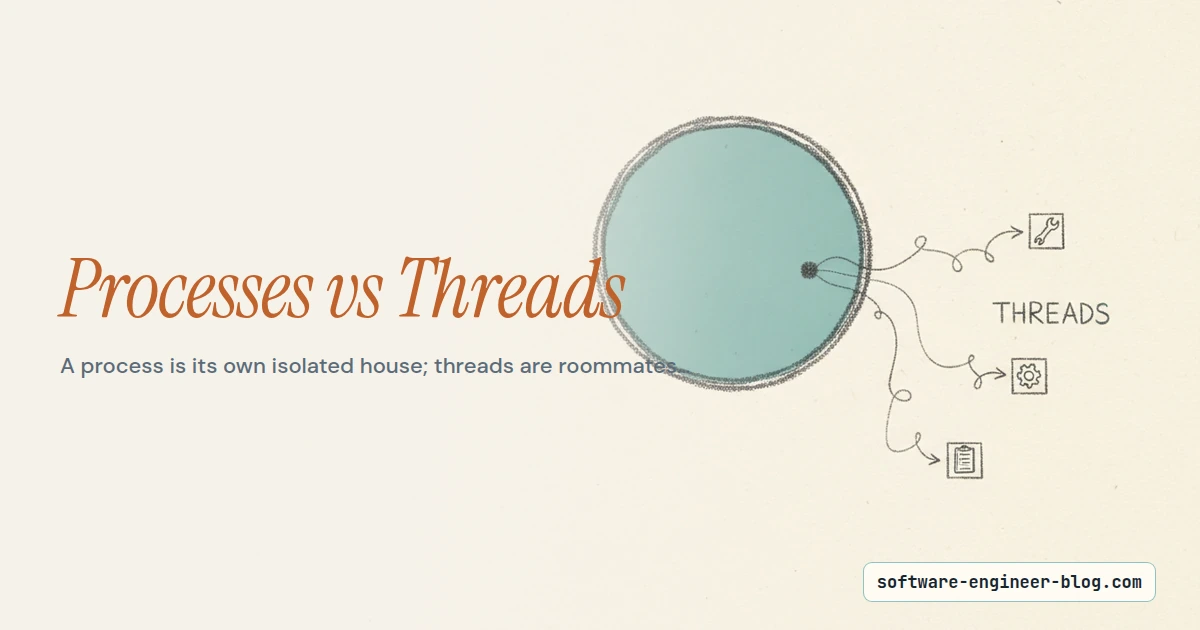
Processes: Isolation at the Cost of Weight
When you start a process, the operating system hands it its own private address space. This means a process cannot directly access the memory of another process. Think of it like separate houses on a street: each has its own utilities, its own walls, and its own set of keys. If one house burns down, it doesn't directly affect the others. In computing terms, this isolation provides robustness. If one process crashes, it generally won't bring down the entire system. The operating system manages these isolated environments.
Creating a new process is a relatively heavyweight operation. The OS has to allocate a new memory space, set up new data structures, and load the program's code. This overhead means that spawning many processes can consume significant system resources, including memory and CPU time for context switching between them. Communication between processes (Inter-Process Communication or IPC) is also more complex. It typically involves mechanisms like pipes, sockets, or shared memory segments, which require explicit setup and synchronization. Data must be explicitly copied or marshaled between the isolated memory spaces.
Threads: Shared Memory, Shared Fate
Threads, on the other hand, live within a single process. They are often described as "lightweight processes." Imagine the process as a single large house, and threads as roommates living inside that house. All roommates share the same address space, meaning they can directly access and modify the same data in memory. This shared memory model makes communication between threads very efficient. They can simply read and write to shared variables without complex IPC mechanisms.
However, this shared nature is also their biggest drawback. If one thread crashes due to an error, it can corrupt the memory space of the entire process. This often leads to the entire process crashing, taking down all other threads within it. It's like one roommate accidentally causing a fire that burns down the entire house. Because threads share resources within a process, creating new threads is much faster and less resource-intensive than creating new processes. Context switching between threads within the same process is also generally quicker because the OS doesn't need to switch memory maps or reload as much state.
Key Differences Summarized
The fundamental divergence lies in resource management and isolation:
- Memory Space: Processes have independent memory spaces; threads share the memory space of their parent process.
- Resource Overhead: Processes are resource-heavy (memory, CPU for creation/switching); threads are lightweight.
- Communication: IPC for processes is complex and slower; thread communication via shared memory is fast and simple.
- Isolation & Stability: Process isolation provides robustness; thread failures can cascade and crash the entire process.
- Data Sharing: Processes require explicit data transfer; threads share data directly.
When to Use Which?
The choice between processes and threads depends heavily on the application's requirements:
Use Processes When:
- Robustness is paramount: You need to ensure that if one part of your application fails, it doesn't bring down everything. Web servers often use multiple processes to handle requests independently.
- Isolation is critical: Different components of your application should not interfere with each other's data or execution state.
- Leveraging multiple CPU cores for independent tasks: For CPU-bound tasks that can be easily parallelized and don't require tight synchronization, separate processes can effectively utilize multiple cores.
Use Threads When:
- Performance and speed are critical: For tasks that require frequent, fast communication and data sharing, threads are more efficient.
- Implementing concurrent operations within a single application: Think of the UI thread in a graphical application, or worker threads that process tasks from a queue.
- Resource constraints are tight: When spawning many concurrent units of work, threads are more economical than processes.
- Tasks are I/O-bound: Threads are excellent for handling I/O operations (like network requests or disk reads) where they can yield the CPU while waiting, allowing other threads to run.
The surprising detail here is not the technical distinction, but how often developers neglect this fundamental choice. Many systems end up with a mix, but understanding the trade-offs is essential for building scalable and stable software.
The Browser Analogy
A helpful analogy is to consider a web browser. Each tab you open in a modern browser is typically a separate process. If a JavaScript error or a crash occurs in one tab, that tab becomes unresponsive, but the other tabs and the browser itself continue to function. This isolation prevents a single misbehaving webpage from crashing your entire browsing session. This is a prime example of using processes for stability. However, within a single tab, the browser uses threads to manage different aspects of rendering the page, handling network requests for resources, and executing JavaScript code concurrently. This internal threading allows the tab to remain responsive even while downloading images or running complex scripts.
The Future and Hybrid Models
Modern operating systems and programming languages offer sophisticated ways to manage both processes and threads. Concepts like thread pools, process managers, and asynchronous programming models abstract away some of the low-level complexities. However, the underlying principles of isolation versus shared resources remain. Developers must still make conscious decisions about how to structure their concurrent applications. The decision impacts not only performance but also the maintainability and robustness of the software. What nobody has addressed yet is how the increasing prevalence of serverless architectures and microservices will further blur the lines or necessitate new paradigms for managing concurrency at scale, potentially abstracting these choices even further from the developer.