
Dynamic AI Performance Throttling at the Hardware Level
Researchers at Princeton University have introduced a novel set of hardware mechanisms designed to dynamically control and limit the performance of Artificial Intelligence (AI) workloads at runtime. This approach, detailed in their technical paper "Hardware Mechanisms to Dynamically Throttle AI Performance," targets the GPU memory subsystem, offering granular control over critical parameters like capacity, bandwidth, and latency. The goal is to provide fine-grained management of AI performance directly within the hardware, moving beyond software-based solutions that can be less efficient or more complex to implement.
The proliferation of AI models and their increasing computational demands place immense pressure on hardware resources. While raw performance is often the primary objective, there are numerous scenarios where dynamic throttling becomes essential. These include power management, thermal regulation, ensuring fairness in shared computing environments, and preventing denial-of-service attacks that exploit resource exhaustion. Traditional methods for throttling AI performance often rely on software-level interventions, such as limiting batch sizes, reducing precision, or modifying model architectures. However, these software approaches can incur significant overhead, require deep integration with specific AI frameworks, and may not always achieve the desired level of control or efficiency.
Princeton's proposed solution shifts the control plane to the hardware itself. By exposing a set of "microarchitecture knobs," the researchers enable dynamic adjustments to the hardware's resource allocation and operational characteristics. This direct hardware control promises a more immediate, efficient, and robust way to manage AI performance. The focus on the GPU memory subsystem is particularly significant, as memory bandwidth and latency are often critical bottlenecks for AI workloads, especially for large models and complex data processing tasks.
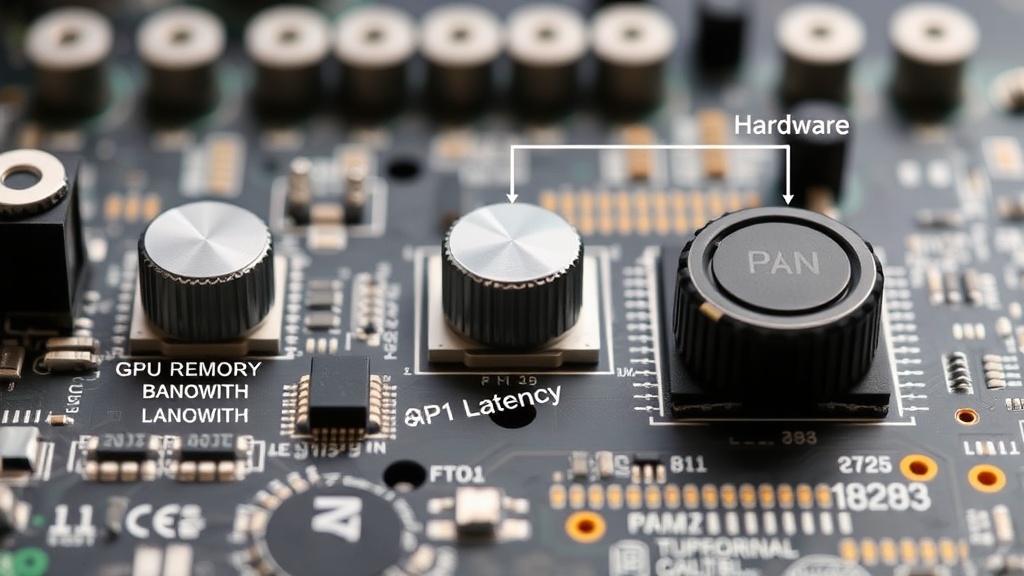
Targeting Key GPU Memory Subsystem Parameters
The paper identifies several candidate "knobs" within the GPU memory subsystem that can be manipulated to throttle AI performance. These include:
- Capacity: Adjusting the effective cache sizes or the amount of memory available to a specific AI task. This can limit the size of models or data that can be processed, thereby controlling computational throughput.
- Bandwidth: Dynamically limiting the rate at which data can be transferred between the GPU cores and the memory. Reducing memory bandwidth directly constrains the flow of data, which is often a limiting factor in AI computation.
- Latency: Increasing the time it takes for memory operations to complete. Higher memory latency can force GPU cores to wait for data, effectively slowing down execution without necessarily reducing peak bandwidth.
By offering control over these fundamental parameters, the hardware mechanisms can exert a powerful influence over the overall performance of AI workloads. This is akin to having precise dials to control the water pressure and pipe diameter in a complex irrigation system, rather than just being able to turn the main valve on or off. The ability to fine-tune these aspects allows for a more nuanced and efficient form of performance management.
Implications for AI Deployment and Management
The implications of this research are far-reaching for the deployment and management of AI systems. For cloud providers and data center operators, these hardware knobs could enable more efficient resource utilization and better Quality of Service (QoS) guarantees. Imagine a scenario where multiple AI inference jobs are running concurrently on the same GPU. Without dynamic throttling, a single demanding job could starve others of resources, leading to inconsistent performance. With hardware-based throttling, operators could allocate specific performance envelopes to each job, ensuring predictable and fair resource distribution. This is particularly relevant for edge AI deployments where power and thermal constraints are often severe.
Furthermore, this approach could enhance the security posture of AI systems. Malicious actors sometimes attempt to overload AI hardware through resource-intensive queries, a form of denial-of-service attack. By dynamically throttling the performance of suspicious or excessively demanding workloads at the hardware level, systems can become more resilient to such attacks without requiring complex, high-level intrusion detection systems. This provides a foundational layer of defense that is harder to bypass.
The research also opens avenues for energy efficiency. AI training and inference are notoriously energy-intensive. By dynamically reducing performance to the minimum required level for a given task or during periods of lower demand, significant power savings can be achieved. This is crucial for sustainability and for extending the operational life of battery-powered edge devices.
The Unanswered Question: Standardization and Adoption
While the technical merits of hardware-based dynamic throttling are clear, a significant question remains: how will this technology be standardized and adopted by hardware manufacturers and AI developers? Implementing these microarchitecture knobs requires close collaboration between GPU designers and those developing AI hardware architectures. The success of this research will ultimately depend on its integration into mainstream GPU designs and the development of intuitive APIs or control interfaces that allow AI frameworks and system administrators to leverage these capabilities effectively. Without widespread adoption and standardization, these powerful controls risk remaining a niche academic innovation.
The potential for dynamic, hardware-level control over AI performance represents a significant step forward in managing the complex computational demands of modern AI. As AI systems become more ubiquitous, the need for efficient, secure, and controllable hardware will only grow, making Princeton's research a timely and important contribution to the field.