The PR Bottleneck Problem
Engineering teams frequently encounter a critical bottleneck: the pull request (PR) review process. As the number of open PRs balloons past 40, senior engineers can spend a third of their week simply reading code diffs. This delays feature releases, increases developer burnout, and often results in unnecessary review cycles for code that is already sound. The core issue isn't the complexity of the code, but the sheer volume of manual review required.
To combat this, PRForge, an AI code review agent, has been developed. It aims to automate the initial triage and approval of PRs, allowing human reviewers to focus on more complex or risky changes.
Introducing PRForge: AI-Powered Code Review
PRForge functions as an AI agent designed to review pull requests the moment they are opened. Its primary goal is to process these requests in under 60 seconds and automatically merge those that meet predefined quality and safety rules. This is a significant departure from many existing tools that are often limited to specific platforms like GitHub.
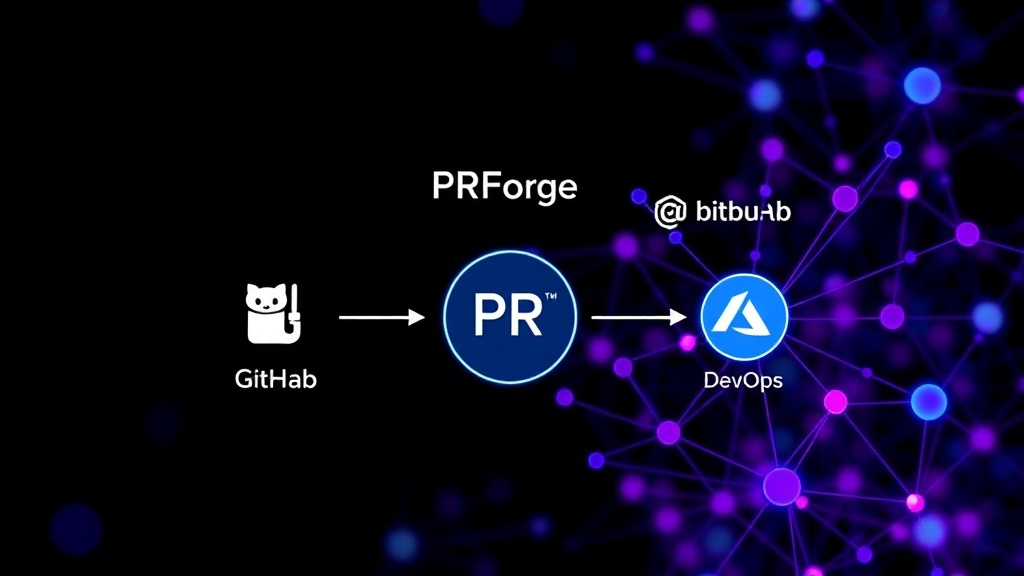
PRForge boasts cross-platform compatibility, supporting GitHub, GitLab, Bitbucket, and Azure DevOps. This broad integration allows it to serve a wider range of development workflows and toolchains.
Key Features and Workflow Integration
PRForge introduces several features to streamline the PR process:
Risk Badges
Upon opening a PR, PRForge assigns a risk score, visualized as a badge: Green, Amber, or Red. Green-merged PRs are automatically merged into the main branch without human intervention. Amber-flagged PRs are flagged for human review, indicating a need for closer inspection. Red-flagged PRs are blocked from merging until a human reviewer has explicitly approved them. This system provides immediate clarity on what requires developer attention.
AI Summaries
Beyond simply detailing code changes, PRForge generates AI-powered summaries. These summaries explain the purpose of the changes, their potential impact, and specific areas that warrant attention from human reviewers. This contextual information helps reviewers understand the PR more quickly and effectively.
Automated Merging
The system is configured with quality rules. When a PR meets these criteria—demonstrating low risk, passing automated tests, and adhering to coding standards—PRForge can automatically merge it. The developers report that this process successfully merges approximately 70% of all PRs, drastically reducing the manual review burden.
Automated Testing Integration
PRForge integrates with CI/CD pipelines to ensure that automated tests have passed before considering a PR for merging. This layer of automated verification is crucial for maintaining code quality and stability.
Customizable Rules
Teams can customize the rules that govern PRForge’s behavior. This includes defining what constitutes a 'Green' PR eligible for auto-merge, setting thresholds for risk scores, and specifying which types of changes should always require manual review. This flexibility ensures that PRForge can be adapted to the specific needs and risk tolerance of different engineering teams.
The Impact on Engineering Workflows
The primary benefit of PRForge is the significant reduction in time engineers spend on manual code reviews. By automating the review of low-risk, straightforward changes, developers can reallocate their time to more strategic tasks, feature development, or complex problem-solving. This not only improves productivity but also helps mitigate burnout associated with repetitive review tasks.
The immediate feedback loop provided by PRForge—instant risk assessment and potential auto-merge—also accelerates development cycles. Features can be integrated and deployed faster, improving time-to-market. For teams struggling with review backlogs, PRForge offers a tangible solution to improve throughput and developer morale.
The surprising detail here is not the AI's ability to detect issues, but its capacity to reliably identify code that is safe to merge. This moves beyond simple linting to a more sophisticated understanding of code quality and risk, enabling the automation of a process previously thought to require human judgment for all but the most trivial changes.
What nobody has addressed yet is the long-term impact on code quality and architectural consistency. While PRForge can enforce current rules, will it inadvertently stifle innovation or prevent the introduction of novel, albeit initially unconventional, solutions that might later prove superior? The reliance on predefined rules could create a subtle pressure towards conformity, potentially at the expense of architectural evolution.
Future Implications
PRForge represents a shift towards greater automation in the software development lifecycle. As AI models become more sophisticated at understanding code context and intent, tools like PRForge could become standard in development workflows. This could lead to faster release cycles, improved developer experience, and a redefinition of the role of human code reviewers, shifting their focus from routine checks to architectural guidance and complex problem-solving.