The Hidden Cost of Reactive Support
Technical support teams often operate under the dangerous illusion that they can handle escalations as they arise. Gartner reports that mid-size enterprises lose an average of $4.2 million annually due to preventable Service Level Agreement (SLA) violations. This reactive model, where breaches are discovered only after customer churn or formal complaints, erodes trust and incurs significant financial penalties. The reality is that when ticket volume surges, this reactive approach crumbles, leaving teams overwhelmed and unable to meet commitments. The core problem nobody wants to admit is that this strategy is fundamentally unsustainable.
The traditional approach to SLA management is reactive. Support teams focus on closing tickets as quickly as possible, often without a clear view of how individual tickets contribute to an overall SLA risk. This leads to a situation where a team might be hours, or even days, away from breaching a critical SLA without realizing it. The cost isn't just financial; it's also the damage to customer relationships and brand reputation. Imagine a scenario where a critical support ticket is on track to miss its 24-hour response SLA, but the team only notices when there are 2 hours left. By then, it's often too late to expedite effectively without compromising quality or overloading other agents.
Shifting to Proactive SLA Management
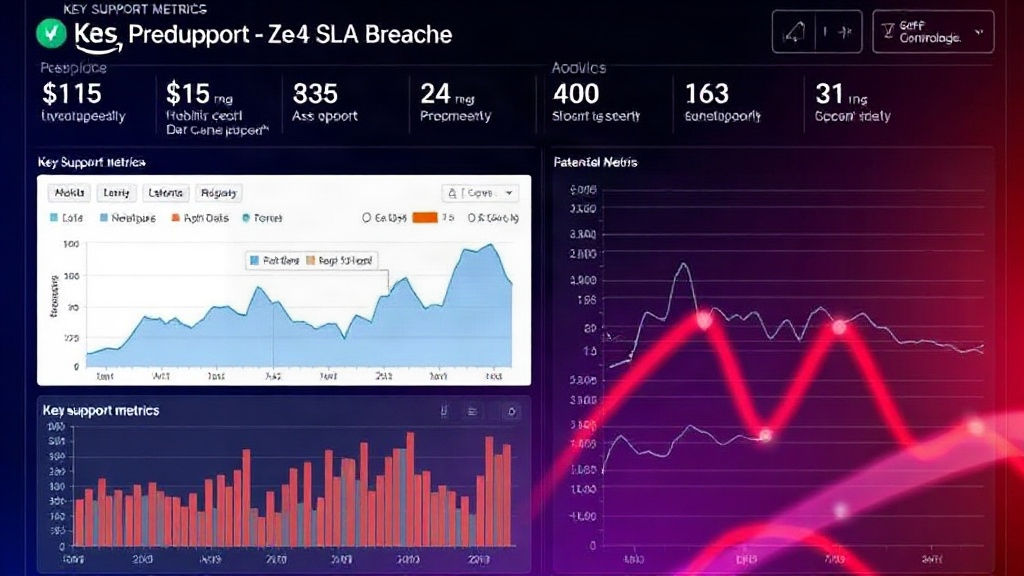
The future of technical support lies in proactive, predictive analytics. Instead of waiting for breaches to occur, teams can leverage data to anticipate them. This shift requires a fundamental change in mindset and tooling, moving from simply tracking ticket resolution times to actively forecasting potential failures. Predictive models can analyze historical data, ticket characteristics, agent availability, and even external factors to estimate the probability of an SLA breach for any given ticket or group of tickets.
This predictive capability allows support operations to move from a state of constant crisis management to one of strategic intervention. When a ticket is flagged as having a high probability of breaching an SLA, the system can trigger alerts. These alerts can prompt supervisors to reassign tickets, allocate additional resources, or provide targeted assistance to the agent handling the ticket. This isn't about micromanagement; it's about empowering the team with foresight. Think of it less like a strict manager looking over your shoulder, and more like a highly intelligent assistant who gently nudges you when a potential problem is on the horizon, offering solutions before the problem becomes critical.
Key Components of a Predictive SLA System
Building an effective predictive SLA system involves several key components:
Data Collection and Integration
The foundation of any predictive model is robust data. This includes:
- Ticket Data: Creation time, assignment, status changes, priority, category, customer, resolution time, agent involved.
- Agent Data: Availability, workload, performance history, skill sets.
- SLA Policies: Response time, resolution time, uptime guarantees, specific service tiers.
- Customer Data: Account value, historical support interactions, product usage patterns.
- External Factors (Optional but valuable): System outages, known bugs, peak usage periods.
Integrating these data sources into a central platform is crucial. This often requires APIs to connect your CRM, ticketing system, HR tools, and potentially monitoring platforms.
Feature Engineering
Raw data is rarely sufficient. You need to engineer features that capture the nuances of support operations. Examples include:
- Time since ticket creation.
- Number of unread replies.
- Average response time for similar tickets.
- Agent's current backlog size.
- Customer's historical SLA adherence.
- Time of day and day of week (to capture peak loads).
The goal is to create variables that are highly correlated with SLA breaches.
Machine Learning Models
Various machine learning algorithms can be employed for prediction. Common choices include:
- Logistic Regression: Good for binary classification (breach/no breach) and provides interpretable coefficients.
- Random Forests/Gradient Boosting Machines (e.g., XGBoost, LightGBM): Powerful ensemble methods that can capture complex, non-linear relationships and handle a large number of features. They are often top performers in such tasks.
- Time Series Models (e.g., ARIMA, LSTM): Useful if predicting future load or trends that impact SLA adherence over time.
The choice of model depends on the data volume, complexity, and the desired interpretability versus predictive accuracy trade-off. For predicting individual ticket breaches, classification models are typically preferred.
Thresholding and Alerting
Once a model predicts the probability of a breach, a threshold must be set. For instance, any ticket with a >70% probability of breaching its SLA within the next X hours might trigger an alert. These alerts should be actionable, providing context to the support manager or lead. This might involve displaying the ticket ID, the predicted breach time, the SLA at risk, and the key factors contributing to the prediction (e.g., high priority, agent overload, long time since last response).
Implementing Predictive Analytics: A Practical Guide
Adopting a predictive SLA system isn't an overnight transformation. It requires a phased approach:
1. Define Your Goals and KPIs
What specific SLAs are you trying to protect? What are the key metrics you want to improve (e.g., reduction in SLA breaches, faster average response time for high-risk tickets)?
2. Assess Your Data Infrastructure
Can you access and consolidate the necessary data? Do you have the tools for data warehousing and analysis? If not, this might be the first hurdle to address.
3. Start with a Pilot Program
Select a specific team, a subset of critical SLAs, or a particular product line for an initial pilot. This allows you to test your models, gather feedback, and refine your approach with lower risk.
4. Choose Your Tools
You can build a custom solution using open-source ML libraries (like scikit-learn, TensorFlow) and data platforms (like Snowflake, BigQuery). Alternatively, several commercial platforms offer predictive support analytics capabilities. The decision depends on your in-house expertise and budget.
5. Train, Deploy, and Iterate
Train your initial models on historical data. Deploy them to provide predictions and alerts. Crucially, establish a feedback loop. Monitor the accuracy of your predictions, retrain your models periodically with new data, and adjust thresholds and features based on real-world performance and operational changes.
The Unanswered Question: Agent Buy-In
While the technical aspects of predictive SLA management are complex, the human element often presents the greatest challenge. What nobody has adequately addressed yet is how to ensure agent buy-in and prevent these systems from being perceived as surveillance tools. Successful implementation hinges on framing these predictions as support for agents, not as a judgment of their performance. Transparency about how the system works and how alerts are used to provide assistance, rather than punishment, is paramount. Without agent trust and adoption, even the most sophisticated predictive model will fail to achieve its potential.
Conclusion: The Proactive Imperative
The shift from reactive to proactive technical support is no longer a luxury; it's a necessity for any organization serious about customer satisfaction and operational efficiency. By embracing predictive analytics, businesses can transform their support operations from a cost center prone to costly violations into a strategic asset that anticipates needs and safeguards customer relationships. The investment in data, technology, and process change will yield significant returns in reduced costs, improved customer loyalty, and a more resilient support infrastructure.