The Problem: The "Tech Neck" Epidemic
Developers, writers, and anyone spending hours in front of a screen know the feeling: a persistent ache in the neck, a tightening in the shoulders, and a general sense of physical fatigue that goes beyond mental exhaustion. This is the ubiquitous "Tech Neck," a modern ailment characterized by poor posture—specifically, the cervical spine misalignment that occurs when the head juts forward. It’s not just uncomfortable; it’s a silent productivity killer and a long-term health concern.
Traditional solutions often involve ergonomic assessments, physical therapy, or simply remembering to sit up straight—all of which require conscious effort and can be easily forgotten in the heat of coding or deep work. The challenge lies in providing a constant, gentle reminder that doesn’t interrupt workflow but actively guides users toward healthier habits.
Introducing PostureGuard: A Real-Time Vision Solution
PostureGuard emerges as a novel solution, aiming to tackle "Tech Neck" head-on by transforming a standard desktop computer into a vigilant posture coach. Developed as a lightweight, real-time monitoring tool, it employs advanced computer vision techniques to detect and correct poor posture. The core innovation lies in its ability to perform this analysis efficiently, making it accessible even without high-end hardware.
At its heart, PostureGuard utilizes Google’s MediaPipe framework, specifically its blazepose model. This model excels at real-time pose estimation, capable of identifying key landmarks on the human body, including those critical to cervical spine alignment. The surprising efficiency of blazepose is a key differentiator; it’s designed to run inference on a standard CPU, eliminating the need for a powerful GPU. This allows PostureGuard to operate as a background utility, constantly observing your posture without hogging system resources.
The application is built using Electron, a framework that enables the creation of cross-platform desktop applications using web technologies like HTML, CSS, and JavaScript. This choice of technology stack makes PostureGuard accessible to a wide range of users and simplifies its development and deployment. By combining MediaPipe’s AI capabilities with Electron’s cross-platform reach, PostureGuard offers a practical, user-friendly approach to posture correction.
How It Works: Behind the Scenes
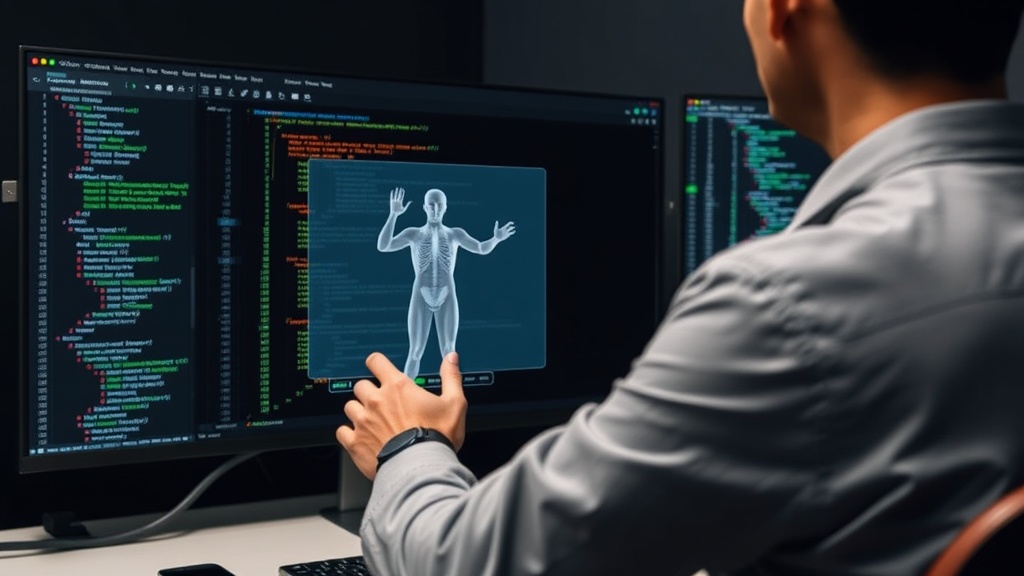
The technical architecture of PostureGuard is designed for both performance and accessibility. The process begins with capturing video input, typically from a webcam. This video stream is then fed into the MediaPipe blazepose model. The model processes each frame, extracting skeletal landmarks and their 3D coordinates. For posture analysis, the critical landmarks are those related to the head, neck, and upper spine.
By analyzing the relative positions of these landmarks, PostureGuard can calculate metrics indicative of poor posture. For instance, it can measure the forward displacement of the head relative to the shoulders or the angle of the cervical spine. When these metrics exceed predefined thresholds—signaling a slouching posture—the application triggers a notification.
These notifications are designed to be gentle nudges rather than jarring interruptions. The system communicates this feedback through a WebSocket connection, enabling real-time interaction between the pose estimation engine and the user interface. This allows for immediate alerts without taxing the main processing thread. The result is a seamless experience where users are subtly reminded to adjust their posture before the habit becomes ingrained or discomfort sets in.
Beyond Basic Detection: The Value Proposition
What sets PostureGuard apart is its focus on practicality and performance. Many sophisticated AI vision projects demand significant computational power, often requiring dedicated GPUs. This high barrier to entry makes them unsuitable for background utility applications. PostureGuard circumvents this by leveraging MediaPipe’s highly optimized blazepose model. This allows the application to run smoothly on typical developer laptops and workstations, making advanced posture monitoring accessible to anyone.
Furthermore, the use of OpenCV, a widely adopted library for computer vision tasks, ensures robust image processing capabilities. While the core pose estimation is handled by MediaPipe, OpenCV can be used for pre-processing frames or visualizing the pose data, although PostureGuard's architecture prioritizes minimal overhead. The integration of these libraries within an Electron framework results in a self-contained desktop application that is easy to install and use.
The development team behind PostureGuard highlights that the goal is not to replace professional medical advice but to provide a tool that promotes healthier daily habits. For developers, whose livelihoods depend on sustained focus and comfort, maintaining good posture can directly impact their well-being and productivity. PostureGuard offers a proactive, technology-driven approach to mitigating the physical tolls of prolonged screen time.
The Future of Posture Monitoring
PostureGuard represents a significant step forward in making AI-powered health and wellness tools accessible for everyday use. By demonstrating that sophisticated computer vision tasks can be performed efficiently on standard hardware, it opens doors for numerous other applications. Imagine similar tools for monitoring eye strain, hand positioning for repetitive strain injuries, or even basic health indicators during long work sessions.
The underlying principles—leveraging lightweight AI models, cross-platform frameworks, and real-time feedback loops—are broadly applicable. As AI models continue to become more optimized and efficient, we can expect to see a proliferation of these intelligent desktop companions, enhancing not just productivity but also the overall health and comfort of users in the digital age.
What nobody has addressed yet is the long-term psychological impact of constant, automated feedback on personal habits. Will users become overly reliant on the software, or will it genuinely foster intrinsic self-correction and awareness? Only time and user adoption will tell.