Understanding B+Tree Indexes and Their Challenges
Databases worldwide rely heavily on B+tree indexes to accelerate data retrieval. These structures organize data in a sorted, hierarchical manner. At the leaf level, pages contain the actual data entries, sorted by key. When you query for a specific value, the database navigates from the root node, through internal nodes that guide the search based on key ranges, down to the correct leaf page. This process ensures that finding an entry, or determining its absence, is efficient. The cost of a lookup is directly proportional to the height of the tree, as each level adds a disk I/O or memory access.
A core operation in B+trees is page splitting when a node becomes full, which can lead to the addition of a new level at the top, increasing the tree's height. Conversely, deleting data can lead to pages becoming sparsely populated. While many B+tree implementations handle deletions by marking pages as empty or by merging them, this can leave the tree structure inefficient over time. In systems like Oracle, such inefficiencies might necessitate manual intervention, such as rebuilding indexes, to reclaim space and reduce tree height. This is where PostgreSQL's approach, particularly its 'fast root' optimization, offers a distinct advantage.
PostgreSQL's Fast Root: A Proactive Deletion Strategy
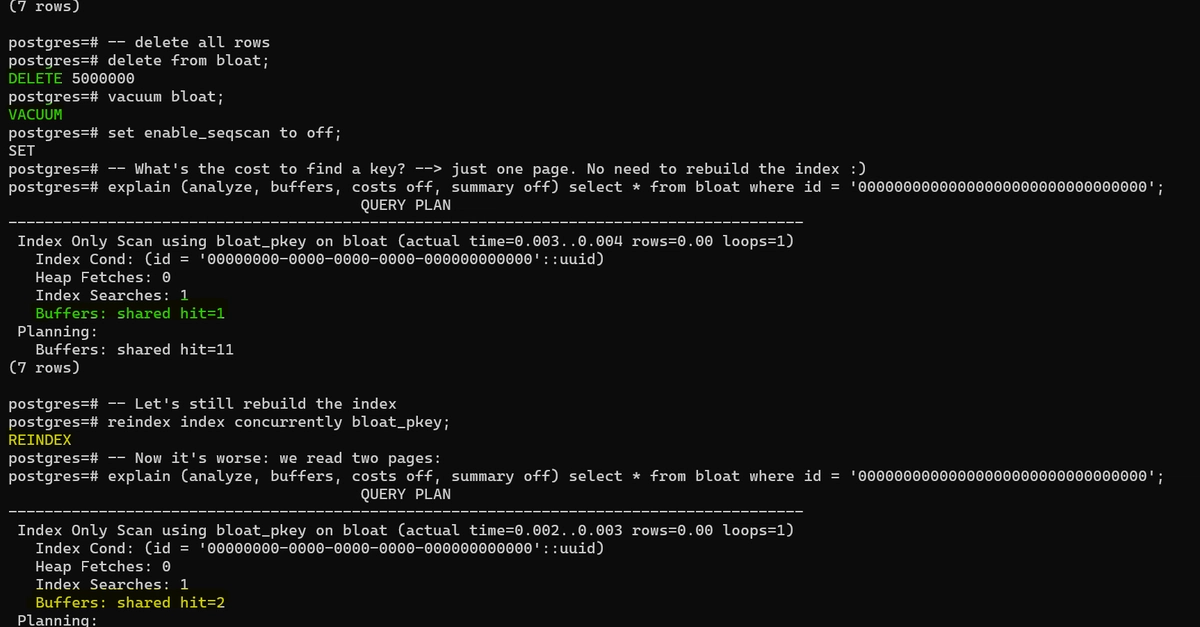
PostgreSQL employs a clever strategy to manage B+tree height, especially after numerous deletions. Unlike systems that might let index structures degrade and require manual cleanup, PostgreSQL's 'fast root' feature aims to maintain optimal performance automatically. The core idea behind fast root is to prevent the tree from growing unnecessarily tall after deletions, and to actively reduce height when possible.
When a page is deleted and becomes nearly empty, PostgreSQL doesn't just leave it there to contribute to an inflated tree height. Instead, it can promote a sibling page to take its place, effectively removing a level of indirection. This means that the internal node that previously pointed to the now-empty page can be updated to point directly to the promoted sibling. The 'fast root' optimization specifically targets the root node. If the root node becomes empty or can be effectively replaced by one of its children, PostgreSQL will promote a child node to become the new root. This process directly reduces the height of the B+tree by one level. For a deep tree, even a single level reduction can significantly impact query performance, as it means fewer disk reads or memory accesses are needed to reach the target leaf page.
Performance Implications of Fast Root
The benefits of the fast root optimization are most pronounced in workloads that involve frequent deletions or updates that trigger page splits and subsequent deletions. Consider an application that processes a large volume of transactions, such as an e-commerce platform during a sale, where orders are created and then later marked as fulfilled or cancelled. These operations can lead to significant churn within the index pages.
Without fast root, a tree that has undergone many deletions might retain an unnecessary height. A lookup that should ideally take 3 levels might, in a less optimized system, still require 4 or 5 levels because the internal nodes are still pointing to empty or near-empty leaf pages that could have been consolidated. This extra traversal adds latency. PostgreSQL's fast root mechanism mitigates this by actively trimming the tree's height whenever possible. This means that queries, especially those that previously would have been slowed by an inflated tree structure, will now resolve faster.
The effect is akin to decluttering a physical filing cabinet. If you remove many files, you might end up with empty folders and drawers. If you don't reorganize, finding what you need might still involve opening all the same drawers, even the empty ones. PostgreSQL's fast root is like automatically consolidating those empty folders and drawers, making the entire cabinet shallower and quicker to navigate.
Comparison with Other Database Systems
While B+trees are a universal concept, their implementation details and maintenance strategies vary. Oracle, for example, often requires manual index rebuilds or `coalesce` operations to address index fragmentation and height issues caused by deletions. These manual interventions can be resource-intensive and require careful scheduling to minimize downtime. PostgreSQL's automated 'fast root' feature represents a more proactive and integrated approach to index maintenance. It aims to keep the index structure lean and efficient without requiring explicit user commands, which is a significant operational advantage for database administrators and developers.
This difference highlights a broader trend in database design: moving towards more automated and intelligent maintenance of data structures. By embedding such optimizations directly into the database engine, PostgreSQL reduces the burden on users and ensures more consistent performance over time, even under heavy write and delete loads.
When Does Fast Root Trigger?
The 'fast root' optimization is not a constant operation. It is typically triggered when specific conditions are met during delete operations. When a leaf page becomes empty after a delete, PostgreSQL checks if its parent (an internal node) can be modified. If the parent node has only one remaining child page after the deletion, it becomes redundant. In such cases, the database can promote the remaining child page to become the new root of the B+tree. This process is efficient because it involves updating pointers rather than complex page reorganizations across the entire tree. The key is that the parent node must have only one child left for this optimization to be applied cleanly at the root level.
This mechanism ensures that the tree height is kept to a minimum required for the current data distribution, preventing the exponential growth of lookup costs associated with deep, fragmented trees. For developers and database administrators, this means less worry about index bloat and more predictable query performance, especially in applications with dynamic data.