PostgreSQL's Uniqueness Strategy: A Deep Dive
The concept of uniqueness in relational databases is fundamental, ensuring data integrity and preventing duplicate records. While most developers understand that unique constraints and indexes enforce this, the underlying mechanisms can differ significantly between database systems. Jonathan Lewis's recent discussion on savepoints brought to light a key distinction in how PostgreSQL handles uniqueness compared to Oracle. The core difference lies in PostgreSQL's reliance on heap tuple visibility for enforcing uniqueness, a mechanism that contrasts with Oracle's more direct index-based approach.
In Oracle, uniqueness is primarily enforced at the index level. When a unique index is created, the database ensures that no two entries in the index B-tree share the same key. If a duplicate key value is encountered during an insert or update, the operation fails. Even for non-unique indexes, Oracle appends a ROWID (a physical address of the row) to the index entry. This ROWID, by its nature, is always unique, thereby ensuring that each entry in the index, even with duplicate logical keys, is physically distinct. This means Oracle's indexes inherently guarantee distinctness at the index entry level.
The PostgreSQL Approach: TID and Visibility
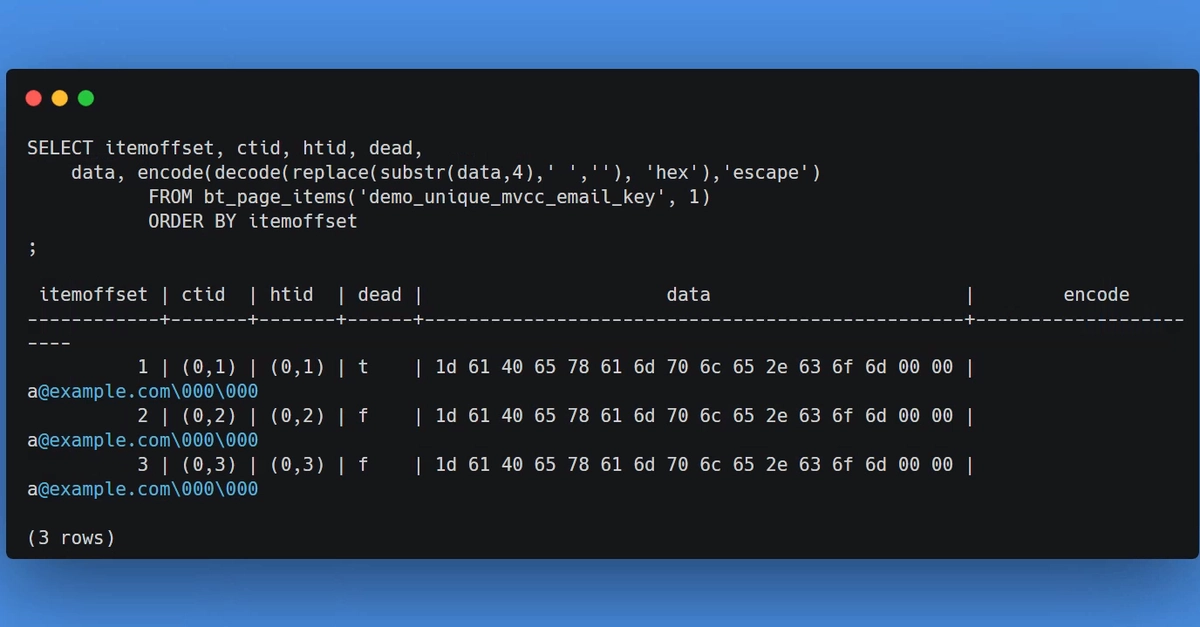
PostgreSQL takes a different path. When you create a unique index in PostgreSQL, or when a unique constraint implicitly creates one, the index entries are not inherently unique based on the logical key alone. Instead, PostgreSQL appends a TID (Tuple Identifier) to the index key. A TID is a physical pointer to the row's location on disk, similar in concept to Oracle's ROWID. This means that multiple index entries can have the exact same logical key values, provided they point to different TIDs.
The actual enforcement of uniqueness in PostgreSQL, therefore, doesn't solely rest on the index's structure. It relies on a combination of the index and the database's visibility map and transaction isolation mechanisms. When a new row is inserted or an existing one updated, PostgreSQL checks the index for potential duplicates. If it finds entries with the same logical key, it then examines the TID associated with those entries. Crucially, it also checks the visibility status of the rows pointed to by those TIDs. A row is considered visible if it has not been deleted or marked for deletion by an active transaction that would prevent its observation.
This visibility check is the linchpin. Even if an index entry with the same logical key exists, if the row it points to is not visible to the current transaction (e.g., it's a stale row from a previous transaction that has since been updated or deleted), the new entry is considered unique in the context of the current operation. Conversely, if the index points to a visible row with the same logical key, the uniqueness constraint is violated, and the operation is rejected.
Implications for Developers and DBAs
This difference has several practical implications. For developers, understanding this behavior can be crucial when debugging unexpected data integrity issues or optimizing queries. While the end result – preventing duplicates – is the same, the path taken by the database differs. In PostgreSQL, an index might appear to have duplicate logical keys, but this is by design and is resolved by the TID and visibility checks during query execution or constraint enforcement.
For database administrators (DBAs), this means that vacuuming and transaction management become even more critical in PostgreSQL, especially in high-concurrency environments. The visibility map, which tracks which pages contain only visible tuples, is essential for efficient vacuuming and for the database to quickly determine tuple visibility. Stale or dead tuples that are not properly cleaned up can, in theory, interfere with uniqueness checks if not handled correctly by the visibility system. However, PostgreSQL's MVCC (Multi-Version Concurrency Control) architecture is designed to manage this complexity effectively.
The comparison also highlights a broader philosophical difference in database design. Oracle's approach is more about enforcing uniqueness at the point of insertion via the index structure itself. PostgreSQL, while using indexes as a primary lookup tool, delegates the ultimate decision of uniqueness to a combination of the index lookup and the transactional visibility of the data it points to. This allows for a more flexible internal representation of data, where the index might not always be a perfect mirror of logical uniqueness but rather a pointer to potential candidates that are then validated against the actual data state.
Performance Considerations
From a performance perspective, both systems aim for efficiency. Oracle's unique indexes can offer very fast duplicate checks because the B-tree itself enforces the uniqueness. PostgreSQL's approach, while seemingly more complex, is also highly optimized. The TID lookup is fast, and the visibility checks are integrated into the query planning and execution process. The efficiency of PostgreSQL's uniqueness enforcement is heavily dependent on the health of the table's heap and the effectiveness of its MVCC implementation, including timely vacuuming.
A potential consequence of PostgreSQL's method is that the physical storage of rows (dictated by TID) plays a role. If rows are frequently updated in ways that change their TIDs (though this is less common for standard updates that don't change physical location), or if there's significant churn, the database must ensure these changes are correctly reflected in the index and visibility maps. However, PostgreSQL's write-ahead logging (WAL) and MVCC ensure that transactions see a consistent snapshot of the data, making this a robust system.
The surprising detail here is not that PostgreSQL uses TIDs, but that the index itself, even a unique index, does not *guarantee* uniqueness in the way one might intuitively expect from other systems. The guarantee comes from the combination of the index and the heap tuple's visibility status, a more dynamic check. This approach is elegant in its integration with PostgreSQL's MVCC architecture, where visibility is a core concept for nearly all data access operations.
The Unanswered Question: Scalability Under Extreme Load
What remains an open question, and perhaps a subject for deeper benchmarking, is how this difference in uniqueness enforcement scales under extreme write loads with very high contention on unique constraints. Does Oracle's index-centric enforcement offer a different performance profile or a more predictable failure mode compared to PostgreSQL's visibility-based checks when thousands of transactions are simultaneously attempting to insert or update rows with identical logical keys? While both are robust, the subtle architectural differences might reveal themselves under such intense, specific conditions.
Ultimately, PostgreSQL's method of resolving uniqueness through heap tuple visibility is a testament to its sophisticated MVCC implementation. It demonstrates that uniqueness can be a runtime property, validated against the current, transaction-consistent state of the data, rather than solely a static property enforced by the index structure itself. This distinction, while nuanced, is critical for anyone seeking a deep understanding of PostgreSQL's internal workings and its robust data integrity guarantees.