
Challenging Conventional Wisdom on PostgreSQL Notifications
For years, the prevailing wisdom in the developer community has been that PostgreSQL's built-in LISTEN/NOTIFY mechanism is a charming but ultimately limited tool, unsuitable for applications demanding high-frequency, real-time data synchronization. Often dismissed as a simple pub/sub system with performance bottlenecks, it was typically relegated to use cases where message delivery wasn't critical or volume was low. However, recent analysis and benchmarks are painting a dramatically different picture, suggesting that LISTEN/NOTIFY can, in fact, scale surprisingly well, even under significant load. This re-evaluation could have substantial implications for how developers architect real-time features within PostgreSQL-centric applications.
The core of the LISTEN/NOTIFY system is straightforward. A client application can issue a LISTEN channel_name command to subscribe to notifications on a specific channel. Another client can then issue a NOTIFY channel_name, payload command to send a message, optionally with a payload, to all subscribed clients. The database itself handles the routing of these notifications. While elegant in its simplicity, the perceived limitations have historically centered on concerns about connection overhead, the single-threaded nature of notification delivery within a PostgreSQL backend process, and potential message loss under heavy load or network partitions.
Understanding the Performance Bottlenecks (and How to Overcome Them)
The common critique often points to the fact that a single PostgreSQL backend process handles notifications. If one client is slow to process notifications, it can theoretically block other clients connected to the same backend from receiving their messages promptly. Furthermore, the overhead of establishing and managing a large number of connections, each potentially listening on multiple channels, has been a point of concern for scalability. The payload size is also limited to 8KB, which can be restrictive for complex data updates.
The new analysis, however, highlights that these perceived limitations are often overstated or can be mitigated with proper architectural choices. The key insight is that LISTEN/NOTIFY is not inherently limited by the database's ability to *send* notifications, but rather by how clients *consume* them and how the overall system is designed. When applications are architected to efficiently manage connections and process notifications asynchronously, the database's capacity becomes far less of a bottleneck than previously assumed.
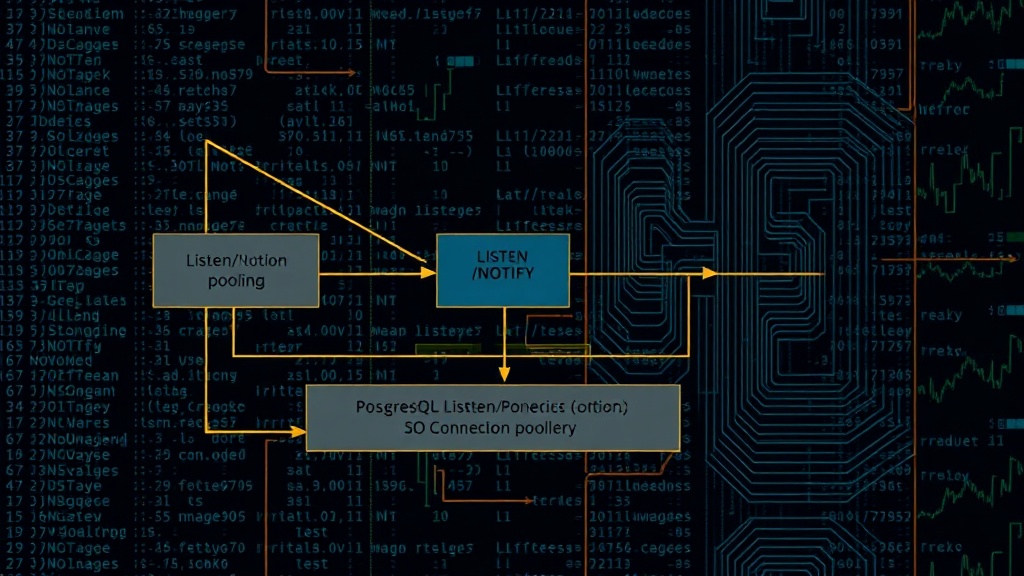
One critical factor is connection pooling. Instead of each client process maintaining its own dedicated connection to PostgreSQL for listening, a shared connection pool can be used. This significantly reduces the overhead associated with connection management. When a notification arrives, it is routed to the appropriate listening client via the pool. By decoupling the notification reception from the application's main processing threads, developers can ensure that slow downstream processing doesn't impact the reception of new notifications.
The benchmarks presented indicate that with effective connection management and asynchronous processing on the client side, LISTEN/NOTIFY can sustain thousands of notifications per second. This level of performance rivals, and in some specific scenarios may even exceed, the performance of dedicated message queuing systems for certain use cases. The critical distinction is that LISTEN/NOTIFY leverages the existing database connection, eliminating the need for a separate messaging infrastructure, which can simplify deployment and reduce operational complexity.
When Does LISTEN/NOTIFY Shine?
The applicability of LISTEN/NOTIFY is not universal, but it excels in specific scenarios where its strengths align with application requirements. It is particularly well-suited for:
- Real-time Data Synchronization: Applications that need to broadcast changes from the database to multiple connected clients in near real-time. Examples include dashboards, collaborative editing tools, and live-updating UIs.
- Decoupling Services: As a lightweight mechanism for microservices within a PostgreSQL ecosystem to signal events to each other without introducing a full-fledged message broker.
- Simplicity and Reduced Infrastructure: When minimizing the number of external dependencies is a priority, leveraging a built-in database feature can be highly attractive.
The limited payload size (8KB) means it's not ideal for broadcasting large amounts of data. Instead, it's best used for signaling that a change has occurred, prompting clients to query the database for the updated information. This pattern, often referred to as a