The Postgres Transaction State Machine
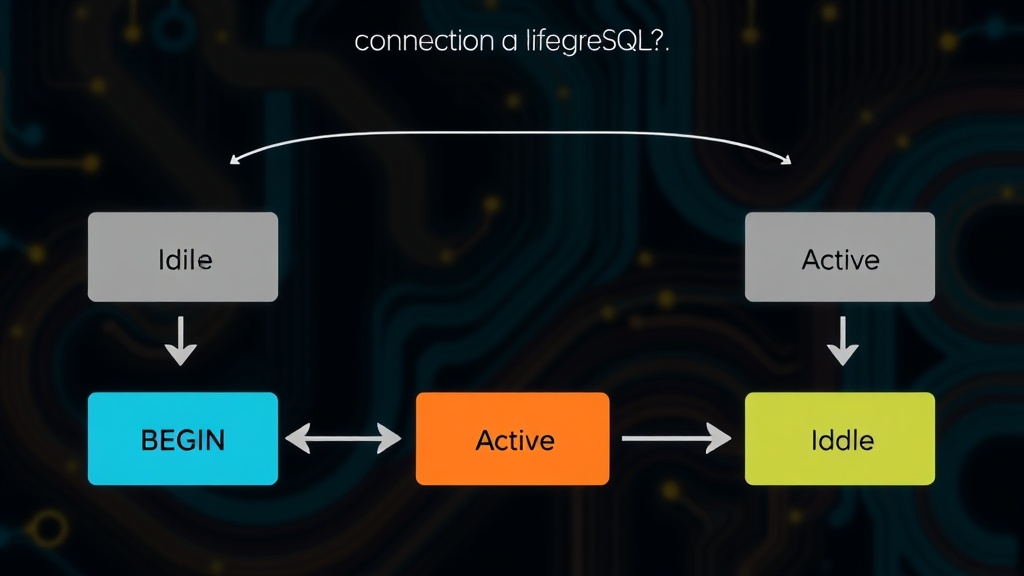
In PostgreSQL, a transaction is more than just a pair of BEGIN and COMMIT statements. It represents a dynamic state machine that governs the lifecycle of a database connection. When a connection begins a transaction with BEGIN, it transitions from an idle state to an active state. Each subsequent statement executed within the transaction keeps the connection in a state known as idle in transaction, awaiting the next command. This is a crucial distinction: the connection is not truly idle; it's actively participating in a transaction.
The real danger arises when errors occur or when code paths are not meticulously handled. An erroneous statement within an active transaction can push the connection into an idle in transaction (aborted) state. In this state, the transaction cannot proceed normally and must eventually be rolled back. However, the most insidious problem isn't necessarily an aborted transaction, but rather a transaction that is never explicitly closed. If a COMMIT or ROLLBACK command is omitted, particularly in error handling scenarios or complex code paths, the connection remains stuck in the idle in transaction state indefinitely.
This state is not benign. Connections in the idle in transaction state hold onto resources and maintain a specific snapshot of the database. This can have cascading negative effects. For instance, the PostgreSQL autovacuum process, essential for reclaiming space and preventing table bloat, cannot effectively clean up tables that are part of an open transaction. The longer a transaction stays open, the more data might be modified, leading to significant table bloat and performance degradation over time. Furthermore, these open transactions can acquire locks, potentially leading to lock contention and blocking other processes, creating a chain reaction that can eventually slow down and even halt the entire service.
The Perils of Unclosed Transactions
The primary threat to application stability stemming from the transaction lifecycle is the unclosed transaction. Developers often encounter this when a specific code path fails to execute a COMMIT or ROLLBACK. This is particularly common in applications that manage database connections through connection pools. When a connection is returned to the pool in an idle in transaction state, it's essentially unusable for new, independent operations that require a clean slate. The pool might report the connection as available, but it carries the baggage of the open transaction, including its locks and its snapshot.
Consider a scenario where a web application handles a user request that involves multiple database operations. If an error occurs after the BEGIN statement but before the COMMIT, and the error handling logic fails to issue a ROLLBACK, the connection might be returned to the pool while still in an open transaction. This connection, now in the idle in transaction state, will remain so until it's eventually timed out by the pool or the database server restarts. During this time, any data modified within that transaction remains in a pending state, and any locks acquired persist. If this happens frequently, especially under load, the accumulation of such connections can exhaust the connection pool, leading to new requests being denied or severely delayed.
Consequences for Performance and Stability
The implications of prolonged idle in transaction states are severe and multifaceted. One of the most immediate impacts is on the autovacuum daemon. PostgreSQL relies on vacuuming to remove dead tuples (rows) and prevent transaction ID wraparound. However, autovacuum cannot clean up rows that might still be visible to an open transaction. If a transaction remains open for a long time, the table can accumulate a large number of dead tuples, leading to significant bloat. This bloat increases the storage footprint, slows down query performance due to larger table scans, and can even prevent future updates if transaction IDs wrap around. Developers must be acutely aware that an unclosed transaction is not just a resource leak; it's an active impediment to essential database maintenance processes.
Beyond bloat, open transactions can lead to lock escalation. When a transaction modifies data, it acquires locks on the rows or tables involved. If the transaction is long-lived, these locks are held for an extended period, increasing the likelihood of lock conflicts with other transactions. This can result in a cascade of lock waits, where one blocked transaction causes others to block, creating a deadlock situation or severely degrading overall system throughput. The problem is compounded when using connection pools, as a single long-running transaction in an idle connection can prevent other requests from completing, making the application appear unresponsive.
Best Practices for Managing Transactions
To mitigate these risks, developers must adopt rigorous practices for managing transaction lifecycles. The golden rule is to ensure that every BEGIN is eventually paired with either a COMMIT or a ROLLBACK. This requires careful structuring of application logic, particularly around error handling.
- Explicit Handling: Always explicitly call
COMMITupon successful completion of a transaction block. Similarly, ensureROLLBACKis called in all error scenarios, including exceptions thrown during statement execution. - Short Transactions: Keep transactions as short as possible. Perform only the necessary database operations within a transaction and avoid lengthy application logic or external API calls while a transaction is open.
- Connection Pool Configuration: Configure connection pool timeouts appropriately. While this can help clean up stuck connections, it's a reactive measure, not a preventative one. It's better to ensure transactions are closed correctly by the application code. Some pools offer features to detect and abort idle-in-transaction connections, which can be invaluable.
- Monitoring: Regularly monitor your database for long-running transactions and idle-in-transaction connections. PostgreSQL provides system views like
pg_stat_activitythat can reveal these problematic states. Look for connections with non-emptystatevalues other thanactive. - Framework and ORM Awareness: If using an Object-Relational Mapper (ORM) or a framework that abstracts transaction management, understand how it handles transactions internally. Ensure that the framework's transaction boundaries align with your application's logical units of work and that it correctly handles rollbacks on errors.
What nobody has addressed yet is what happens to the thousands of developers who built their applications assuming a certain behavior from connection pools regarding idle-in-transaction states, and how quickly they need to adapt their codebases if pool providers start enforcing stricter timeouts or aborts by default.
By treating transactions as state machines and diligently managing their lifecycle, developers can prevent performance bottlenecks, avoid data integrity issues, and ensure the overall stability and responsiveness of their PostgreSQL-powered applications.