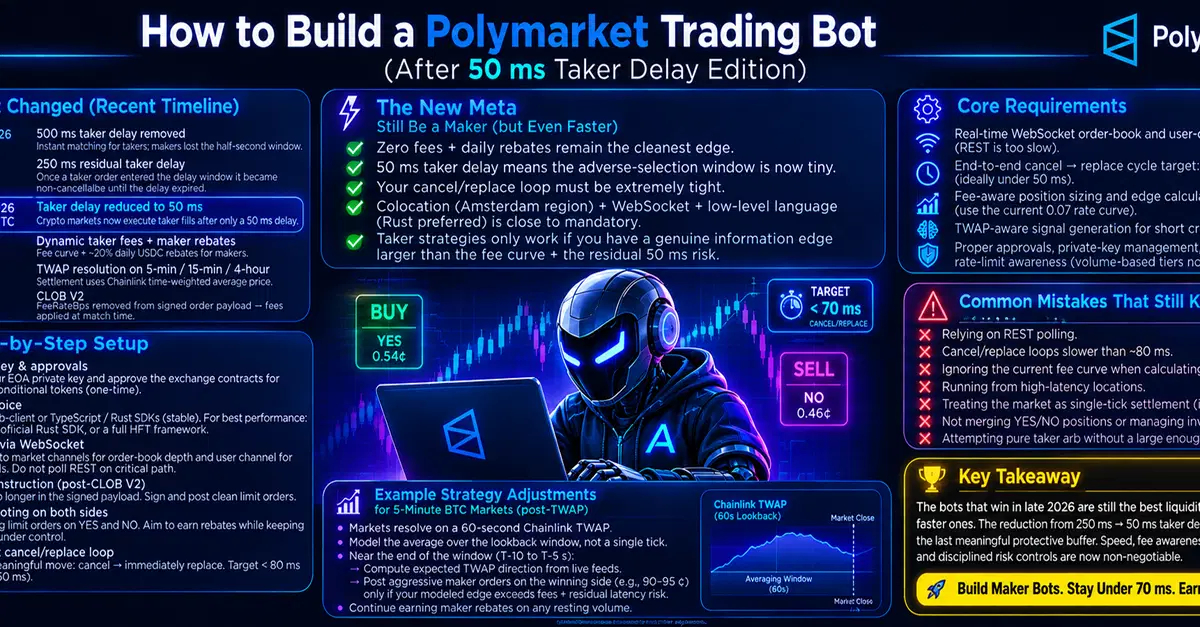
The New 50ms Taker Delay on Polymarket
Polymarket, a decentralized prediction market platform, has significantly reduced its taker delay from 250ms to 50ms, effective August 17, 2026, at 11:00 AM UTC. This change, announced by PolymarketDevs, marks the latest in a series of adjustments to the platform's trading mechanics. Previously, the taker delay was 500ms, then reduced to 250ms with additional order-locking rules implemented in June 2026 to prevent gaming the delay. The new 50ms window intensifies the race for speed in automated trading strategies on the platform.
This reduction means that roughly half of the trading bots previously optimized for the 250ms delay are now relatively slower. The opportunity for sophisticated 'maker' bots that can execute trades within this tighter window has increased, while the risk for slower bots has correspondingly grown. Any bot still operating with assumptions based on the older 500ms or 250ms delays is likely to be ineffective and should be discarded.
Understanding the Impact of Reduced Taker Delay
The taker delay is a crucial parameter in automated trading systems, especially on decentralized exchanges and prediction markets. It represents the time window during which a taker order can be matched against an existing maker order. A shorter delay directly favors participants with lower latency connections and more efficient execution logic. For Polymarket, this shift means that sophisticated trading strategies that rely on speed arbitrage or rapid order execution will now have a narrower, more competitive window to operate within.
Think of it like a high-speed train. If the station platform is extended from 250 meters to 50 meters, trains that were designed to stop precisely at the 250-meter mark will now overshoot. Similarly, trading bots that calculated their execution speed based on a 250ms buffer will find their strategies outpaced by the new 50ms reality. This necessitates a fundamental re-evaluation of bot architecture, network connectivity, and order management systems for anyone aiming to remain competitive.
Building a 50ms-Optimized Polymarket Bot
Developing a trading bot for Polymarket under the new 50ms constraint requires a focus on minimizing latency at every stage of the trade lifecycle. This includes:
1. Network Latency Optimization
The physical distance between your trading server and Polymarket's nodes is a primary factor. Utilizing servers in close geographical proximity to Polymarket's infrastructure, ideally within the same data center or cloud region, is paramount. Techniques such as using high-performance network interfaces, optimizing TCP/IP stack settings, and employing network monitoring tools to identify and mitigate packet loss or jitter are essential. For ultimate speed, consider co-location if operating at institutional scale.
2. WebSocket Connectivity
Polymarket's API likely uses WebSockets for real-time data feeds and order submission. Ensuring a stable, low-latency WebSocket connection is critical. This involves efficient handling of incoming market data, minimizing processing time before acting on new information, and ensuring that order submission requests are sent immediately upon decision. Libraries that offer high-performance WebSocket implementations and efficient serialization/deserialization of messages are preferred.
3. Order Book Management and Strategy Logic
The bot's strategy must be designed to operate within the 50ms window. This means that market data must be processed, decisions made, and orders submitted with extreme efficiency. Strategies that require complex calculations or multiple API calls will struggle. Prioritize strategies that can be executed with simple, fast logic. This might involve focusing on price discrepancies between markets, arbitrage opportunities that can be identified and acted upon within milliseconds, or rapid order book manipulation. The bot's internal state management needs to be lean and efficient, avoiding any unnecessary computations or data storage that could introduce delays.
4. Order Submission and Confirmation
When submitting an order, the goal is to get it to Polymarket's servers as quickly as possible. This involves efficient API client implementation and careful payload construction. While the 50ms taker delay is critical, it's also important to consider the time it takes for the order to be acknowledged and confirmed by the network or platform. Strategies might need to account for potential rejections or partial fills that occur if the market moves against the order even within the brief confirmation period.
5. Backtesting and Simulation
Thorough backtesting is crucial, but it must be performed with latency simulation that accurately reflects the 50ms environment. Simply backtesting on historical data without considering the impact of real-world network delays can lead to flawed strategy development. Tools that allow for precise simulation of network latency, order execution times, and slippage are necessary to validate the effectiveness of the bot's logic before deploying it live. This includes simulating the processing time of the bot itself, not just network latency.
The Evolving Landscape of Decentralized Trading
Polymarket's move to a 50ms taker delay is indicative of a broader trend in decentralized finance and prediction markets: the increasing importance of speed and latency. As platforms mature and competition intensifies, the technical edge often shifts from pure strategy to sophisticated infrastructure and execution optimization. Developers and traders must continually adapt their tools and approaches to stay ahead. The days of simply reacting to price changes are rapidly fading; the future belongs to those who can anticipate and act within microsecond-level windows. This trend will likely continue, pushing the boundaries of what's technically feasible in decentralized trading environments.
What nobody has addressed yet is the long-term impact of this continuous latency reduction on the accessibility of decentralized trading platforms. As the technical bar for participation rises, will these markets become exclusively the domain of high-frequency trading firms and sophisticated developers, alienating the average retail user?