Industrial Control Challenges and the SLX FlowControl Solution
Industrial control systems often face complex challenges, particularly in managing buffer tanks. These systems must seamlessly accept incoming fluid, supply downstream demand, and maintain an operational reserve around a target level. The complexity escalates when commands overlap, sensors are missing during startup, data streams falter, or operators need to understand why a process refuses to restart. Traditional approaches can buckle under these conditions.
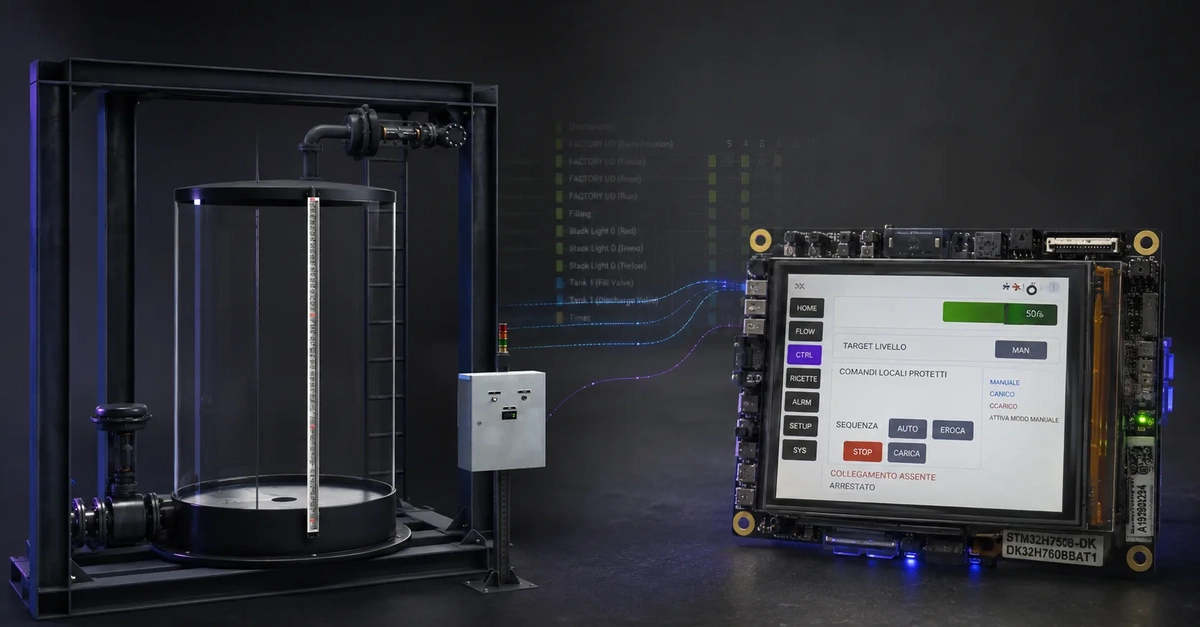
The SLX FlowControl demonstrator, built on an STM32H750B-DK development kit, offers a robust solution. It integrates several key components to tackle these issues head-on. At its core is a FreeRTOS control task, responsible for the real-time execution of the control logic. This is complemented by an LVGL (Light and Versatile Graphics Library) touch Human-Machine Interface (HMI), providing an intuitive visual layer for operators. Communication with other industrial systems is handled via a Modbus TCP/IP server, a widely adopted industrial communication protocol. To validate the system's behavior without a physical machine, it incorporates a Factory I/O Fill Tank digital twin, simulating the process dynamics.
The primary goal of SLX FlowControl is to make system behavior testable before a physical machine is connected. This approach significantly de-risks development and commissioning. By treating field demand, automatic control, conflict resolution, alarm management, and recovery procedures as distinct, yet interconnected, elements, the system achieves a higher degree of reliability and predictability. The design emphasizes clear state transitions, ensuring that the firmware, HMI, and simulated process all reflect the same operational status.
System Architecture and Key Components
The architecture of SLX FlowControl is designed for modularity and real-time performance, leveraging the capabilities of the STM32H750B-DK microcontroller. The STM32H7 series microcontrollers are known for their high performance, featuring dual-core Cortex-M7 and Cortex-M4 processors, which allow for sophisticated real-time control and a responsive HMI. This dual-core capability is particularly advantageous here, potentially allowing the Cortex-M7 to handle the demanding HMI and communication tasks while the Cortex-M4 manages the core control loops and FreeRTOS tasks.
FreeRTOS serves as the real-time operating system, providing task scheduling, inter-task communication, and synchronization primitives. This is crucial for managing the concurrent operations of fluid intake, demand supply, sensor monitoring, and alarm handling. The real-time nature of FreeRTOS ensures that critical control operations are executed deterministically, even under heavy system load.
The LVGL library is instrumental in creating the graphical user interface. LVGL is well-suited for embedded systems with limited resources, offering a rich set of UI elements and animations. For SLX FlowControl, it renders the state of the buffer tank, displays sensor readings (level, flow rates), presents alarms, and allows operators to input commands or acknowledge events via the touch screen. The HMI's ability to accurately reflect the system's state, as managed by the FreeRTOS task, is a key indicator of the system's integrity.
Modbus TCP/IP is implemented as the communication backbone. This protocol allows the STM32-based controller to act as a server, serving data to supervisory control and data acquisition (SCADA) systems or other industrial controllers. It enables the exchange of process variables, setpoints, and status information over an Ethernet network. The implementation must carefully manage data consistency, ensuring that the data served via Modbus accurately reflects the current state of the control system, as determined by the FreeRTOS task.
The Factory I/O Fill Tank digital twin acts as a virtual representation of the physical process. This simulation allows for extensive testing of the control logic and HMI interactions without the risk of damaging physical equipment or disrupting actual operations. It models the dynamics of fluid entering and leaving the tank, providing simulated sensor inputs and responding to control outputs from the STM32. This digital twin is critical for developing and verifying complex scenarios, such as startup sequences, failure modes, and recovery procedures.
Behavioral Testing and State Management
A core tenet of SLX FlowControl is its focus on testable behavior. The system is architected to ensure that the control logic, the HMI display, and the simulated process (or physical process) are always synchronized in their understanding of the system's state. This is not a trivial task in industrial automation.
Consider the scenario of a buffer tank. The automatic control might be trying to maintain a level, while an operator issues a manual override. Simultaneously, a critical sensor might fail, triggering an alarm. The system must correctly prioritize these events, update its internal state, and reflect this accurately on the HMI and via Modbus. For instance, if the HMI shows the tank is filling and an alarm for sensor failure is active, the FreeRTOS task must be in a state that reflects both the ongoing action and the detected fault. The Modbus server should then provide data that aligns with this unified state.
The digital twin plays a vital role in testing these complex interactions. Developers can script various scenarios: simulating a gradual sensor degradation, introducing a sudden surge in inflow, or testing the response to simultaneous manual commands. The ability to replay these scenarios and observe consistent behavior across the control task, HMI, and simulated process provides high confidence in the system's robustness. This contrasts sharply with traditional methods where testing often relies heavily on physical hardware, which is slow, expensive, and carries a risk of damage.
The design treats conflicts, alarms, and recovery as first-class citizens. Instead of being afterthoughts, they are integral parts of the state machine. When a conflict arises (e.g., automatic control vs. manual override), the system transitions to a specific conflict state. Alarms are not just simple flags but can trigger specific recovery routines. The HMI provides clear visual cues for these states, and the Modbus interface exposes relevant error codes and status flags. This structured approach to fault management is essential for reliable industrial operations.
Implications for Industrial Automation
The SLX FlowControl demonstrator highlights a shift towards more robust and testable industrial control solutions. By combining powerful microcontrollers like the STM32H7 with mature real-time operating systems (FreeRTOS) and industry-standard communication protocols (Modbus TCP), developers can create sophisticated edge controllers and HMIs with greater confidence.
The emphasis on digital twins and pre-physical deployment testing is becoming increasingly critical. As industrial processes grow more complex and interconnected, the cost of errors during commissioning rises dramatically. Solutions that allow for extensive simulation and validation can significantly reduce development cycles, minimize downtime, and improve overall system safety and reliability. The ability to test state transitions rigorously before deploying to the factory floor is a significant advantage.
Furthermore, the integration of an HMI directly onto the edge controller streamlines deployment. Instead of separate HMI panels communicating with a PLC or controller, a single device can handle both local control and operator interaction. This can reduce hardware costs, simplify wiring, and potentially improve response times for local operations. The use of LVGL on embedded hardware demonstrates that rich graphical interfaces are achievable even on resource-constrained devices, enhancing the user experience in industrial settings.
The Modbus TCP implementation ensures interoperability with existing industrial infrastructure. This makes the STM32-based solution adaptable to a wide range of automation systems, from legacy SCADA systems to modern distributed control architectures. The ability to expose detailed operational status and control parameters via a standard protocol is key for integration and monitoring.
The approach taken by SLX FlowControl represents a practical application of modern embedded development principles to the demanding field of industrial automation. It underscores the importance of a well-defined architecture, rigorous testing, and the strategic use of available hardware and software tools to build reliable and efficient control systems.