The Limits of Simple Majority Voting in Prediction Markets
In the fast-paced world of 5-minute Bitcoin markets on platforms like Polymarket, the immediate question for many traders is straightforward: Which side is winning? If the 'UP' outcome is clearly ahead with only a minute left, the temptation to simply bet on 'UP' is strong. This approach, however, often overlooks a more nuanced and potentially more profitable signal: the underlying order flow. Simply put, just because more people are betting on UP doesn't mean the smart money is flowing that way.
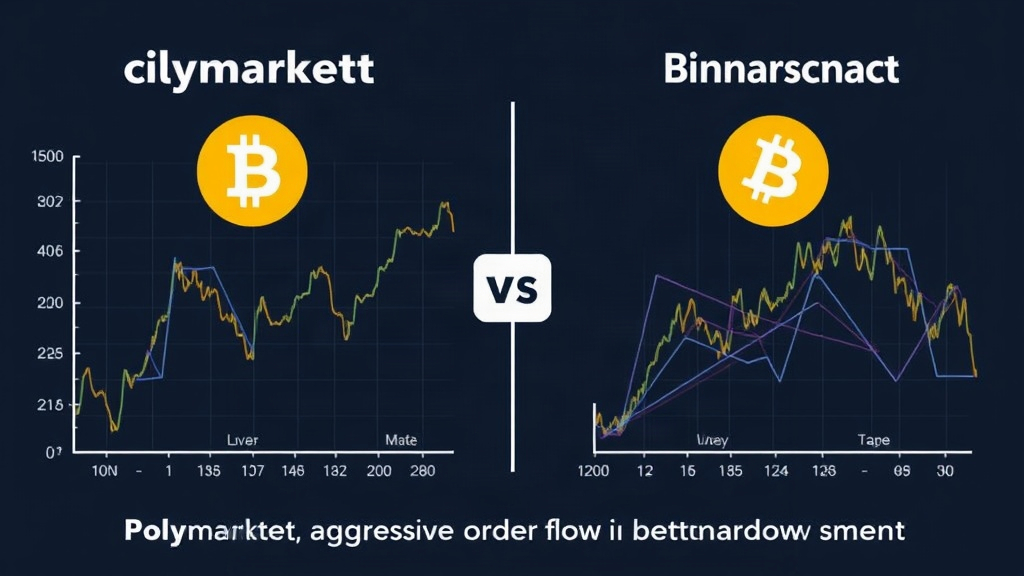
This research delves into a more sophisticated strategy by analyzing whether the aggressive buying or selling pressure on a major exchange, Binance, confirms or contradicts the prevailing sentiment in a Polymarket. The core hypothesis is that markets where the price action and the underlying order flow agree are more predictable than those where they diverge. This method aims to provide a deeper layer of validation beyond what the public market sentiment alone can offer.
To test this, a study examined 2,833 BTC, ETH, and SOL 5-minute Polymarket markets. The analysis compared the late-stage leader in these prediction markets against the aggressive order flow data from Binance. The findings revealed a significant difference in predictability between scenarios where price and order flow were aligned and those where they were not. This suggests that order flow analysis can act as a crucial filter for late-stage prediction market signals, moving beyond a simple majority rule.
Developing the Flow-Alignment Trading Bot
Building a trading bot for these 5-minute markets requires a robust architecture capable of processing real-time data and executing trades with minimal latency. The bot's core logic hinges on two primary data streams: the Polymarket market data and the Binance order book data for the corresponding BTC perpetual futures contract. The Polymarket data provides the public sentiment and current market leadership, while the Binance data offers insight into the aggressive buying and selling pressure.
The bot's strategy can be conceptualized as a confirmation mechanism. When the Polymarket shows a clear leader (e.g., 'UP' is winning), the bot then checks the Binance order flow. If Binance shows aggressive buying pressure (more aggressive buy orders being filled than sell orders), this confirms the 'UP' move, and the bot might consider a long position on 'UP'. Conversely, if Binance shows aggressive selling pressure, it signals a divergence, and the bot might ignore the 'UP' signal or even consider a short position on 'DOWN'.
The technical implementation involves several key components:
- Data Ingestion: Real-time APIs from Polymarket and Binance are crucial. For Polymarket, this would involve fetching current market probabilities and the number of contracts on each side. For Binance, this means subscribing to order book snapshots and, more importantly, to aggressive trade streams (trades that execute against the bid or ask).
- Data Processing: Raw order flow data needs to be aggregated and analyzed to determine the net aggressive order flow. This involves calculating the difference between aggressive buys and aggressive sells over a short interval, corresponding to the 5-minute market timeframe.
- Signal Generation: The bot compares the Polymarket leader with the processed order flow. A divergence occurs when the Polymarket leader is contradicted by the net order flow. A convergence happens when they align.
- Trade Execution: Based on the convergence or divergence signals, the bot decides whether to place a trade. For a 5-minute market, the timing of the trade is critical, often needing to be placed within the last minute or two to capture the final price movements. The bot must be able to interact with the Polymarket API to place bets on the desired outcome.
The challenge lies in defining the precise thresholds for 'leading' and 'aggressive flow.' For instance, how much of a lead in Polymarket constitutes a clear leader? What volume of aggressive trades on Binance is needed to signify strong conviction? These parameters would be tuned through backtesting and further empirical analysis.
Empirical Results and Implications
The research identified distinct patterns based on the alignment of Polymarket sentiment and Binance order flow. When both signals converged – meaning the Polymarket leader was supported by aggressive buying on Binance (for an 'UP' outcome) or aggressive selling (for a 'DOWN' outcome) – the predictability of that outcome was significantly higher. Conversely, when the signals diverged, the outcome became much less certain, and betting against the Polymarket leader, in alignment with the order flow, often proved more successful.
For example, if 'UP' is leading on Polymarket but Binance shows significant aggressive selling pressure, it suggests that while retail sentiment might be leaning 'UP,' institutional or more informed traders are aggressively selling. In such a divergence, betting on 'DOWN' might be the more rational choice, despite the public market sentiment.
The study's findings suggest that late-stage prediction market signals can be substantially improved by incorporating real-time order flow data. This moves beyond simple heuristics and taps into the more immediate, pressure-driven dynamics of the underlying asset market. The implication is that traders and bots that can effectively integrate these two data sources will have a distinct advantage.
This research opens the door to more sophisticated automated trading strategies for prediction markets. It highlights that the true signal in these markets isn't just the aggregated belief, but the underlying pressure that drives the final movements. For founders building on or operating prediction market platforms, understanding these dynamics is key to fostering more efficient and robust markets.
Future Directions and Unanswered Questions
While this study provides a compelling case for flow alignment, several questions remain. The research analyzed 5-minute markets; how would this strategy perform on longer timeframes? What are the optimal parameters for defining 'aggressive order flow' and 'market leadership' across different assets and market conditions? Furthermore, the study focused on BTC, ETH, and SOL; do other asset classes exhibit similar behavior?
Perhaps the most significant unanswered question is how this strategy scales and its potential impact on market efficiency. If more participants adopt flow-alignment strategies, will the alpha decay? And critically, what are the latency requirements for a bot to effectively capture these short-lived divergences? The development of such bots pushes the boundaries of real-time data processing and algorithmic trading, demanding infrastructure that can react in milliseconds.
The potential for building automated trading systems that leverage these insights is immense. For developers, this presents an opportunity to explore advanced trading algorithms that go beyond simple technical indicators or public sentiment analysis. For platforms like Polymarket, it underscores the importance of data integrity and the potential for sophisticated analytics to enhance user experience and market depth.