The Dawn of AI-Specific Documentation
For decades, software documentation followed a predictable script: READMEs, API references, and code comments. Architecture diagrams were a bonus, a sign of a disciplined team. This established vocabulary served developers well. Then, artificial intelligence arrived, not just as a new tool, but as a catalyst for an entirely new category of documentation. This new documentation is often unassigned in bootcamps and CS degrees, yet its production is increasingly expected—driven by the need for clarity among teammates, the demands of auditors, and, as of 2026, by legal mandates.
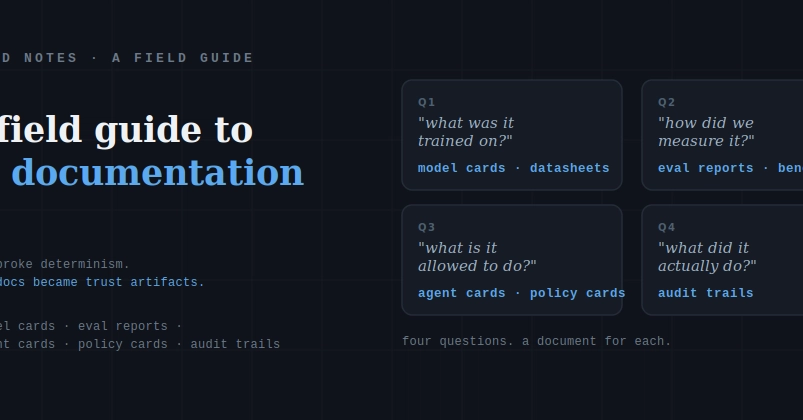
This field guide explores this evolving landscape, detailing the essential AI documentation types. We’ll group them by what they document, explain their purpose, outline when they are necessary, and clarify why they exist. The unifying principle behind all these new documents is the inherent complexity and opacity of AI systems, which traditional software documentation simply cannot capture.
Why AI Demands New Documentation
The fundamental shift lies in what AI systems *do*. Traditional software, at its core, describes a set of deterministic instructions. You write code, it executes that code. Documentation for such systems focuses on the logic, the interfaces, and the expected behavior of that code. AI, particularly modern machine learning and large language models, operates differently. These systems learn from data, make probabilistic decisions, and can exhibit emergent behaviors that are not explicitly programmed.
This inherent unpredictability and data-dependency necessitate documentation that goes beyond code. We need to understand not just *how* the model works internally (which is often a black box), but *what* it was trained on, *how* it performs in practice, *what* its limitations are, and *how* it behaves in specific contexts. This is akin to understanding not just the blueprint of an engine, but also the fuel it consumes, the road conditions it’s tested on, and the safety records of the vehicles it powers.
Model Cards: Transparency for AI Models
Model Cards, first proposed by Google researchers, are perhaps the most foundational of these new documents. They are designed to provide a standardized, transparent overview of a machine learning model. Think of a Model Card as a nutrition label for an AI model.
A typical Model Card includes:
- Model Details: Information about the model architecture, version, date of development, and intended use cases.
- Data: A description of the training, validation, and testing datasets, including their sources, characteristics, and any preprocessing steps. This is crucial because a model’s behavior is inextricably linked to its training data.
- Intended Use: Clearly defined applications for which the model is designed, and importantly, use cases that are explicitly out of scope.
- Performance Metrics: Quantitative evaluations of the model's performance, often broken down by different demographic groups or subpopulations to identify potential biases. This is where the model's effectiveness and fairness are rigorously assessed.
- Ethical Considerations: A discussion of potential societal impacts, fairness concerns, and mitigation strategies for identified risks.
- Caveats and Recommendations: Any known limitations, potential failure modes, and advice for users on how to deploy and monitor the model responsibly.
Model Cards are essential for fostering trust and accountability in AI systems. They enable developers, auditors, and even end-users to understand a model's capabilities, limitations, and potential risks before deployment.
Evaluation Reports: Deep Dives into Performance
While Model Cards provide a summary, Evaluation Reports offer a more in-depth analysis of an AI model's performance. These reports are typically generated after rigorous testing and validation phases. They serve as the detailed evidence underpinning the claims made in a Model Card.
Key components of an Evaluation Report include:
- Test Setup: A detailed description of the testing environment, hardware, software versions, and evaluation datasets used.
- Comprehensive Metrics: Beyond standard accuracy or F1 scores, these reports detail performance across a wide array of metrics, including precision, recall, AUC, latency, throughput, and robustness against adversarial attacks or noisy inputs.
- Bias and Fairness Analysis: Detailed breakdowns of performance across various sensitive attributes (e.g., race, gender, age) and specific fairness metrics (e.g., demographic parity, equalized odds). This is where potential discriminatory outcomes are meticulously investigated.
- Error Analysis: An examination of common failure modes, including qualitative examples of misclassifications or erroneous outputs. Understanding *why* a model fails is as important as knowing that it does fail.
- Sensitivity Analysis: How model performance changes with variations in input data or environmental conditions.
Evaluation Reports are vital for regulatory compliance, internal quality assurance, and for making informed decisions about model deployment. They provide the granular data needed to justify a model's readiness for production or to identify areas requiring further development.
Agent Cards: Documenting Autonomous Systems
As AI systems become more autonomous and interactive, a new documentation need arises for agents—AI systems designed to perceive their environment and take actions to achieve goals. Agent Cards are emerging as the standard for documenting these complex entities.
An Agent Card is analogous to a Model Card but tailored for systems that act in the world. It might include:
- Agent Architecture: How the agent is structured, including its perception, reasoning, planning, and action modules.
- Environment Specifications: The simulated or real-world environments in which the agent is designed to operate, including their characteristics and constraints.
- Goal Definition: Clearly articulated objectives the agent is programmed to achieve.
- Capabilities and Limitations: What the agent can do, and more importantly, what it cannot do or is not designed to do.
- Safety Protocols: Mechanisms in place to ensure the agent operates safely and within defined ethical boundaries.
- Interaction Guidelines: How humans or other agents should interact with this agent.
Agent Cards are critical for understanding the behavior, risks, and operational parameters of autonomous AI systems, especially as they are integrated into more complex workflows and physical systems.
Beyond the Core: Other Emerging AI Document Types
The AI documentation landscape is still rapidly evolving. Several other types of documents are gaining traction:
- Datasheets for Datasets: Similar to Model Cards but focused on the datasets themselves. They detail the motivation, composition, collection process, preprocessing, and intended uses of a dataset, crucial for understanding data provenance and potential biases.
- AI Incident Reports: Documentation of significant failures, biases, or unexpected behaviors encountered during AI system operation. These reports are vital for post-mortem analysis and learning from mistakes.
- Fairness Audits: Specific reports detailing the results of fairness assessments, often performed by independent third parties.
- Explainability Reports: Documents that provide insights into *why* an AI model made a particular decision, using techniques like LIME or SHAP.
What is surprising is not just the proliferation of these document types, but the implicit assumption that developers will intuitively understand their purpose and creation. Unlike traditional software documentation, which has decades of established best practices and educational curricula, AI documentation is a nascent field. The onus is on practitioners to develop these skills, often through trial and error, or by referencing emerging standards and guidelines.
The Unanswered Question: Standardization and Tooling
While the need for these documents is clear, a significant challenge remains: standardization and tooling. How do we ensure consistency across different organizations and AI systems? What tools will automate the generation of these reports, integrating them into MLOps pipelines? The current state often involves manual creation or ad-hoc processes. The next frontier in AI documentation will likely involve robust frameworks and automated tools that make creating and consuming these essential documents seamless and reliable.
Conclusion: Embracing the New Documentation Paradigm
The arrival of AI has fundamentally altered the documentation landscape. Model Cards, Evaluation Reports, Agent Cards, and Datasheets for Datasets are not mere add-ons; they are essential components for building trustworthy, transparent, and responsible AI systems. As AI continues to permeate every aspect of technology and society, mastering this new documentation paradigm is no longer optional—it is a critical skill for any developer, researcher, or organization working with AI.