The Core Idea: A Layered Approach to Market Prediction
Developing a consistently profitable trading strategy is a journey of iteration. For one trader, this involved thousands of trades on Polymarket, the decentralized prediction market. The outcome is a bot strategy focused on Bitcoin (BTC) Up/Down markets, built not on initial theory but through empirical discovery. After 11,717 trades, the strategy has demonstrated a stable win rate, moving beyond the initial volatility of experimental trading.
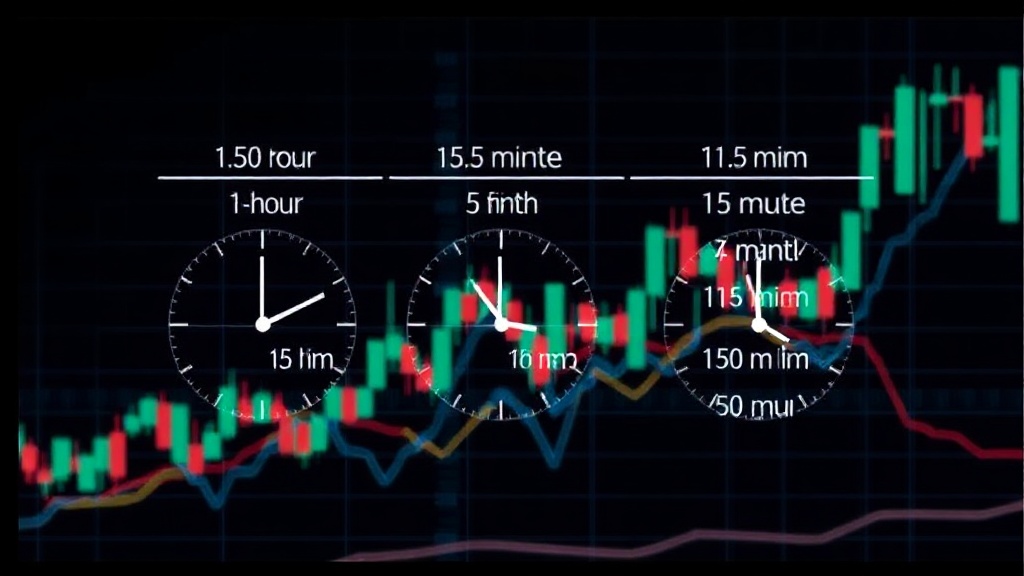
At its heart, this strategy employs a multi-timeframe framework: 5-minute, 15-minute, and 1-hour. Crucially, these are not independent strategies but interconnected layers designed to filter and confirm trading signals. The 1-hour timeframe serves to identify the overarching trend, providing the macro direction. The 15-minute timeframe then confirms momentum within that established trend. Finally, the 5-minute timeframe is where the actual trade entries are executed. The bot is programmed to recognize when all three timeframes align, significantly increasing its confidence and allocating larger trade sizes during such high-conviction setups.
5-Minute Markets: The Engine of High-Frequency Trading
The 5-minute market is the primary engine of this strategy, responsible for the majority of trades and the significant daily gains. The exceptional trading days, marked by gains of $1,210, are attributed to successful setups identified and executed on this shortest timeframe. This implies that while the longer timeframes provide direction and confirmation, the execution and profit realization are heavily concentrated in the high-frequency 5-minute action.
The bot's logic on the 5-minute chart focuses on identifying specific patterns or conditions that indicate a high probability of short-term price movement in the direction confirmed by the higher timeframes. This could involve breakout patterns, momentum shifts, or candlestick formations that have historically preceded profitable moves. The key is the bot's ability to rapidly process these signals and execute trades before the market can fully price in the move, especially when supported by the 15-minute and 1-hour trends.
15-Minute Markets: Confirming Momentum and Filtering Noise
The 15-minute timeframe acts as a crucial intermediary, bridging the gap between the broad trend identified on the 1-hour chart and the high-frequency entries on the 5-minute chart. Its primary role is to confirm the momentum that is expected to carry the price in the direction of the larger trend. Without this confirmation, a 5-minute signal might be a false positive, a temporary fluctuation against the prevailing larger trend.
For instance, if the 1-hour chart indicates an uptrend, the 15-minute chart would be scrutinized for signs of upward momentum. This might manifest as higher highs and higher lows on the 15-minute chart, or a bullish crossover on a relevant moving average. When this momentum is confirmed, it lends greater credence to a buy signal on the 5-minute chart. Conversely, if the 15-minute chart shows weakening momentum or a bearish divergence, the bot would likely ignore a 5-minute buy signal, effectively filtering out a potentially losing trade. This filtering mechanism is vital for maintaining a high win rate.
1-Hour Markets: Establishing the Macro Trend
The 1-hour timeframe is the foundational layer of the strategy. It provides the 'big picture' view, defining the dominant trend. Trading against the 1-hour trend is generally considered a high-risk endeavor, and this strategy actively avoids it. The bot identifies the trend by analyzing price action, support and resistance levels, or longer-term moving averages on the 1-hour chart. This macro trend assessment is the first and most critical filter.
If the 1-hour chart suggests an uptrend, the bot will only consider long positions on the lower timeframes. If it indicates a downtrend, only short positions will be entertained. Sideways or undecided markets on the 1-hour chart might lead to the bot reducing its trading activity or abstaining altogether, preserving capital and avoiding choppy, unpredictable conditions. This top-down approach ensures that entries are always taken in the direction of the most significant market force.
Trade Sizing and Risk Management
The effectiveness of any trading strategy is amplified by robust risk management and intelligent trade sizing. This Polymarket bot incorporates a dynamic sizing mechanism. When all three timeframes (1-hour, 15-minute, and 5-minute) align, signaling a high-conviction trade, the bot increases its position size. This is a direct reward for confluence and a key driver of the significant daily gains observed.
Conversely, when signals are weaker, perhaps with only two timeframes aligning or with mixed signals on the shorter timeframes, the bot would likely use a smaller position size or refrain from trading. This adaptive approach to risk management ensures that capital is deployed most aggressively when the probability of success is highest, and conserved when the signals are less clear. This is not about predicting the future, but about systematically exploiting probabilistic advantages identified through rigorous, data-driven observation over thousands of trades.
Empirical Discovery Over Theoretical Design
The genesis of this strategy is a testament to the power of empirical discovery in algorithmic trading. The trader explicitly states that the strategy was not designed on paper but evolved through active trading, experiencing losses, and making iterative adjustments. This process of 'trading, losing, adjusting, and trading again' until a stable win rate was achieved is often more effective than purely theoretical model building, especially in dynamic markets like cryptocurrency predictions.
This hands-on approach allows the strategy to adapt to the real-time behavior of the market, uncovering nuances and patterns that might be missed in a purely theoretical model. The 11,717 trades serve as a large dataset from which the bot learned and optimized its decision-making process. This continuous learning and adaptation are likely key to its sustained profitability and stable win rate, demonstrating that in trading, practical experience often trumps abstract planning.