Running Advanced AI Models Locally
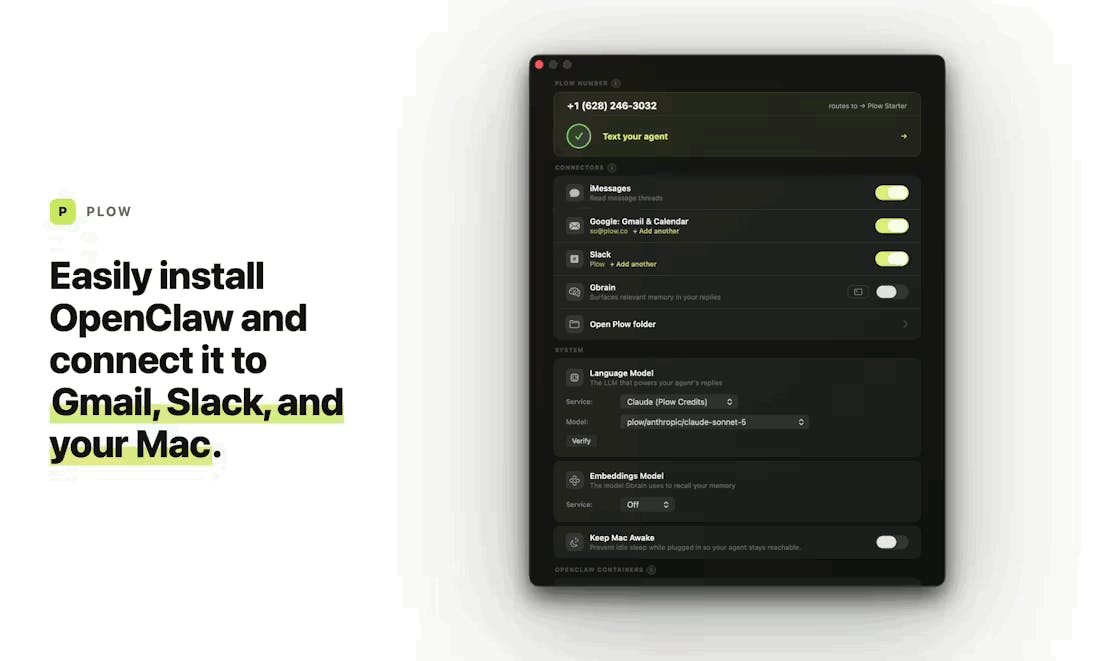
Plow, a new macOS application, introduces the capability to run advanced AI models, specifically GPT-5.6 agents, directly on a user's local machine. This marks a significant shift for developers and AI enthusiasts who have primarily relied on cloud-based services for accessing powerful large language models (LLMs). By enabling local execution, Plow aims to address concerns around data privacy, security, and the recurring costs associated with cloud APIs.
The application leverages open-source frameworks and models, including OpenClaw and Hermes, to facilitate this local deployment. This approach is particularly beneficial for users who handle sensitive data or require uninterrupted access to AI capabilities without an internet connection. The ability to run these sophisticated models offline means that complex tasks, such as code generation, data analysis, and content creation, can be performed with greater assurance of data confidentiality.
Key Features and Benefits of Plow
Plow's primary offering is its ability to facilitate the secure execution of AI agents on a local macOS environment. This is achieved through a user-friendly interface that abstracts away much of the underlying complexity involved in setting up and managing local AI models. Users can select from supported models and run them without the need for extensive technical configuration.
One of the most compelling advantages of Plow is enhanced privacy. When AI models are run locally, the data processed by these models never leaves the user's machine. This is a critical differentiator for professionals dealing with proprietary information, personal data, or confidential research. Unlike cloud-based solutions where data is transmitted to and processed by third-party servers, Plow offers a direct, end-to-end secure pathway for AI computations.
Beyond privacy, local execution also offers potential cost savings. While powerful AI models can incur significant expenses through API calls on cloud platforms, running them locally eliminates these per-use charges. The initial investment is in the hardware and the software itself, after which the operational cost is primarily electricity. This model is particularly attractive for individuals and small teams who might find continuous cloud usage prohibitively expensive.
Furthermore, Plow provides a level of control and customization that is often missing in managed cloud services. Users can experiment with different model configurations, fine-tune parameters, and integrate local AI agents into their existing workflows with greater flexibility. This is akin to having a dedicated AI supercomputer on your desk, tailored to your specific needs and projects.
Technical Underpinnings and Supported Models
Plow is built upon robust open-source foundations. The application's ability to run GPT-5.6 agents relies on the integration of advanced LLM architectures and efficient inference engines. While the specifics of GPT-5.6 are not publicly detailed by OpenAI, Plow appears to support models that offer comparable capabilities, likely through fine-tuned open-source alternatives that mimic or exceed performance benchmarks.
The mention of OpenClaw and Hermes suggests that Plow is leveraging community-developed, open-source LLMs. OpenClaw, for instance, is an initiative focused on creating powerful, open-source AI models. Hermes, another notable open-source LLM, has gained traction for its performance and versatility. By supporting these models, Plow democratizes access to cutting-edge AI technology, making it accessible beyond large corporations with substantial cloud budgets.
The inference process for these large models is computationally intensive. Plow likely employs optimized libraries and techniques to ensure that the models can run efficiently on modern macOS hardware, including Apple Silicon processors. This optimization is key to providing a responsive user experience, allowing for near real-time interaction with the AI agents.
The Future of Local AI on macOS
Plow's emergence signals a growing trend towards decentralized and on-device AI processing. As LLMs become more powerful and efficient, the technical feasibility of running them locally on consumer hardware increases. This shift has profound implications for the entire AI ecosystem, from individual developers to enterprise solutions.
For developers, Plow provides a sandbox environment to test and deploy AI-powered applications without the immediate need for cloud infrastructure. This can accelerate the development cycle and reduce the barrier to entry for creating sophisticated AI applications. The ability to iterate quickly on a local machine, coupled with the assurance of data privacy, is invaluable.
The broader market implications are also significant. Companies that have traditionally relied on centralized cloud AI services might begin to explore hybrid models, leveraging local processing for certain tasks and cloud for others. This could lead to more resilient and cost-effective AI deployments. The success of applications like Plow could also spur further innovation in on-device AI hardware and software optimization.
What remains to be seen is how Plow will evolve to support future models and hardware advancements. The pace of AI development is relentless, with new architectures and larger, more capable models emerging frequently. Plow's long-term success will depend on its ability to adapt and integrate these advancements, ensuring that users can continue to run the most powerful AI agents locally on their Macs.
The security implications of local AI are also noteworthy. While local processing enhances data privacy, it also places the onus of securing the AI model and the data on the user. This means users must be diligent about operating system security, software updates, and general cybersecurity practices. Plow's claim of