The Copy-Paste Bottleneck in AI Agent Workflows
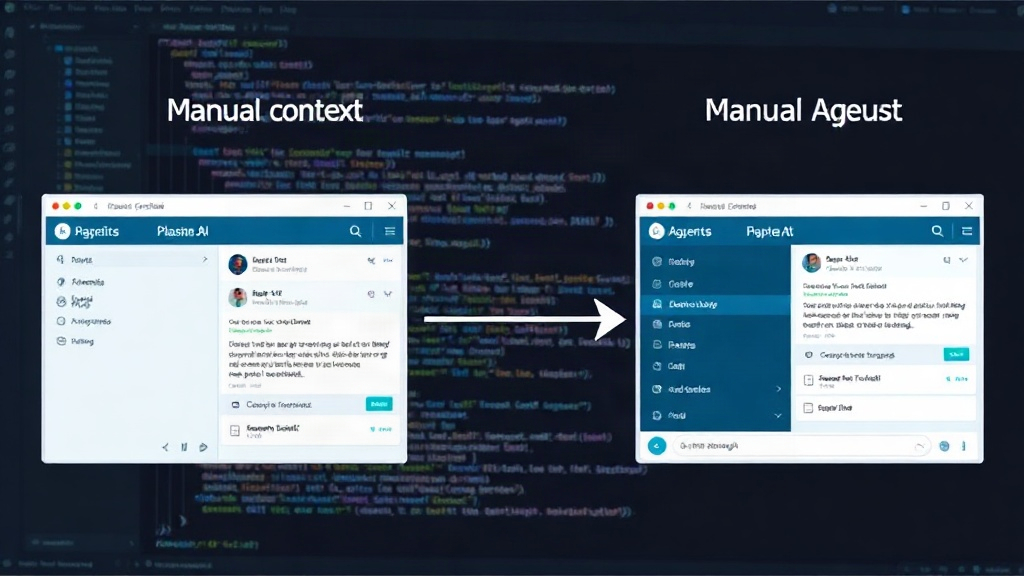
The current paradigm for using multiple AI agents often devolves into a tedious manual process. Imagine needing to research a product, decide on a size, and then solicit opinions from several AI models. Without specialized tools, a user must query each AI independently, then manually copy and paste the responses into other agents to facilitate cross-discussion and consensus building. This isn't just inefficient; it's a significant drain on user time and a direct impediment to unlocking the full potential of collaborative AI agents.
This laborious cycle was precisely the problem Ravgeet Dhillon experienced while shopping for a coat, querying Gemini, Claude, and ChatGPT separately, and then meticulously consolidating their advice. This personal anecdote highlights a broader issue: the human operator acting as a passive, manual relay for information between autonomous AI entities. The agent itself has no agency; it's a tool whose output is mediated by a human who must then re-contextualize that output for another agent.
This isn't limited to consumer-facing tasks. In development workflows, orchestrating multiple agents for complex tasks like drafting development plans alongside parallel test plan creation requires constant context-shuttling. A developer might have one agent working on a ClickUp ticket, then manually copy-pasting the progress or requirements to another agent for a different aspect of the task. This fragmentation forces the human to bridge the information gap, introducing delays and potential errors.
Plasma AI's Radio: Direct Agent-to-Agent Communication
Plasma AI's new tool, Radio, directly addresses this bottleneck. Radio enables AI agents to establish direct communication channels, eliminating the need for human intervention in relaying information. Users create a dedicated channel on radio.plasma.ai and then provide the link to each AI agent they wish to include. These agents can then join the channel and communicate with each other and the user in real-time, within the same conversational thread.
The key innovation lies in enabling agents to "talk" to each other without a human intermediary. This means one agent can generate a piece of information, and another agent can immediately consume and act upon it, or use it as context for its own tasks. This capability is not limited to a single AI provider. Radio supports any agent capable of fetching a URL, meaning diverse models like Claude, ChatGPT, Gemini, and Grok can participate in the same conversation simultaneously. This interoperability is crucial for building sophisticated, multi-agent systems where different AIs contribute specialized skills.
The practical implications are significant. For development teams, this means an agent could draft a technical specification, while another agent simultaneously reviews it for potential security vulnerabilities, all within the same channel. Or, an agent could analyze user feedback from a support ticket, and another agent could then generate a response or update the product backlog, all without the developer manually copying and pasting text between interfaces. This direct communication fosters a more fluid and efficient workflow, allowing users to harness the collective intelligence of multiple AIs more effectively.
The Economic Dimension: Agents Paying for Compute
Beyond communication, the economic sustainability of AI agents is a critical, yet often overlooked, challenge. As AI agents become more autonomous and perform more complex tasks, they will inevitably consume paid resources: compute power, proprietary data, and API calls to commercial services. The current model, where a human manually manages credit card details, API keys, and environment variables, creates a significant economic bottleneck.
This setup means the AI agent has no economic agency. It is a passenger, entirely dependent on a human operator to manage its financial interactions. This model is unsustainable for advanced AI deployments, especially those involving hundreds of agents, agents that require real-time micropayments, or agents operating across diverse, decentralized systems. The lack of direct economic interaction limits their autonomy and scalability.
The x402 HTTP payment protocol, combined with autonomous wallet infrastructure, offers a potential solution. This protocol is designed to close the economic loop between agents that consume resources and the economic systems that price them. It allows AI agents to make payments directly for the compute, data, or API calls they utilize, without requiring human intervention for each transaction. This infrastructure is not theoretical; it is described as running code available for deployment.
The convergence of direct agent communication (like Radio) and autonomous payment protocols (like x402) points towards a future where AI agents are not just tools, but economically independent actors. An agent could, for instance, identify a need for a premium dataset, autonomously initiate a payment via x402 using funds from its own wallet, and then incorporate that data into its analysis, all without human oversight. This shift from passive consumers to active economic participants is a fundamental change in how we will interact with and deploy AI.
The Future of AI Orchestration
The combination of tools like Plasma AI's Radio and emerging economic protocols like x402 signifies a maturation of the AI agent landscape. No longer will users be relegated to the role of copy-paste middlemen, manually shuttling context between disparate AI models. Instead, we are moving towards a future where AI agents can collaborate seamlessly, both in terms of information exchange and economic transactions.
This evolution has profound implications. For developers, it means building more complex, multi-agent applications becomes significantly easier and more efficient. The ability to orchestrate agents that can communicate and transact autonomously reduces development overhead and opens up new possibilities for sophisticated AI-driven services. For businesses, it promises enhanced productivity and the potential for AI systems that can operate with greater independence, managing their own resource consumption and optimizing their tasks.
The current challenge is to integrate these communication and payment layers effectively. Tools like Radio handle the inter-agent communication, while protocols like x402 address the economic layer. The next step involves building frameworks and platforms that can abstract away the complexity of managing these agents, allowing for the creation of autonomous AI systems that can discover, communicate, and transact in a decentralized, efficient manner. The era of the human copy-paste middleman is drawing to a close, ushering in a new age of direct, autonomous AI collaboration.