
The Science of Vanishing: How Phantom Twist Works
Researchers at Northwestern University have engineered a novel drone, dubbed 'Phantom Twist,' that achieves a remarkable feat: near-invisibility. This isn't a trick of light or advanced camouflage; instead, the drone leverages a fundamental optical phenomenon – motion blur. By spinning its rotors at an astonishing speed, the drone manipulates how our eyes and cameras perceive it, effectively rendering it invisible under certain conditions. This breakthrough has significant implications for aerial observation, surveillance, and even potentially for new forms of artistic expression.
The core principle behind Phantom Twist's invisibility lies in the persistence of vision. Our eyes, and by extension, most cameras, do not process visual information instantaneously. Instead, they capture a series of frames, and our brain (or the camera's processing unit) stitches these together to create the perception of continuous motion. When an object moves extremely fast, each frame captures only a fleeting glimpse of its position. The collective effect is that the object appears smeared across its path, or in the case of Phantom Twist, so blurred that it becomes indistinguishable from the background.
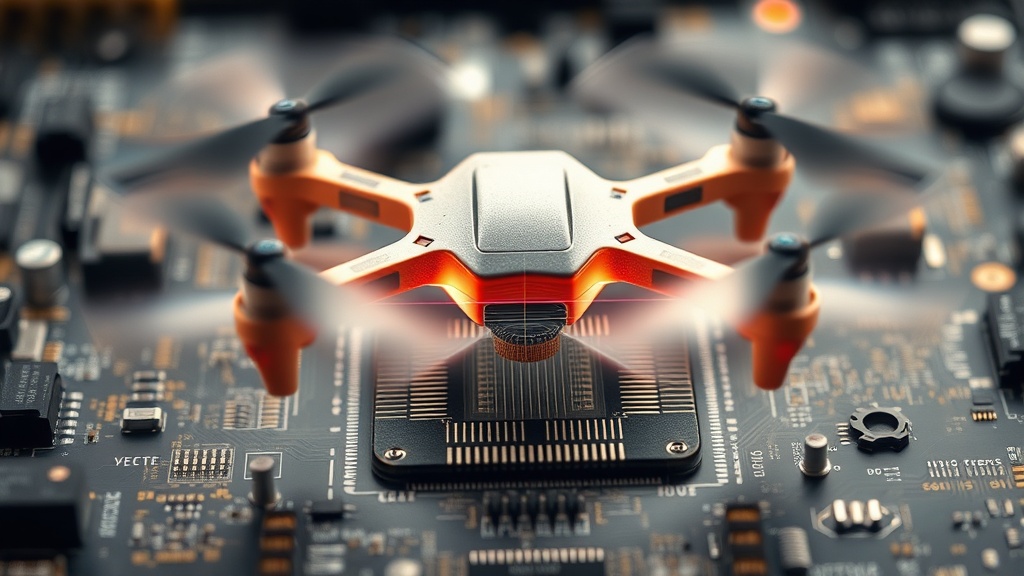
Think of it like a fan on high speed. When you look at a rapidly spinning fan, you don't see individual blades; you see a blur. The Phantom Twist drone applies this same concept to its entire aerial platform. Its rotors, designed for high-speed rotation, generate a visual effect that effectively erases the drone's distinct form from view. The faster it spins, the more pronounced the motion blur, and the closer it gets to true invisibility. This is not about bending light or becoming transparent; it's about overwhelming the visual system with rapid, repetitive information that prevents a clear image from forming.
Engineering for Extreme Rotation
Developing a drone capable of such extreme rotational speeds presented significant engineering challenges. Standard drone rotors are designed for lift and stability, not for sustained, high-velocity spinning that could lead to structural failure. The Phantom Twist likely incorporates specialized materials and rotor designs to withstand the immense centrifugal forces involved. Furthermore, the power requirements for such high-speed rotation would be substantial, necessitating an efficient and robust power system. The control mechanisms also need to be incredibly precise to maintain stability while operating at these velocities.
The researchers had to balance the desire for invisibility with the practicalities of drone operation. A drone that is completely invisible might be difficult to track for control purposes, even for its operator. Therefore, the system likely operates within specific parameters where the blur effect is maximized but control is still maintained. This could involve optimizing rotor speed based on ambient light conditions, background complexity, and the desired level of stealth. The successful demonstration suggests that these challenges have been overcome, at least in a controlled research environment.
Applications and Implications
The immediate applications for a drone that can effectively disappear are numerous, particularly in fields requiring covert observation. Military and law enforcement agencies could utilize such technology for reconnaissance missions, surveillance, or tactical operations where minimizing detection is paramount. The ability to fly undetected offers a significant advantage in gathering intelligence without alerting targets. This could range from monitoring sensitive areas to tracking individuals or groups without their knowledge.
Beyond security and surveillance, Phantom Twist opens up new avenues for scientific research. For instance, it could be used to study wildlife in its natural habitat without disturbing the animals. Imagine a drone that can hover near a sensitive ecosystem, collecting data and imagery without causing stress to the local fauna. This non-intrusive observation capability could provide invaluable insights into animal behavior, migration patterns, and ecological dynamics.
The technology also presents intriguing possibilities for creators. Filmmakers could use such drones for unique aerial shots, creating effects that are impossible with conventional cameras. Imagine a scene where a drone appears to materialize out of nowhere, or a chase sequence where the pursuer is a blur of motion. Artists might explore the aesthetic potential of a visually elusive aerial platform, creating performances or installations that play with perception and presence. However, the ethical considerations surrounding a truly stealthy drone are substantial and will require careful deliberation and regulation.
The Future of Visual Stealth
The development of Phantom Twist is a significant step in the evolution of aerial technology. It demonstrates that invisibility can be achieved not through exotic materials or active cloaking, but by cleverly exploiting the limitations of human and machine vision. As drone technology continues to advance, we can expect to see further innovations in stealth capabilities, potentially leading to a new arms race in aerial detection and evasion.
What remains to be seen is how this technology will scale and be integrated into practical, deployable systems. The current iteration is likely a proof-of-concept, and miniaturizing the power systems and control mechanisms for widespread use will be the next hurdle. Furthermore, the development of countermeasures that can detect high-speed rotating objects, perhaps through thermal imaging or acoustic sensors, will be crucial as this technology matures. The question for engineers is no longer *if* a drone can be made nearly invisible, but *how* to control and detect such a device in the real world.