
Subquery Pushdown Accelerates Complex Queries
The most significant advancement in pg_clickhouse v0.10 is the implementation of subquery pushdown. This optimization technique allows pg_clickhouse to translate and execute subqueries directly within ClickHouse, rather than pulling intermediate results back into PostgreSQL for processing. This dramatically reduces data transfer and processing overhead, particularly for complex analytical queries that often involve nested or correlated subqueries.
Traditionally, when a PostgreSQL query utilized a subquery intended for analytical processing, the entire subquery result set would be materialized in PostgreSQL. This could become a bottleneck, especially with large datasets, as PostgreSQL is not optimized for the kind of aggregate, columnar-based analytics that ClickHouse excels at. By pushing these subqueries down to ClickHouse, pg_clickhouse leverages ClickHouse's native columnar storage and vectorized query execution engine. This means aggregations, filtering, and joins within the subquery are handled by ClickHouse's highly efficient architecture, leading to substantial performance gains.
The impact of this feature is particularly pronounced in scenarios involving common analytical patterns: calculating running totals, performing self-joins for time-series analysis, or executing complex filtering logic based on aggregated data. Developers and data analysts can now write more intuitive SQL that mirrors their analytical thought process, confident that the underlying execution engine will optimize it for speed.
1000x Speedup on TPC-H Benchmarks
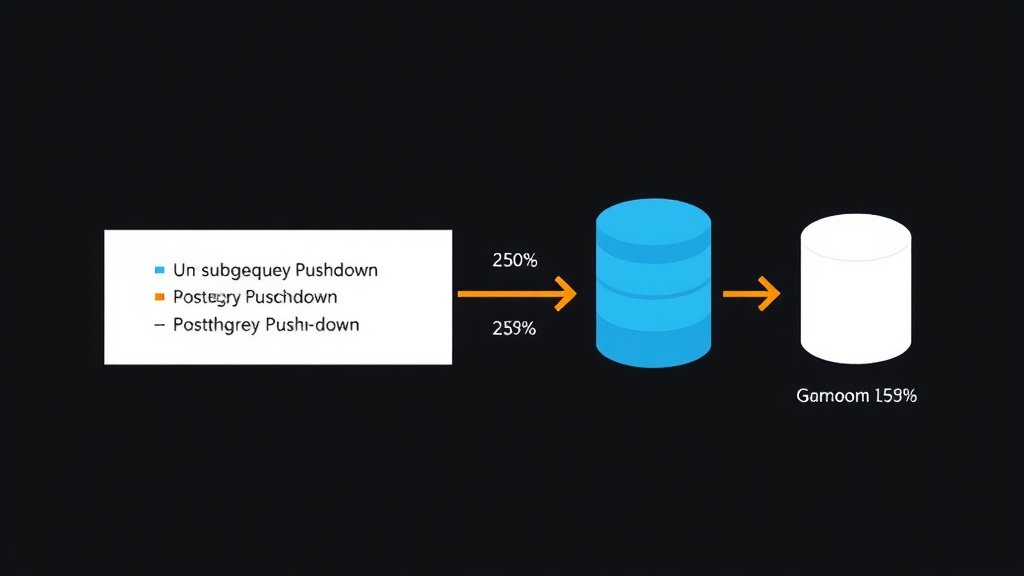
To quantify the performance improvements, the pg_clickhouse team conducted rigorous testing using the TPC-H benchmark suite. This industry-standard benchmark simulates typical decision support system workloads, involving complex queries with aggregations, joins, and subqueries against a large database. The results are striking: pg_clickhouse v0.10 demonstrated query execution speeds up to 1000 times faster than previous versions on certain TPC-H queries.
This leap in performance is a direct consequence of the subquery pushdown optimization, coupled with ongoing enhancements to ClickHouse's core query engine and pg_clickhouse's efficient translation layer. The ability to achieve such dramatic speedups means that organizations can now perform complex, ad-hoc analytics on massive datasets in near real-time, directly from their PostgreSQL environment. This can significantly reduce the need for separate data warehousing solutions or complex ETL pipelines, simplifying data architecture and accelerating time-to-insight.
Consider a scenario where a business analyst needs to understand customer purchasing patterns over the last five years, segmented by region and product category, and then identify customers who spent more than the regional average. Previously, such a query might take hours, if it completed at all, on a large dataset. With v0.10, this could potentially be reduced to minutes or even seconds, enabling more interactive data exploration and faster strategic decision-making.
Expanded Data Type Support and Usability Enhancements
Beyond the headline performance improvements, pg_clickhouse v0.10 also introduces expanded data type support. This includes better handling of complex PostgreSQL types, ensuring greater compatibility and reducing potential data loss or transformation issues when working with diverse datasets. Enhanced support for types like arrays, nested structures, and JSONB means that more sophisticated data models can be seamlessly integrated with ClickHouse's analytical power.
Usability has also been a key focus. The release includes improvements to connection management, error handling, and SQL dialect compatibility. These enhancements aim to make pg_clickhouse easier to set up, manage, and integrate into existing PostgreSQL workflows. For developers and database administrators, this translates to less time spent on troubleshooting and more time on building analytical applications.
The project also continues to refine its foreign data wrapper (FDW) capabilities, allowing PostgreSQL to treat ClickHouse tables as if they were local PostgreSQL tables. This abstraction layer is crucial for integrating ClickHouse into the broader PostgreSQL ecosystem, enabling tools and applications that interact with PostgreSQL to seamlessly query data residing in ClickHouse without requiring specialized ClickHouse drivers.
Broader Implications for Hybrid Data Architectures
The advancements in pg_clickhouse v0.10 signal a maturing approach to hybrid data architectures, where the transactional strengths of PostgreSQL are combined with the analytical prowess of columnar databases like ClickHouse. This release demonstrates that the boundary between OLTP and OLAP systems can become increasingly blurred, offering a unified interface for diverse data workloads.
For companies already invested in PostgreSQL, pg_clickhouse offers a compelling path to unlock high-performance analytics without a complete database migration. It allows them to leverage existing SQL skills and tooling while gaining access to ClickHouse's superior performance for data warehousing, business intelligence, and complex reporting. The simplified data access and improved performance reduce the architectural complexity and operational overhead traditionally associated with managing separate OLTP and OLAP systems.
What remains to be seen is how quickly other PostgreSQL extensions or similar hybrid solutions will adopt comparable subquery pushdown mechanisms. The success of this feature in pg_clickhouse may set a new benchmark for performance expectations in integrated analytical solutions, pushing competitors to innovate and offer similar optimizations to their users.