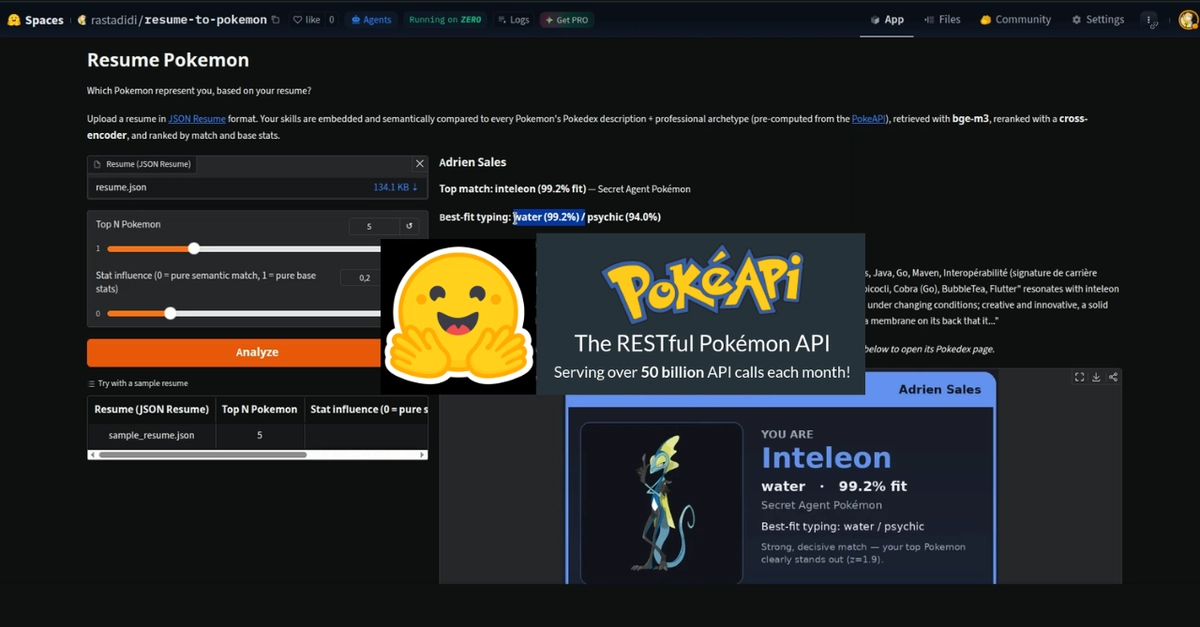
The Core Idea: Matching Personalities with Pokemon
At its heart, this project is about mapping human personality traits, as expressed in a resume, to the archetypal personalities of Pokemon. The goal is to answer the question: "Which Pokemon best represents me?" This isn't just a fun thought experiment; it leverages modern AI techniques like embeddings to create a surprisingly sophisticated matching system. The underlying principle is that language carries meaning, and by converting text into numerical representations, we can compare them. Think of it less like a simple keyword search and more like asking an AI to understand the *vibe* of your resume and compare it to the *vibe* of a Pokemon.
How It Works: From Resume Text to Pokemon Matches
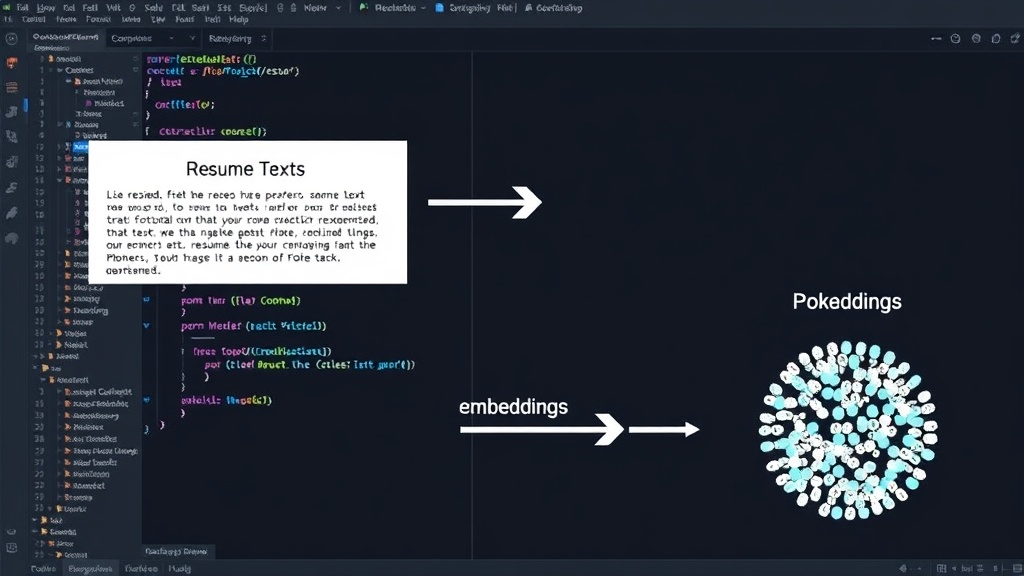
The process starts with the user's resume. This document, typically filled with professional experience, skills, and achievements, is fed into an embedding model. Embeddings are numerical vectors that capture the semantic meaning of text. Words, sentences, or entire documents can be represented as these vectors. The key here is that similar meanings result in vectors that are close to each other in a high-dimensional space. The developer used an embedding model to process the resume, transforming its textual content into a single, dense vector representing the user's professional persona.
The next crucial component is PokéAPI, a comprehensive, free API for all things Pokemon. This API provides data on every Pokemon, including their types, abilities, base stats, and even descriptions. For this project, the relevant data points are those that can be interpreted as personality traits. While not explicitly defined as 'personality' in the API, attributes like Pokedex descriptions, primary/secondary types (e.g., Psychic for intelligence, Fighting for strength, Water for adaptability), and even certain abilities can be inferred as indicators of character.
The system then processes the Pokemons' data, also converting descriptive text and relevant attributes into embeddings. This creates a parallel set of vectors, one for the user's resume and one for each Pokemon. The matching algorithm then calculates the distance between the resume's embedding vector and each Pokemon's embedding vector. The Pokemon whose vector is closest to the resume's vector is deemed the best match – your spirit Pokemon.
Technical Underpinnings: Embeddings and Semantic Search
The magic behind this project lies in the use of embeddings. Traditionally, finding matches between documents or concepts involved keyword matching or complex rule-based systems. Embeddings, particularly those generated by large language models (LLMs), offer a more nuanced approach. They learn to represent words and phrases based on their context, allowing for comparisons that go beyond mere word overlap.
For instance, if a resume mentions "strategic planning," "team leadership," and "problem-solving," an embedding model can infer a persona that values foresight, guidance, and analytical thinking. Similarly, a Pokemon like Alakazam, known for its immense psychic power and intelligence, would have embeddings reflecting these traits. The system then finds the Pokemon whose embedding is closest to the resume's embedding, effectively performing a semantic search for personality alignment.
The choice of embedding model is critical. Models trained on vast amounts of text data can capture subtle linguistic patterns. The developer likely used a model accessible via an API or a library that can process text and output these dense vector representations. The accuracy of the match directly correlates with the quality of the embeddings and how well the chosen Pokemon attributes (like descriptions and types) align with the qualities one might infer from a resume.
Why This Matters: Beyond a Fun Weekend Project
While framed as a fun weekend challenge, this project demonstrates practical applications of AI in personalization. Imagine this concept applied to:
- Career Counseling: Helping individuals understand their strengths and potential career paths based on their self-description.
- Team Building: Identifying individuals whose professional styles might complement each other.
- Recruitment: Potentially identifying candidates whose inferred personality aligns with a company's culture (though this raises significant ethical considerations).
- Personalized Content: Recommending books, movies, or even courses based on an inferred user profile.
The surprising detail here is not the use of PokéAPI, which is a readily available resource, but the sophisticated application of resume embeddings to a seemingly whimsical task. It shows how AI can bridge the gap between abstract concepts (like personality) and structured data (like resumes and API information) in novel ways.
Future Directions and Unanswered Questions
This project opens up several avenues for future development. Could more nuanced personality traits be extracted? What about incorporating other data sources, like LinkedIn profiles or personal essays? How would different embedding models affect the accuracy of the matches?
What remains unaddressed is the potential for bias in the embedding models and the interpretation of Pokemon traits. Are certain Pokemon archetypes inherently associated with positive or negative connotations that could unfairly influence the results? Furthermore, as AI tools become more integrated into professional life, like Claude Code mentioned by the author for yearly reviews, understanding how these tools interpret personal data becomes increasingly important. This project, while lighthearted, touches on the deeper implications of AI in understanding and categorizing individuals based on their digital footprint.