The Shifting Landscape of Hardware Design
For decades, hardware development followed a predictable cycle: a few large players designed powerful, general-purpose chips, and the rest of the world adapted. This era, characterized by monolithic architectures and a one-size-fits-all approach, is rapidly drawing to a close. We are entering the age of personalized hardware, where specialized silicon, tailored to specific tasks and applications, will become the norm. This shift is not driven by a single innovation but by the confluence of several powerful trends: the pervasive influence of artificial intelligence, the rise of open-source hardware architectures like RISC-V, and the maturation of advanced manufacturing techniques.
The core of this transformation lies in the demand for efficiency and performance that general-purpose hardware can no longer meet for increasingly specialized computational needs. AI workloads, in particular, require architectures optimized for matrix multiplication, parallel processing, and specific data types. While GPUs have been the workhorses for deep learning, they are often over-provisioned and energy-inefficient for many inference tasks. This has created an opening for custom-designed chips, often referred to as ASICs (Application-Specific Integrated Circuits) or domain-specific architectures (DSAs), that can perform these operations with far greater speed and lower power consumption.
The AI Imperative for Specialization
Artificial intelligence is the primary catalyst for personalized hardware. As AI models grow larger and more complex, and as their deployment expands from massive data centers to edge devices, the need for hardware tailored to AI computations becomes critical. Traditional CPUs and even GPUs, designed for broad applicability, struggle to deliver the optimal balance of performance, power efficiency, and cost for specific AI tasks. Think of it less like using a powerful, general-purpose wrench for every bolt and more like having a custom-made socket for each specific fastener. This is where personalized hardware, designed from the ground up for neural network inference, training, or specific algorithms, shines.
These custom chips can drastically reduce latency, cut energy consumption, and lower the overall cost of deploying AI. For instance, a chip designed solely for real-time object detection in autonomous vehicles will not waste precious silicon real estate on graphics rendering or general-purpose computing. It will be packed with specialized cores and memory hierarchies optimized for the specific mathematical operations and data flows involved in computer vision. This hyper-optimization is what unlocks new levels of performance and efficiency previously unattainable.
RISC-V: The Open Foundation for Custom Silicon
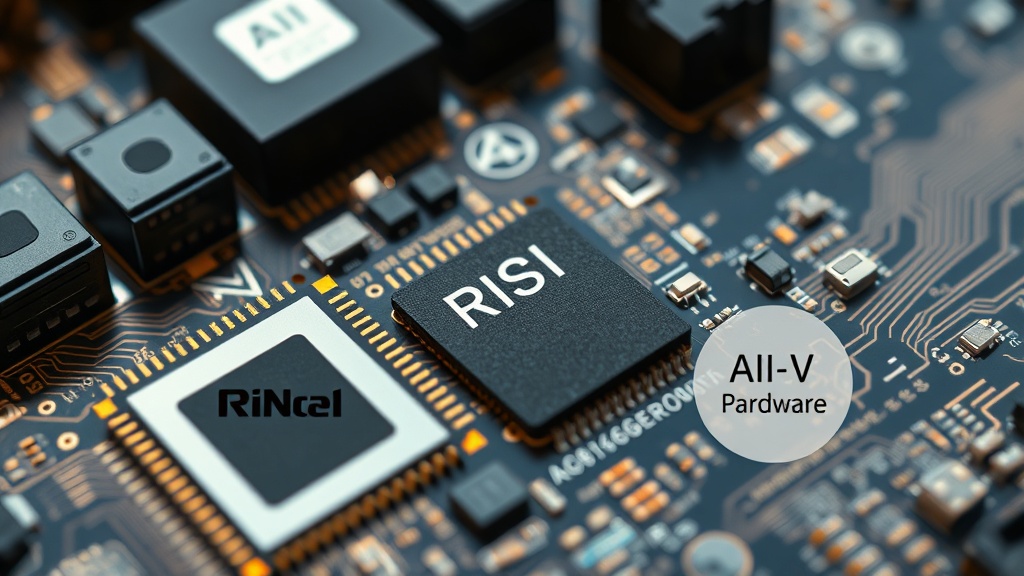
The rise of RISC-V is another pivotal factor. Unlike proprietary architectures such as ARM or x86, RISC-V is an open-source instruction set architecture (ISA). This openness means anyone can design, manufacture, and sell RISC-V chips and IP without paying licensing fees. This democratization of silicon design fundamentally lowers the barrier to entry for creating custom hardware. Startups and even individual teams can now design their own specialized processors, integrating custom extensions for AI acceleration, cryptography, or other specific functions, without needing to negotiate complex licensing agreements with established players.
RISC-V's modularity is key. Developers can select and customize only the extensions they need, creating highly tailored processors. This is akin to building a modular kitchen; you pick only the cabinets, countertops, and appliances you require, avoiding the cost and complexity of features you'll never use. This flexibility allows for the creation of extremely lean, efficient, and application-specific processors. The open ecosystem also fosters rapid innovation, as a global community of researchers and engineers contribute to its development and create a rich set of readily available IP blocks.
Advanced Manufacturing Enables Tailored Production
Complementing AI and RISC-V are advancements in manufacturing technologies. Techniques like advanced packaging (chiplets), heterogeneous integration, and increasingly sophisticated semiconductor fabrication processes are making it feasible and cost-effective to produce smaller batches of specialized chips. The old model of high-volume, multi-billion dollar fabrication plants was only economical for mass-produced, general-purpose chips. However, new methods allow for the assembly of chips from smaller, pre-fabricated functional blocks (chiplets) that can be sourced from different foundries and optimized for different tasks.
This chiplet approach allows for a more flexible and modular design process, similar to how software developers assemble applications from microservices. A complex system can be built by combining a RISC-V CPU core, an AI accelerator chiplet, a memory controller chiplet, and an I/O chiplet, all connected through a high-speed interconnect. This enables rapid prototyping and iteration, and it allows for the optimization of each component independently. Furthermore, advancements in additive manufacturing and specialized foundries are beginning to cater to lower-volume, high-value custom silicon production, making personalized hardware accessible beyond the hyperscalers.
The Implications for Every Sector
The age of personalized hardware promises a profound impact across numerous industries. For developers, it means access to more powerful and efficient tools. Instead of being constrained by the limitations of general-purpose hardware, they can leverage silicon designed specifically for their applications, leading to faster development cycles and more innovative products. Imagine building a robotics simulation that runs orders of magnitude faster because the underlying hardware is optimized for physics calculations, or developing an on-device AI application for healthcare diagnostics that is both highly accurate and incredibly power-efficient.
Founders can build entirely new product categories or significantly enhance existing ones by exploiting the unique performance and efficiency gains offered by custom silicon. Companies that traditionally relied on off-the-shelf processors might find their competitive edge eroded by rivals who adopt tailored hardware solutions. This could lead to a significant shift in market dynamics, where hardware specialization becomes a key differentiator and a source of competitive moat.
Security professionals will also see changes. While custom hardware can be designed with enhanced security features from the ground up, it also introduces new complexities in verification and supply chain management. The proliferation of diverse, custom silicon components may create new attack vectors if not managed meticulously. However, the ability to bake security directly into the silicon for specific functions, such as secure enclave operations or hardware-based encryption, offers unprecedented levels of protection.
Looking Ahead: A New Era of Computation
The transition to personalized hardware is not an overnight event. It requires significant investment in design tools, IP development, and verification methodologies. However, the trajectory is clear. The demand for computational efficiency, fueled by AI, coupled with the enabling power of open architectures like RISC-V and advanced manufacturing, is paving the way for a future where hardware is no longer a constraint but a precisely tailored solution. This era promises a more efficient, powerful, and specialized computational landscape, unlocking possibilities we are only beginning to imagine.