The Problem with Traditional Journaling
Journaling has long been a tool for self-reflection, but its effectiveness often stops at recording thoughts. Users frequently struggle to extract deeper meaning, identify recurring patterns, or organize complex emotions. Turning these reflections into practical, actionable steps for personal growth remains a significant challenge. Furthermore, maintaining the privacy of deeply personal journal data in an increasingly connected world is a paramount concern.
Traditional journaling, while valuable for capturing thoughts, often lacks the analytical power to help users truly understand themselves. The process can feel like shouting into the void; you record your thoughts, but without a sophisticated mechanism to process them, they remain just that – recorded thoughts. This is where AI can offer a transformative layer, moving beyond simple note-taking to active analysis and insight generation. The goal is to bridge the gap between introspection and tangible progress.
Introducing Personal Gemini Journal
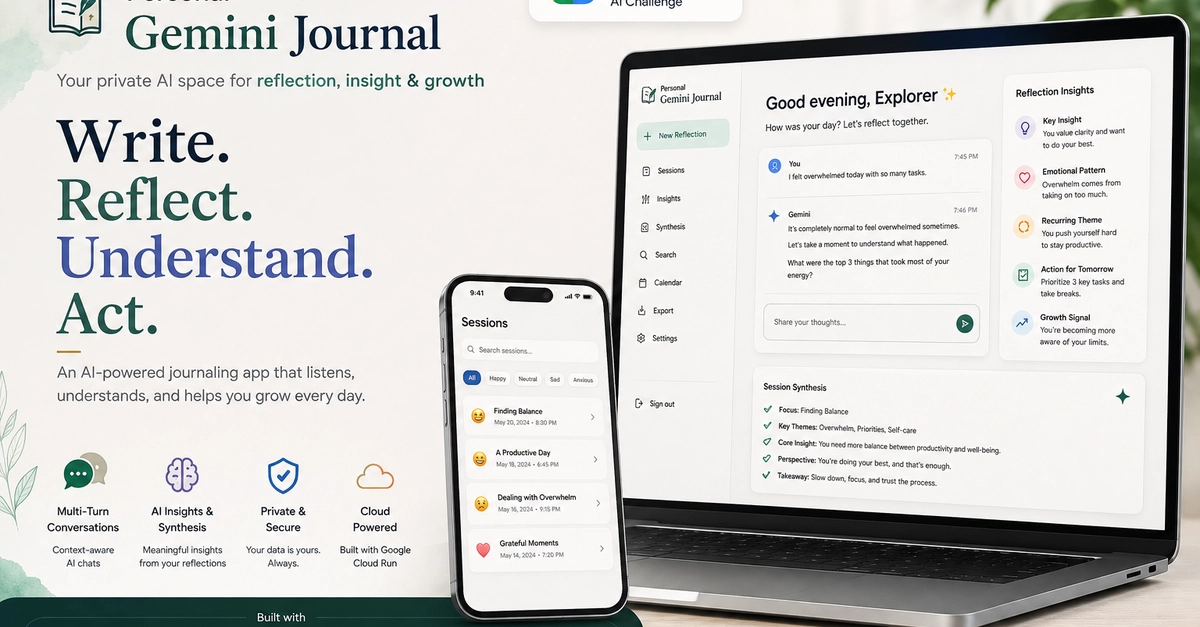
Personal Gemini Journal, developed as part of the Google Cloud Run AI Challenge, tackles these issues head-on. It’s designed to be more than just a digital notebook; it’s a private, AI-powered companion for self-discovery. The app follows a simple yet powerful workflow: Write → Reflect → Understand → Act. This cycle encourages users to not only document their experiences but also to engage in meaningful dialogue with an AI that can help them process their entries.
At its core, the application leverages Google’s Gemini AI model for natural language understanding and generation. This allows the journal to offer conversational reflection, helping users explore their thoughts from different angles. Instead of a static entry, users can have a dynamic exchange with the AI about their feelings, experiences, and ideas. The AI can help identify underlying themes, question assumptions, and prompt deeper introspection. This interactive element is key to transforming passive recording into active processing.
The architecture of Personal Gemini Journal is built on robust Google Cloud services, emphasizing security and scalability. Firebase is used for authentication and database management, ensuring user data is handled securely. Cloud Run provides a serverless environment for running the AI model, allowing the application to scale automatically based on user demand without requiring manual infrastructure management. This combination ensures that the application is not only functional but also secure and capable of growing with its user base.

Key Features and How They Work
The Personal Gemini Journal app aims to provide a comprehensive suite of features to enhance the journaling experience:
- Secure & Private Storage: User data is stored securely, with Firebase providing a reliable and protected backend. This ensures that personal reflections remain private and accessible only to the user. The emphasis on privacy is critical for an application dealing with sensitive personal information.
- AI-Powered Reflection: The integration of Gemini AI allows for intelligent analysis of journal entries. Users can ask the AI to identify patterns, summarize recurring themes, or explore the emotional context of their entries. This moves beyond simple keyword searches to a more nuanced understanding of the content.
- Actionable Insights Generation: The app doesn't just help users understand their thoughts; it guides them toward action. By analyzing reflections, the AI can suggest concrete steps or strategies to address challenges, pursue goals, or improve well-being. This closes the loop from introspection to practical application.
- Personal Growth Tracking: Over time, the AI can help users review their progress, highlighting how their thoughts and actions have evolved. This provides a valuable overview of personal development, reinforcing positive changes and identifying areas that still require attention.
- Organized Thought Processing: For complex or overwhelming thoughts, the AI can assist in breaking them down, categorizing them, and presenting them in a more digestible format. This makes it easier for users to tackle multifaceted issues systematically.
The Technology Stack Behind the Journal
The choice of technology reflects a focus on modern, scalable, and secure cloud-native development. Google Cloud Run provides the serverless compute layer, allowing the AI model to run efficiently and scale on demand. This is crucial for handling potentially large volumes of text processing and AI inference without over-provisioning resources. Cloud Run abstracts away much of the operational overhead, letting developers focus on the application logic.
Firebase serves as the backend-as-a-service (BaaS) platform, handling crucial aspects like user authentication and data persistence. Firestore, Firebase’s NoSQL document database, is well-suited for storing journal entries, which can vary in structure and length. Realtime Database could also be leveraged for certain features requiring immediate data synchronization. The integration of Firebase simplifies the development of secure user management and data storage, which are fundamental for a personal journaling application.
The Gemini AI model is the intellectual engine of the application. Its advanced natural language processing capabilities enable sophisticated analysis of user-provided text. This includes sentiment analysis, topic modeling, pattern recognition, and the generation of contextually relevant responses. The ability of Gemini to understand and generate human-like text makes the conversational reflection aspect of the journal feel natural and insightful. The development for the Google Cloud Run AI Challenge specifically highlights the synergy between these components.
Implications for AI-Powered Personal Development
Personal Gemini Journal represents a significant step in leveraging AI for personal growth and mental well-being. By focusing on privacy and actionable insights, it addresses key limitations of both traditional journaling and generic AI chatbots. The app demonstrates how AI can move beyond entertainment or productivity tools to become a genuine partner in self-understanding and development.
The success of such applications hinges on building trust through robust security and transparent data handling. Users must feel confident that their most private thoughts are protected. The use of established cloud services like Firebase and Cloud Run, coupled with a powerful AI like Gemini, provides a strong foundation for this trust. As AI technology continues to evolve, we can expect to see more sophisticated applications that integrate seamlessly into our daily lives, offering personalized support for mental health, learning, and personal development.
The challenge ahead for developers in this space will be to balance the power of AI with the need for user control and privacy. Making AI insights truly actionable, rather than just interesting observations, will be key to sustained user engagement. What remains to be seen is how effectively these AI-driven reflection tools can be integrated into broader wellness ecosystems or how they might evolve to offer therapeutic support, always with ethical considerations at the forefront.