The Flaw in Standard RAG's Assumption
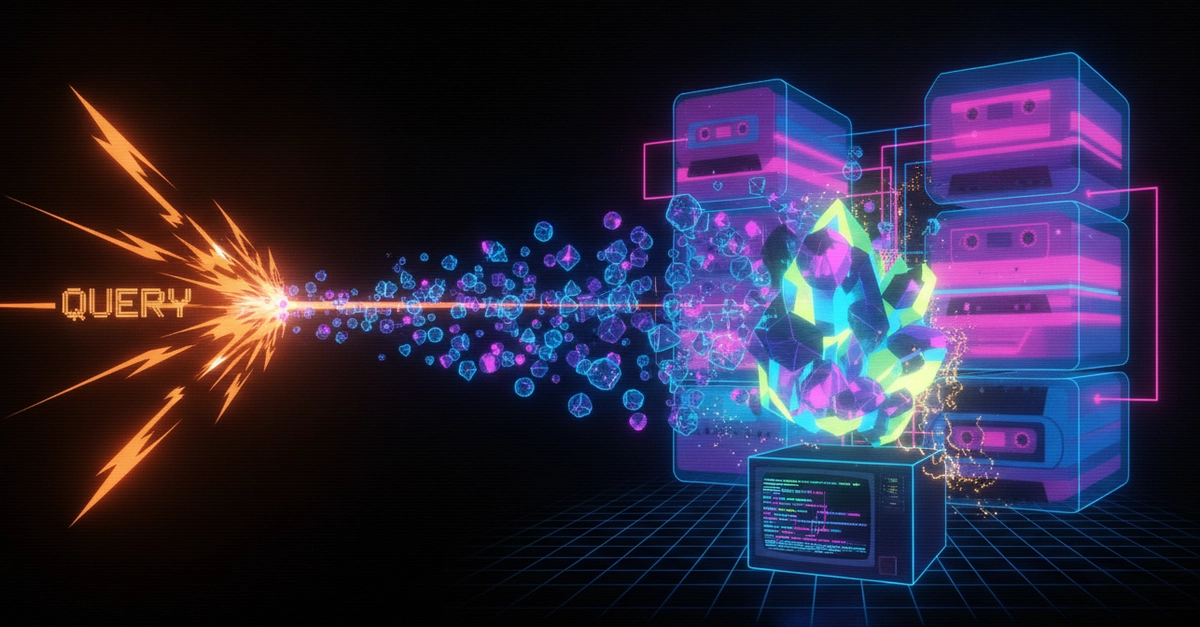
Most Retrieval-Augmented Generation (RAG) demonstrations operate on a critical, yet often unstated, assumption: a user's query can be satisfied by a single vector search. This works perfectly for simple, isolated questions like "What is our parental leave policy?" In such cases, the system embeds the query, performs a top-k lookup in a vector database, retrieves a single relevant chunk, and feeds it into the language model for an answer. This linear, pipeline approach is efficient and effective for straightforward information retrieval.
However, this model breaks down dramatically when faced with the complexity of real-world user queries. Consider a question like: "Did the carrier rate change we approved in Q2 actually reduce our cost per shipment in the Northeast, and does that hold if I exclude the Boston depot?" This query is not a single information retrieval task. It requires accessing multiple data sources: a policy document, a rate table, transactional aggregates, and the ability to perform filtered re-computations. A standard RAG system would embed this complex sentence, find the three chunks nearest to it in vector space, and likely return text that is topically adjacent but factually irrelevant or insufficient to answer the nuanced question. The language model, forced to work with poor input, will attempt to answer, often fabricating information or providing a vague, unhelpful response. The problem isn't necessarily the embedding model or the chunking strategy; it's the fundamental limitation of treating retrieval as a static, one-shot pipeline stage.
Introducing Agentic RAG: Dynamic Retrieval at Runtime
Agentic RAG fundamentally shifts how retrieval operates. Instead of a fixed pipeline, it treats retrieval as a dynamic, runtime decision-making process, orchestrated by an agent. This agent acts as an intelligent controller, capable of understanding complex user intents and breaking them down into a series of actions. These actions can include multiple retrieval steps, data analysis, tool usage, and iterative refinement of information.
Think of standard RAG like a librarian who, when asked a question, pulls only the single book closest to the subject on the shelf. Agentic RAG is like a research assistant who, upon receiving the same question, might first consult an index, then pull several books, cross-reference information between them, perhaps even run a quick statistical analysis on some data tables found within, and only then synthesize a comprehensive answer. The agent doesn't just retrieve; it plans, executes, and reasons about the retrieval process itself.
The core of agentic RAG lies in the agent's ability to assess the user's query and determine the *best* way to gather the necessary information. This might involve:
- Decomposing complex queries: Breaking down a multi-faceted question into smaller, manageable sub-questions.
- Selecting appropriate tools: Deciding whether to perform a vector search, query a structured database, call an API, or execute a piece of code.
- Iterative retrieval: Performing multiple retrieval steps, using the results of one step to inform the next. For example, a first retrieval might identify relevant policy documents, and a subsequent retrieval might query a database for specific data points mentioned within those policies.
- Reasoning and synthesis: Using the retrieved information to construct a coherent and accurate answer, potentially involving calculations or logical deductions.
This approach moves retrieval from a passive data retrieval step to an active, intelligent process integrated with the language model's reasoning capabilities. The agent acts as a meta-controller, guiding the entire information-gathering and response-generation workflow.
The Technical Underpinnings and Challenges
Implementing agentic RAG involves leveraging advanced LLM capabilities, particularly in tool use and multi-step reasoning. Frameworks like LangChain and LlamaIndex are actively developing abstractions and patterns to support agentic workflows. These typically involve:
- Agent Orchestration: Using an LLM as the central reasoning engine to decide which action to take next. This often involves prompt engineering to define the agent's capabilities, goals, and available tools.
- Tool Definition: Exposing various data sources and computational functions as 'tools' that the LLM agent can call. This could include vector databases, SQL databases, APIs, or custom Python functions.
- Memory and State Management: Maintaining context across multiple turns of interaction or multiple steps within a single query, allowing the agent to build upon previous findings.
The primary challenge is managing the complexity and reliability of the agent's decision-making. While powerful, LLMs can still hallucinate or make logical errors. Ensuring that the agent reliably selects the correct tools, interprets their outputs accurately, and avoids infinite loops or incorrect reasoning is an ongoing area of research and development. The cost of executing multiple LLM calls for orchestration, tool execution, and final synthesis can also be significantly higher than a single RAG query.
What This Means for Developers and Users
For developers, agentic RAG represents a significant evolution in building more capable AI applications. It allows for the creation of systems that can tackle far more complex user intents than standard RAG. Instead of building a new RAG pipeline for every type of complex query, developers can design agents that are adaptable and can dynamically leverage various data sources and computational tools. This opens the door to applications that can act as sophisticated knowledge workers, capable of complex analysis and problem-solving.
Users, on the other hand, will experience AI systems that are more robust, accurate, and capable of handling nuanced, multi-part questions. They will no longer be limited by the system's ability to map their query to a single document. Instead, they can interact with AI assistants that can genuinely understand and act upon complex requests, leading to higher satisfaction and more effective problem resolution. The shift from a static retrieval pipeline to a dynamic, agent-driven approach marks a crucial step towards more intelligent and versatile AI applications.