
What is WebForms Core?
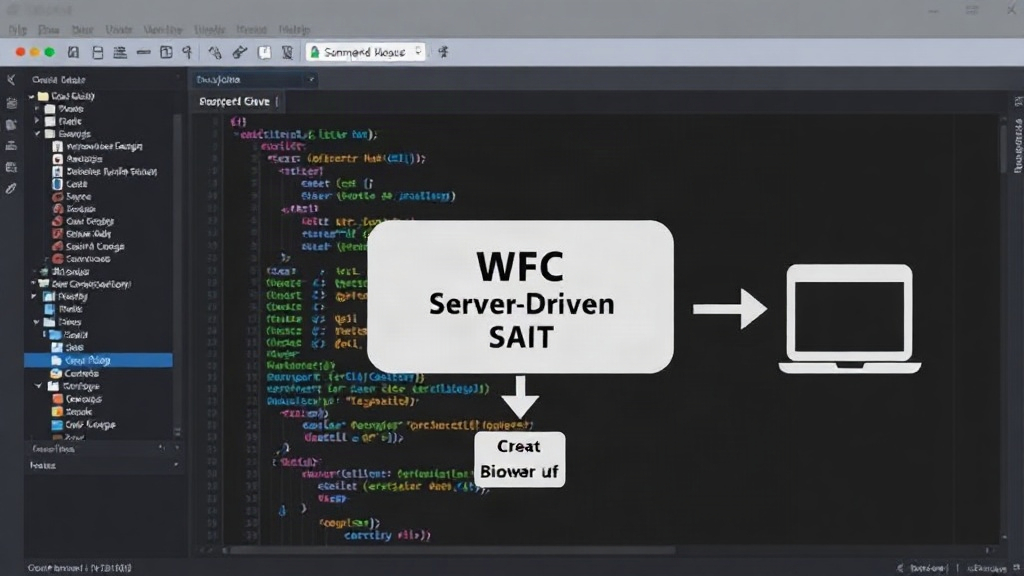
Perl has a long history in server-side web development, often handling logic and data. However, modern web applications frequently offload UI manipulation to JavaScript frameworks running in the browser. WebForms Core (WFC) offers an alternative: a server-driven approach where the server generates UI commands executed by a browser runtime. This technology, developed by Elanat, allows server applications to construct commands using the WebForms class to manipulate the HTML DOM and control UI behavior directly. The goal is to keep UI logic on the server, simplifying development and potentially improving performance by reducing client-side processing.
Instead of building a separate frontend application or relying on complex JavaScript for every user interaction, WFC allows the server to orchestrate the UI. The WebFormsJS library handles the execution of these commands in the browser. This means developers can write Perl code that dictates how the user interface looks and behaves, sending instructions to the client that the browser runtime then interprets and applies.
Integrating WFC with Mojolicious in Perl
This article demonstrates how to integrate WebForms Core with Perl, specifically using the Mojolicious framework. Mojolicious is a real-time web framework for Perl, known for its speed and extensibility. Combining WFC with Mojolicious allows developers to leverage Perl's server-side strengths for building interactive web interfaces. The process involves setting up a Mojolicious application and then incorporating WFC commands into the server's response.
The core idea is to have the Perl server application generate a sequence of WFC commands. These commands are then embedded within the HTML response sent to the browser. The WebFormsJS runtime, included in the client-side, parses these commands and executes them. This could involve updating specific DOM elements, showing or hiding components, handling user input events, or triggering animations, all without requiring the developer to write explicit JavaScript for these actions. The server acts as the single source of truth for UI state and behavior.
Consider a scenario where a user clicks a button. Traditionally, a JavaScript event listener would capture this click, potentially make an AJAX call to the server, receive data, and then update the DOM. With WFC, the Perl server could be configured to listen for this button click event (via a WFC-generated event handler on the client). Upon receiving the click instruction from the client, the server processes the request and sends back new WFC commands to update other parts of the page, such as displaying a success message or refreshing a list, all managed from the Perl backend.
Benefits of a Server-Driven UI with Perl
The primary advantage of using WFC with Perl is the consolidation of UI logic on the server. This can lead to several benefits:
- Simplified Development: Developers can focus on writing Perl code, reducing the cognitive load of managing separate frontend and backend codebases or learning complex JavaScript frameworks.
- Consistency: UI behavior is dictated by the server, ensuring consistency across different browsers and client environments, as the server logic is the single point of control.
- Performance Potential: While client-side rendering can be fast, server-driven UI can be efficient for applications with complex state management or where initial load times are critical. The server can pre-render or pre-process UI elements and send only necessary updates.
- Maintainability: Centralizing UI logic on the server can make applications easier to maintain and update. Changes to UI behavior can be made in one place (the Perl backend) and propagated to all clients.
This approach is particularly compelling for developers already invested in the Perl ecosystem who want to build modern, interactive web applications without a steep learning curve into contemporary JavaScript development practices. It offers a path to create dynamic user experiences using familiar server-side programming paradigms.
Potential Use Cases and Considerations
WebForms Core with Perl is well-suited for applications where the server has significant control over the application's state and logic. This includes internal tools, content management systems, administrative dashboards, and data-intensive applications where the UI is heavily driven by backend data and business rules. For example, an e-commerce backend could use WFC to dynamically update order status displays or manage product inventory interfaces directly from the Perl application managing the data.
However, it's important to consider the potential trade-offs. Heavy reliance on server-driven UI might introduce latency for highly interactive, real-time applications that demand instant visual feedback. The round trip from client event to server processing and back to client UI update could be noticeable if not carefully managed. Developers need to architect their applications to minimize this latency, perhaps by strategically using WFC for less time-sensitive updates or by optimizing server response times.
The surprising detail here is not that Perl can be used for web UIs, but that a mature server-side language can still offer a viable path to modern, interactive web experiences by abstracting away client-side complexity. It challenges the notion that all dynamic UIs must be built with client-side JavaScript frameworks from the ground up. The success of this approach hinges on the efficiency of the WFC command generation and execution, and the developer's ability to design efficient server-side logic that translates into responsive client UIs.
The Future of Server-Driven UI in Perl
The adoption of WebForms Core in Perl signifies a potential shift in how Perl developers approach web application interfaces. By providing a structured way to manage UI from the server, WFC democratizes the creation of dynamic web applications for those already proficient in Perl. As the technology matures and more examples emerge, it could empower a new generation of Perl-based web applications that are both powerful and maintainable. If you are a Perl developer looking to build interactive web interfaces without adopting a full JavaScript frontend stack, exploring WFC with Mojolicious is a compelling next step.