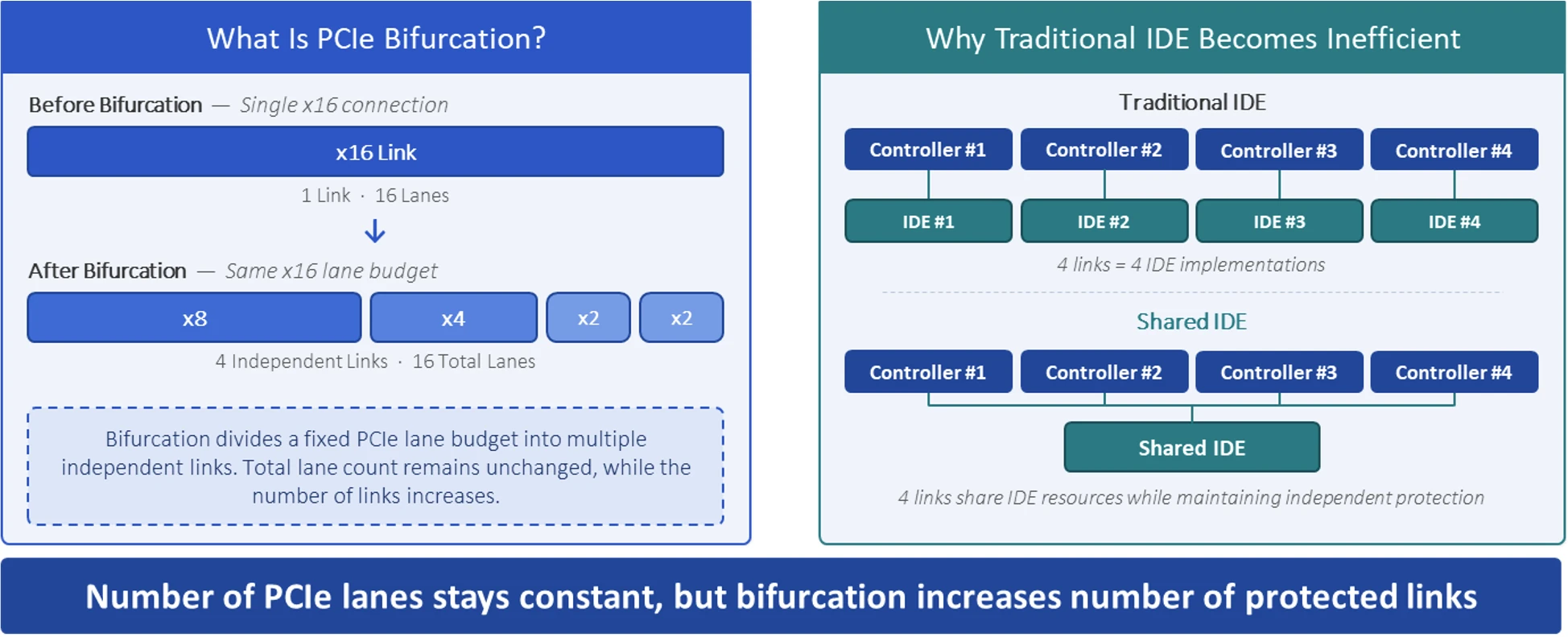
The Challenge of PCIe Bifurcation Security
Peripheral Component Interconnect Express (PCIe) bifurcation is a powerful technique that allows a single PCIe slot to be divided into multiple smaller links. This flexibility is crucial for modern server and high-performance computing architectures, enabling denser configurations and better resource utilization. However, this division introduces significant security challenges. Each bifurcated link, potentially serving a different device or function, requires its own independent security mechanisms. Managing these individual protections across numerous links and controllers can quickly become an overwhelming task, consuming substantial system resources and increasing complexity for designers and security professionals.
Traditionally, securing bifurcated PCIe links meant implementing dedicated security logic for each controller and, by extension, each bifurcated endpoint. This approach is akin to giving every single room in a large hotel its own unique, complex security system and a dedicated security guard. While it offers granular control, the overhead in terms of hardware resources, design effort, power consumption, and ongoing management is immense. As systems grow more complex, with dozens or even hundreds of bifurcated links, this model becomes unsustainable. The sheer volume of individual security policies, key management operations, and potential attack surfaces multiplies exponentially, demanding ever-increasing resources and increasing the likelihood of misconfiguration or oversight.
Introducing the Shared Infrastructure Security Model
The core innovation described is a new approach to managing security for PCIe bifurcation that moves away from individual, isolated security per link. Instead, it proposes a shared infrastructure for security, often referred to as a Shared Integrated Development Environment (IDE) in this context, though the term IDE here signifies a shared security framework rather than a coding environment. This shared security model allows multiple PCIe controllers and their associated links to leverage a common security infrastructure while still maintaining independent protection mechanisms for each link. Think of it less like a separate security guard for every room, and more like a centralized, highly efficient security operations center that monitors and manages the security for the entire hotel, dispatching specialized response teams only when specific threats are detected in individual rooms. This drastically reduces the need for duplicated hardware and complex, per-link management logic.
This shared infrastructure can abstract away many of the low-level security details, providing a unified interface for policy enforcement, authentication, and threat detection. For instance, rather than each controller managing its own cryptographic keys and operations for link integrity, a central security module handles these functions. This module can then serve multiple controllers, performing the necessary encryption, decryption, or integrity checks as requested. The key is that while the underlying security operations might be centralized or shared, the policies and the enforcement points remain distinct for each bifurcated link. This ensures that a security event or policy violation on one link does not affect others, preserving the required isolation and independence.
Key Benefits: Scaling Security, Reducing Complexity
The primary advantage of this shared IDE for PCIe bifurcation is its ability to scale security without a proportional increase in complexity or resource consumption. By consolidating common security functions, such as key management, policy enforcement, and root of trust operations, into a shared component, designers can significantly reduce the silicon area, power budget, and design effort required. This translates directly into cost savings and enables the deployment of more sophisticated security features in resource-constrained environments.
Furthermore, simplifying the security architecture leads to fewer potential points of failure and easier management. Instead of configuring and monitoring dozens or hundreds of individual security instances, administrators can focus on a more manageable, centralized security framework. This reduction in complexity lowers the risk of human error in configuration, a common source of security vulnerabilities. The shared model also facilitates easier updates and patching of security logic, as updates can often be applied to the central infrastructure rather than to every individual link.
This approach is particularly relevant for emerging security standards and requirements within PCIe, such as those related to confidential computing, secure boot, and advanced access control. Implementing these advanced features on a per-link basis would be prohibitively expensive and complex. A shared infrastructure makes these advanced security capabilities more attainable and deployable across a wider range of systems, from enterprise servers to edge devices.
Implementation Considerations and Future Outlook
Implementing a shared IDE for PCIe bifurcation requires careful architectural design. Key considerations include ensuring the security of the shared infrastructure itself, as it becomes a high-value target. Robust isolation mechanisms are needed to prevent interference or breaches between different bifurcated links accessing the shared resources. The interface between the shared security module and the individual PCIe controllers must be well-defined and secure, ensuring that requests from controllers are authenticated and authorized correctly.
The ongoing evolution of PCIe standards, including PCIe 6.0 and beyond, with their increased speeds and new features like CXL (Compute Express Link), will only amplify the need for efficient and scalable security solutions. Technologies like memory encryption, secure device discovery, and attestation will become critical. A shared security framework is well-positioned to address these future requirements, providing a foundation for robust security that can adapt to the increasing demands of high-performance computing and data-intensive workloads. The challenge now lies in the widespread adoption and standardization of such shared security models to ensure interoperability and a consistent security posture across diverse hardware platforms.