
The Bandwidth Imperative
The relentless growth in data generation and processing demands, particularly from AI/ML workloads, high-performance computing (HPC), and advanced networking, necessitates a significant leap in interconnect performance. PCI Express (PCIe) has consistently been the backbone of system connectivity, evolving to meet these challenges. PCIe 7.0, the latest iteration, is poised to double the bandwidth of its predecessor, PCIe 6.0, pushing the limits of serial I/O technology.
PCIe 7.0 aims to deliver up to 128 GT/s per lane, translating to a staggering 512 GB/s bidirectional bandwidth for a x16 link. This dramatic increase is achieved through a combination of advanced signaling techniques, including PAM4 signaling (Pulse Amplitude Modulation with 4 levels), and a move to the 200+ GHz frequency spectrum. While PCIe 6.0 introduced PAM4 and adopted 1:1 encoding, PCIe 7.0 builds upon this foundation, likely refining equalization and signal integrity measures to achieve even higher data rates.
The primary drivers for this bandwidth explosion are clear: AI training and inference clusters require immense data throughput to feed accelerators like GPUs and TPUs. High-speed networking, essential for distributed computing and low-latency communication, also benefits directly from faster interconnects. Even traditional storage solutions, with the advent of NVMe SSDs and emerging computational storage, are pushing the boundaries of what a single interface can handle.
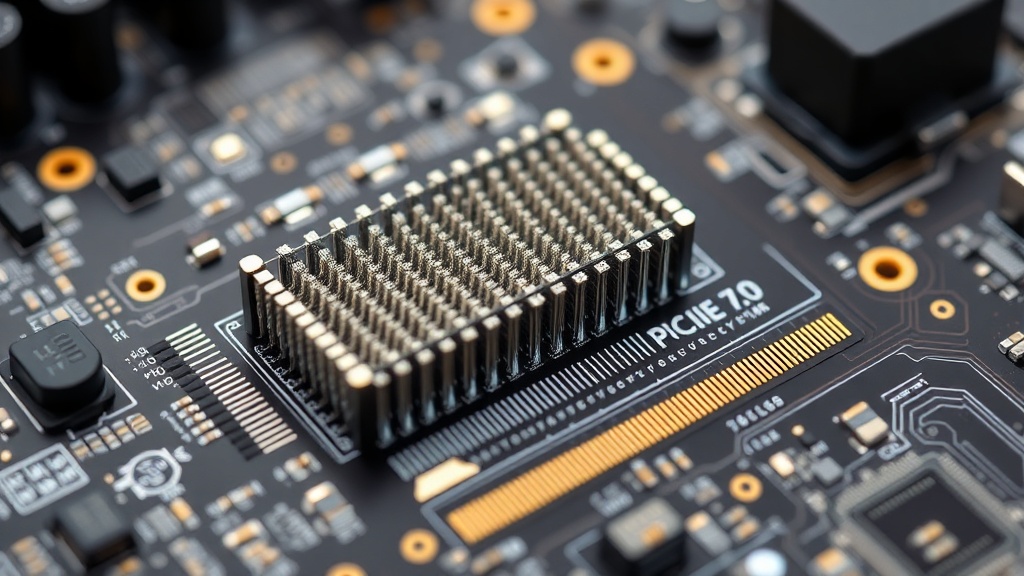
However, this leap in performance is not without its complexities. The physical layer challenges are substantial. Higher frequencies mean shorter signal wavelengths, making signal integrity a paramount concern. Trace routing on PCBs becomes critical, requiring meticulous attention to impedance matching, crosstalk minimization, and power delivery. The transition from PCIe 6.0's 64 GT/s to PCIe 7.0's 128 GT/s will demand more sophisticated signal conditioning, advanced connector designs, and potentially new materials for PCBs and cables to mitigate signal loss and distortion.
Design Considerations for Key Domains
Storage
For storage, PCIe 7.0 promises to unlock the full potential of next-generation NVMe SSDs and computational storage devices. The increased bandwidth will allow for higher IOPS (Input/Output Operations Per Second) and lower latency, enabling faster data access for applications. This is particularly relevant for data-intensive workloads like large database operations, real-time analytics, and high-resolution media processing. Designers will need to consider how to effectively partition these high-bandwidth links to serve multiple high-performance storage devices without creating new bottlenecks. The challenge lies in managing the increased power consumption and thermal output associated with higher-speed components and maintaining signal integrity over longer trace lengths, especially in dense server environments.
Networking
In networking, PCIe 7.0 will enable faster network interface cards (NICs) and switch fabrics. This is crucial for high-performance computing clusters, data centers, and emerging applications like real-time AI inference at the edge. The ability to move data between network interfaces and processing units at 128 GT/s per lane will reduce latency and improve overall network throughput. This could facilitate more efficient distributed AI training, faster data ingestion for analytics, and support for higher bandwidth network standards. However, the increased speed will also exacerbate issues related to signal integrity and power delivery. System architects must carefully plan PCB layouts, select appropriate connectors, and implement robust error detection and correction mechanisms to ensure reliable data transfer.
AI and HPC
The most significant impact of PCIe 7.0 is anticipated in the realms of AI and High-Performance Computing. These domains are characterized by massive datasets and computationally intensive tasks, often involving thousands of accelerators. PCIe 7.0's bandwidth will be critical for efficiently feeding data to GPUs and other AI accelerators, reducing the time spent waiting for data. This can directly translate to faster training times for large language models and complex deep learning networks. For HPC, it means improved communication between nodes and faster data transfer for simulations and scientific research. The challenge here is not just the interface speed but also the overall system architecture. Designers must consider how to scale these high-bandwidth interconnects across entire server racks and data centers, manage the associated power and thermal loads, and ensure compatibility with existing infrastructure where possible.
The Role of Controller IP and Ecosystem Readiness
Moving from the PCIe 7.0 specification to a working implementation requires robust and well-validated controller IP. Companies specializing in IP development play a critical role in accelerating the design cycle for silicon vendors and system integrators. These IP blocks encapsulate the complex logic required to implement the PCIe 7.0 protocol stack, including the physical layer, link layer, and transaction layer. The challenge for IP providers is to deliver solutions that not only meet the stringent performance requirements of PCIe 7.0 but also offer low power consumption and high reliability. For designers implementing these IPs, rigorous verification and testing are essential to ensure compliance with the standard and interoperability with other PCIe 7.0 components.
The broader ecosystem, including motherboard manufacturers, component suppliers, and test equipment vendors, must also be ready to support PCIe 7.0. This involves developing new PCB fabrication processes, high-speed connectors, cables, and testing methodologies capable of handling the frequencies and signal integrity demands of the new standard. The transition from PCIe 6.0 to 7.0 will likely involve a phased adoption, with initial implementations focusing on high-demand applications before becoming more widespread.
What remains to be seen is how quickly the industry can mature the necessary signal integrity techniques and materials to reliably achieve 128 GT/s over practical trace lengths in standard server environments. The cost implications of these advanced designs and the potential for new interoperability challenges between different vendor implementations will be critical factors in the pace of adoption. As systems become more interconnected and data-centric, the performance gains offered by PCIe 7.0 are essential, but the path to realizing them will require significant engineering effort and innovation across the entire technology stack.