
The Challenge of Distributed Consensus
In distributed systems, multiple computers must agree on a single value, even in the face of network failures or unreliable nodes. This is the problem of consensus, and it's notoriously difficult. Imagine a group of people trying to decide on a restaurant for dinner. If some people can't hear the suggestions, or if messages between them get lost, agreeing on one place becomes a significant challenge. This is analogous to the problem Paxos solves, but for computers.
Leslie Lamport's 2001 paper, "Paxos Made Simple," tackles this challenge head-on. Despite its title, Paxos is a complex algorithm, and Lamport's paper aims to clarify its core concepts. The algorithm's goal is to ensure that even if some messages are lost or delayed, and even if some servers crash, the remaining servers can still reliably agree on a single proposed value. This agreement is crucial for building fault-tolerant systems.
The paper introduces a specific protocol, known as Paxos, designed to achieve this consensus. It's not about agreeing on a sequence of values (that's a different problem), but about agreeing on a single value. The beauty of Paxos lies in its ability to guarantee safety – meaning no two nodes will ever decide on different values – and liveness, which means that eventually, some node will decide on a value (though it doesn't guarantee that *all* nodes will decide, or that a decision will be reached in a bounded time).
The Paxos Protocol: Roles and Phases
The Paxos algorithm operates with three distinct roles: Proposers, Acceptors, and Learners. A single node can embody multiple roles. The algorithm proceeds in two main phases.
Phase 1: Preparing to Propose
In the first phase, a Proposer wants to suggest a value. To do this, it must first obtain permission from a majority of Acceptors. The Proposer sends a "Prepare" request, which includes a proposal number (guaranteed to be unique and increasing). This request is sent to a set of Acceptors. Each Acceptor, upon receiving a Prepare request with proposal number n, must respond with a promise not to accept any proposal numbered less than n. If the Acceptor has already accepted a proposal, it also returns the highest-numbered proposal it has already accepted, along with its associated value.
The crucial aspect here is that an Acceptor, once it promises not to accept proposals with numbers less than n, must uphold that promise for any future Prepare requests with numbers less than n. This prevents older, lower-numbered proposals from interfering with newer, higher-numbered ones. The Proposer collects these promises. If it receives promises from a majority of Acceptors, it can proceed to Phase 2.
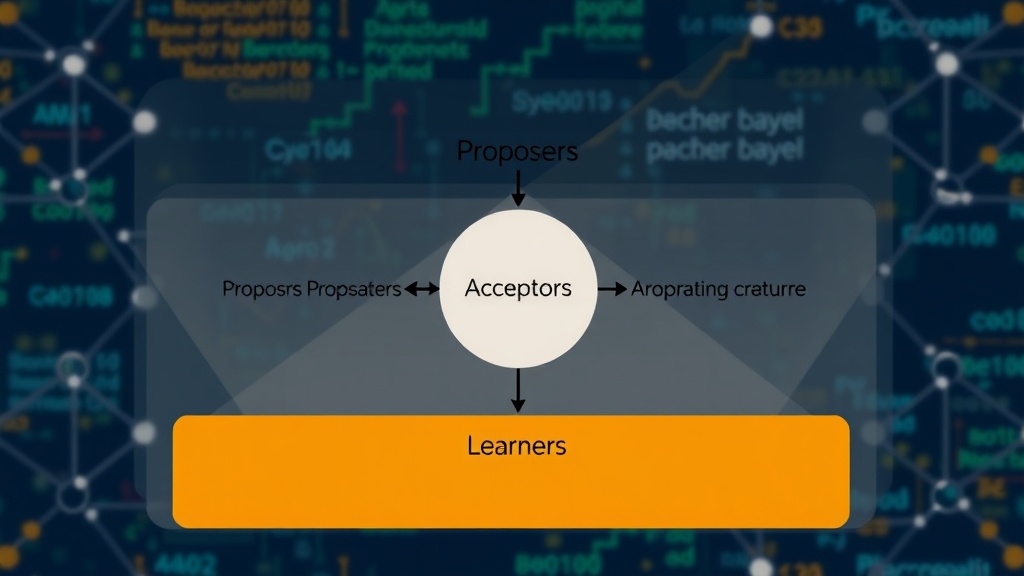
Phase 2: Accepting a Value
Once a Proposer has the majority promises from Phase 1, it can then propose a specific value. If the Proposer receives no previously accepted values from the Acceptors in Phase 1, it can propose any value it wishes. However, if one or more Acceptors *did* return previously accepted values, the Proposer must choose the value associated with the highest proposal number returned by the Acceptors. This is a critical step to ensure that a value chosen by one Proposer is not overridden by a previous, higher-priority proposal that was already accepted by a majority.
The Proposer then sends an "Accept" request to the same majority of Acceptors. This request contains the proposal number (the same one used in the Prepare request) and the chosen value. An Acceptor receives this request and, if it has not already promised to ignore proposals with this number or higher, it accepts the proposal and records the proposal number and its associated value. It then informs Learners that it has accepted this proposal.
Learning the Decided Value
The Learners' role is to find out what value has been decided. A value is considered decided when a majority of Acceptors have accepted a proposal with the same proposal number and the same value. Learners can learn this in several ways. They might receive direct messages from Acceptors, or they might observe a sequence of Accept messages from a majority of Acceptors. Once a Learner knows that a specific value has been accepted by a majority, it considers that value to be the decided value.
The algorithm ensures that only one value can be chosen. If multiple Proposers are active, they might propose different values. However, the mechanism of using increasing proposal numbers and the requirement for Proposers to adopt the highest previously accepted value ensures that eventually, a single value will be consistently accepted by a majority and thus learned by the Learners.
The 'Simple' in Paxos Made Simple
Lamport's paper simplifies the problem by focusing on the core consensus mechanism for a single value. It abstracts away many practical complexities, such as how to handle multiple concurrent proposers efficiently, how to elect a leader, or how to recover state after a crash. These are often addressed in implementations by building upon the basic Paxos protocol.
The surprising detail here is not the complexity of the algorithm itself, but how a seemingly simple set of rules for communication and state management among distributed nodes can guarantee such strong properties like fault tolerance and consistency. It’s like a carefully choreographed dance where each dancer (node) follows a strict set of steps, and even if a few dancers stumble or leave the floor, the overall performance (consensus) can still succeed.
Implications and Applications
Despite its academic origins, Paxos and its variants (like Multi-Paxos and Raft) are fundamental to many distributed systems. Databases that require strong consistency, distributed key-value stores, and cluster coordination services all rely on consensus algorithms. Understanding Paxos is key to understanding how these systems achieve reliability in the face of failure.
The paper, while dense, provides a clear articulation of the fundamental logic. It's a cornerstone for anyone building or deeply understanding distributed systems that cannot afford to lose data or fall out of sync. The continued relevance of Paxos, even decades after its publication, underscores its elegant and robust solution to a problem that remains central to modern computing infrastructure.