
The Problem with Partial Syncs
When a user changes their password, that change needs to propagate across multiple systems. This typically involves a directory, an external database, and the application’s own user store. The complexity arises when two separate applications, each with slightly different codebases and their own configuration toggles (like sync_oracle => true|false), handle this propagation independently.
This setup, while seemingly offering flexibility, is a trap. It quietly allows for 'partial' syncs – scenarios where a password change is successfully applied to some systems but not others. This is not a feature; it's a critical bug that can lead to user lockout, security vulnerabilities, and a chaotic state of affairs for system administrators.
The core issue is that any write operation spanning multiple independent systems is inherently prone to failure. If one system is down, misconfigured, or simply slower than the others, the overall operation can become inconsistent. When the logic for handling these failures is also distributed and configurable, the chances of subtle, hard-to-detect errors increase dramatically.
Why Configurable Backends Are a Footgun
The illusion of flexibility offered by configurable backends for multi-system writes is precisely why they are so dangerous. Imagine a system where changing a password requires three distinct steps: updating the primary directory, syncing to an external database, and updating the application's local store. If each of these steps can be independently enabled or disabled via configuration flags, a developer might, for instance, disable the external database sync for maintenance.
However, if the primary directory update succeeds, but the application store update fails for an unrelated reason (perhaps a network glitch or a transient service outage), the user might still be able to log in using their old password against the application store. Conversely, if the directory update fails but the others succeed, the user might be locked out of the application entirely, even though their password was technically changed in some systems. This creates a state of partial synchronization, where the user's password is valid in some places but not others. This is not only confusing for the user but also a significant security risk. The ability to 'turn off' a backend, even temporarily, should not result in a state where the user's credentials are inconsistent across the system.
The problem is amplified when multiple applications implement this configurable backend pattern. Each application might have its own interpretation of what constitutes a 'complete' sync, and its own set of toggles. This divergence means that a password change initiated in App A might sync to Systems X and Y, while a change in App B might only sync to System X, leaving System Y in an outdated state. This is not a matter of minor inconvenience; it’s a fundamental breakdown in data integrity.
The danger lies in the *quiet* nature of these failures. If a system is designed to log every success and failure loudly, such inconsistencies are easier to spot. But when the system simply allows certain backends to be skipped, the inconsistency can persist for extended periods, only surfacing when a user reports being unable to log in or when a security audit reveals credential mismatches.
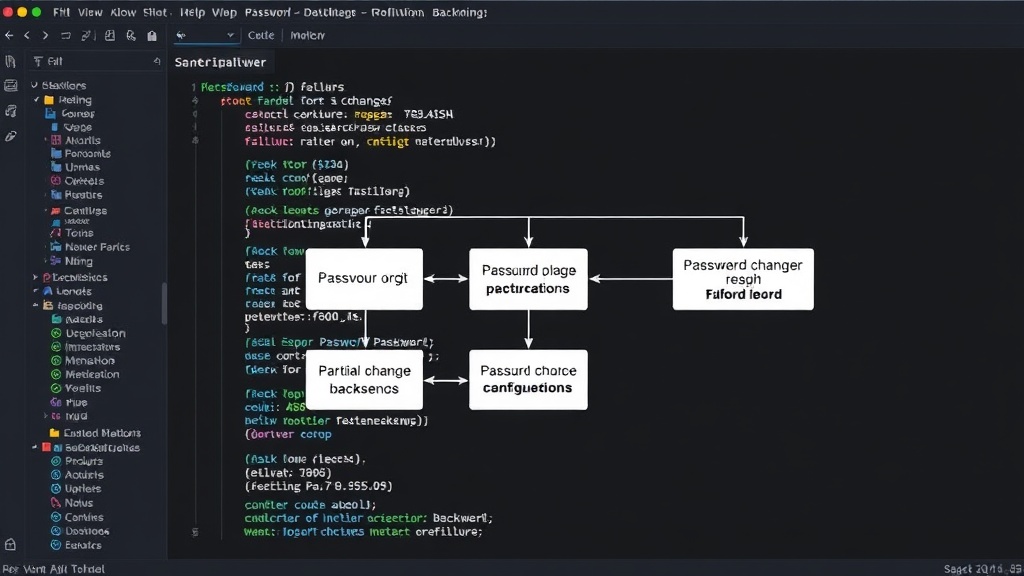
The Canonical Flow Solution
The solution to this problem is to converge on a single, canonical flow for all write operations that span multiple systems. This means defining one authoritative sequence of operations and ensuring that each operation is mandatory and auditable.
In the context of password synchronization, this translates to several key principles:
- One Shared Engine: Instead of each application managing its own sync logic, a single, dedicated engine should handle all password change propagations. This centralizes the complexity and ensures consistency.
- One Canonical Order: The order in which systems are updated must be fixed and non-negotiable. This eliminates ambiguity and ensures that the process is predictable. For example, always update the primary directory first, then the external database, then the application store.
- Mandatory Backends: Configuration toggles to disable backends must be removed. Every target system is critical for maintaining consistent user authentication. If a backend is truly unavailable, the entire operation should fail, not proceed partially.
- Loud Failure: Every attempt to write to a backend, whether successful or failed, must be meticulously logged. These audit logs serve as an irrefutable record of what happened, when, and why. If an operation fails, the failure must be explicit and trigger alerts.
Implementing a canonical flow means that if any part of the process fails, the entire operation is rolled back or clearly marked as failed. There is no middle ground, no 'partly done'. This approach treats any deviation from the complete, successful execution as a critical error, forcing developers and operators to address the underlying issue immediately.
The Lesson for Multi-System Writes
The takeaway from this scenario is clear: for any write operation that needs to be reflected across multiple systems, introducing configurable steps is a dangerous anti-pattern. It's a 'footgun' – a feature that seems helpful but is easy to misuse, leading to unintended and severe consequences.
Instead, the flow must be fixed. The sequence of operations should be immutable, and the success of each step should be guaranteed. If any step fails, the entire operation must be treated as a failure. Furthermore, failures must not be silent. They must be loud, visible, and actionable. This means implementing robust error handling, comprehensive logging, and alerting mechanisms that immediately notify the relevant teams when an inconsistency occurs.
This principle extends beyond password synchronization. Any critical data write that involves multiple distributed systems – be it user profile updates, financial transactions, or inventory management – should adhere to the principle of a single, fixed, and auditable canonical flow. The goal is not to offer the illusion of flexibility through configuration, but to ensure data integrity and system reliability through a predictable and robust process. The cost of debugging subtle, intermittent partial sync bugs far outweighs the perceived benefit of configurable backends.
The surprising detail here is not the complexity of password synchronization itself, but how a seemingly innocuous feature like configurable backends can silently undermine the integrity of the entire system, leading to a state where 'partly done' is treated as acceptable. It is never acceptable. It is a bug that demands immediate attention and a fundamental redesign of the synchronization process towards a singular, reliable, and transparent flow.