Defensive Parsing for AI Coding Transcripts
JSON Lines (JSONL) is deceptively simple. The format, where each line is a valid JSON object, suggests straightforward parsing with a basic loop. However, live coding-agent transcripts introduce complexities that shatter this illusion. These include partial final appends, unusually large records, duplicate events, provider-specific envelopes, and outdated completion markers invalidated by subsequent activity. These edge cases demand a robust, defensive parsing strategy before attempting to infer session state.
Agent Island, for instance, employs platform-specific safeguards. The macOS Claude reader implements a 64 MiB backstop, while the Windows reader imposes a line character limit of 1,000,000, skipping excessively long lines before parsing. These are not unified limits but distinct policies designed to prevent a single malformed or pathological record from corrupting the entire transcript scan. The core principle is to protect the integrity of the overall data stream.
Bound I/O Before JSON Parsing
The most critical safeguard is avoiding unbounded I/O. Never read an entire transcript into a single string. Instead, utilize a streaming reader coupled with a well-defined line policy. This approach treats the transcript not as a monolithic block of text but as a sequence of discrete, manageable records. By processing the data line by line, or in bounded chunks, the system can isolate and handle problematic entries without jeopardizing the rest of the data.
A documented line policy is essential. This policy should clearly articulate how the system will handle lines that exceed certain thresholds, either in character count or byte size. For example, a policy might dictate that lines exceeding 1 million characters are logged, skipped, and potentially reported, rather than causing a parser crash. This is akin to a chef who, when encountering a spoiled ingredient, removes only that ingredient and continues with the rest of the dish, rather than discarding the entire meal.
Handling Large and Duplicate Records
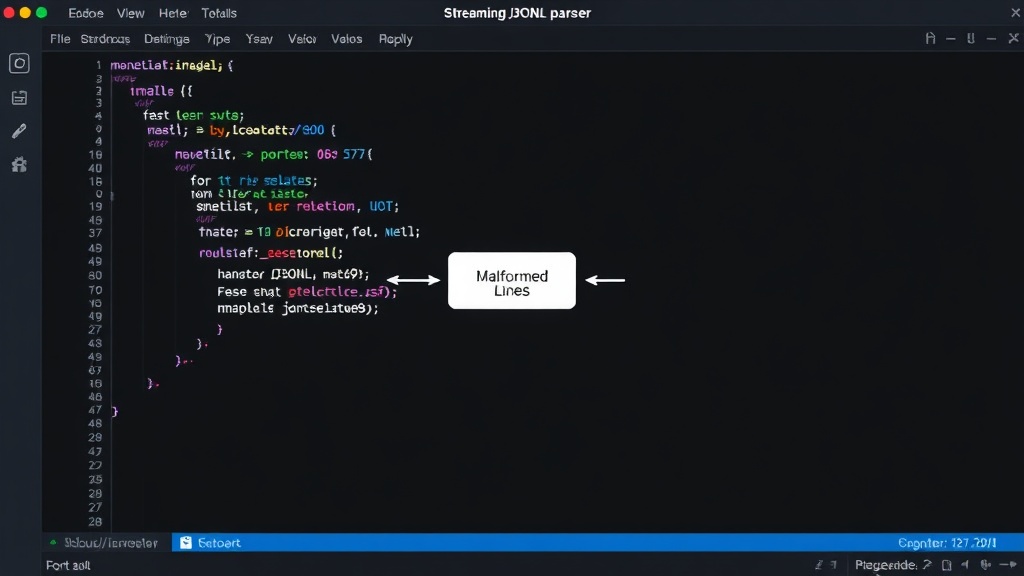
Unusually large records can exhaust memory or processing resources. Implementing a maximum record size limit, enforced by the streaming reader, prevents such issues. If a record exceeds this limit, it can be truncated, logged, or discarded based on the defined policy. This ensures that even a single, massive JSON object cannot bring the entire parsing operation to a halt.
Duplicate events are another common problem in agent transcripts. These can arise from retries, network glitches, or system inconsistencies. A robust parsing system should include logic to detect and handle duplicate records. This might involve checking for unique event IDs, timestamps, or a combination of fields. When duplicates are identified, the system should either discard the redundant entries or merge them according to predefined rules, maintaining a clean and accurate representation of the agent’s activity.
Provider-Specific Envelopes and Obsolete Markers
AI models often wrap their output in provider-specific envelopes. These are additional JSON structures that contain metadata or control information alongside the actual agent output. The parser must be aware of these envelopes and know how to extract the relevant payload while ignoring or processing the envelope data appropriately. Failure to account for these envelopes can lead to parsing errors or incorrect data interpretation.
Furthermore, completion markers can become obsolete. In long-running agent sessions, an initial completion marker might later be invalidated by new activity or a correction. The parsing logic needs to distinguish between active and outdated markers. This often involves examining the sequence of events and relying on the most recent, valid state information. A defensive parser will prioritize the latest valid data, effectively ignoring or flagging older, superseded markers to maintain chronological accuracy and infer the correct session state.
Inferring Session State Safely
The ultimate goal is to infer session state reliably from these potentially messy transcripts. This requires a multi-stage validation process. First, the raw data stream is processed with bounded I/O and line policies. Second, individual records are validated for size and structure. Third, duplicate and obsolete entries are handled. Only after these defensive measures are in place can the system proceed to interpret the cleaned data to infer the agent’s state, decisions, and outputs.
This careful, step-by-step approach ensures that the inference process is built upon a foundation of clean, reliable data. It’s the difference between building a house on solid bedrock versus shifting sand. By anticipating and mitigating the common pitfalls of AI coding transcript parsing, developers can build more resilient systems that accurately reflect agent behavior without succumbing to data corruption.
The surprising detail here is not the inherent complexity of JSONL, but how quickly real-world data, especially from live, evolving AI agent interactions, can expose the fragility of naive parsing assumptions. What nobody has addressed yet is the long-term impact of these data integrity issues on training models that rely on these transcripts for reinforcement learning or fine-tuning.